Pomegra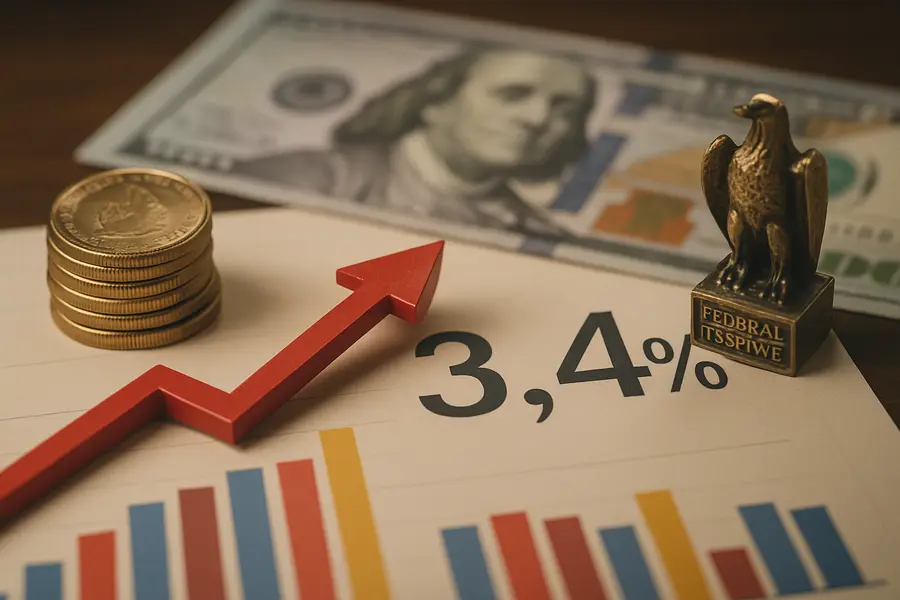
Core PCE inflation climbed to 3.4% annually in May 2026, edging past April and keeping Fed rate hike risk firmly on the table for the second half.
- Core PCE rose 0.3% month-over-month and 3.4% year-over-year in May, above April's 0.2% and 3.3% readings.
- Nine of 18 FOMC members projected at least one rate hike by year-end at the June 17 meeting; the fed funds rate holds at 3.50%–3.75%.
- Economists see May as the likely 2026 inflation peak as tariff-driven goods price pressures begin to stabilize.
Lead
The Bureau of Economic Analysis on June 25 released its May 2026 Personal Income and Outlays report, showing the core personal consumption expenditures (PCE) price index — the Federal Reserve's preferred inflation measure — rising 0.3% month-over-month and 3.4% year-over-year. Both readings exceeded April's 0.2% monthly and 3.3% annual gains, marking four consecutive months of core PCE above 3% and reinforcing prospects that the central bank will remain on hold or move toward tightening in the second half of 2026.
What Happened
The May PCE print landed in line with consensus expectations, offering little relief to policymakers seeking confirmation that disinflation has resumed. Services-side pressures — concentrated in shelter and healthcare — sustained the monthly acceleration, while goods prices contributed modestly despite early signs that tariff pass-through is losing momentum.
The May reading arrived two weeks after the consumer price index showed prices rising 4.2% annually, a broader proxy that tracks above PCE due to methodological differences in weighting. Together, the two reports sketch a consistent picture: inflation in the United States has not materially retreated from the elevated plateau reached in early 2026.
The April Personal Income and Outlays report, the most recent prior release, showed consumer spending advancing 0.5% in nominal terms even as personal income contracted slightly and the savings rate fell to 2.6% of disposable income — near its lowest level since mid-2022. That dynamic, where households sustain spending by drawing down savings rather than income gains, carries implications for demand-driven price pressures going forward.
Federal Reserve Context
The Federal Reserve held its benchmark rate in the 3.50%–3.75% target range at the June 17 FOMC meeting — the first presided over by Chair Kevin Warsh — and delivered a materially more hawkish set of economic projections. Officials raised the 2026 headline PCE forecast to 3.6% from 2.7% in the March projection, while lifting the core PCE outlook for the year to 3.3%.
Nine of 18 FOMC participants projected at least one 25-basis-point rate increase before year-end 2026 — a significant shift from the earlier expectation of one to two cuts. Warsh declined to submit a personal dot-plot entry and has publicly characterized artificial intelligence as "structurally disinflationary," positioning him at the more patient end of the committee. Nonetheless, the dot plot's hawkish tilt leaves the hike scenario firmly in play if inflation fails to soften through summer.
Markets have effectively priced out rate reductions. Implied probabilities placed the likelihood of zero cuts in 2026 at roughly 80% ahead of Wednesday's data release.
Tariff and Energy Dynamics
Tariff effects on PCE prices peaked in the first quarter of 2026. Levies enacted through November 2025 raised core goods PCE prices by an estimated 3.1%, accounting for the entirety of excess inflation in that category relative to pre-pandemic norms and contributing roughly 0.8 percentage points to the broader core index. That pass-through is now expected to fade gradually as import cost increases cease compounding.
Energy prices, elevated in part by geopolitical tensions affecting global supply, have added to headline readings but are excluded from the core gauge. The combination of plateauing goods inflation and potentially lower energy costs underpins economist expectations that May marks the high-water mark for 2026 PCE inflation, with gradual deceleration projected into the second half of the year.
Market Reaction
Treasury yields edged higher following the release, with the two-year note — most sensitive to near-term rate expectations — reflecting the sustained probability of a Fed hike. Equity markets absorbed the in-line print with limited disruption; a significant upside surprise would have been required to sharply reprice rate expectations beyond where markets already stood.
The U.S. dollar held near recent highs, supported by the persistent rate differential with major trading partners. Gold traded sideways, caught between real rate stability and residual geopolitical hedging demand.
Outlook
May's PCE data confirms that disinflation has stalled rather than reversed. Core inflation at 3.4% year-over-year sits 140 basis points above the Fed's 2% target, and the committee's own projections do not show a return to target before 2027. The forward trajectory hinges on whether services inflation moderates as goods price pressures ease — a sequence that has yet to materialize cleanly. If June and July readings do not show meaningful deceleration, the minority of FOMC members favoring a hike is likely to grow, placing the September meeting at the center of policy risk for the rest of the year.
Mentioned tickers: SPY, TLT, GLD, UUP