 Pomegra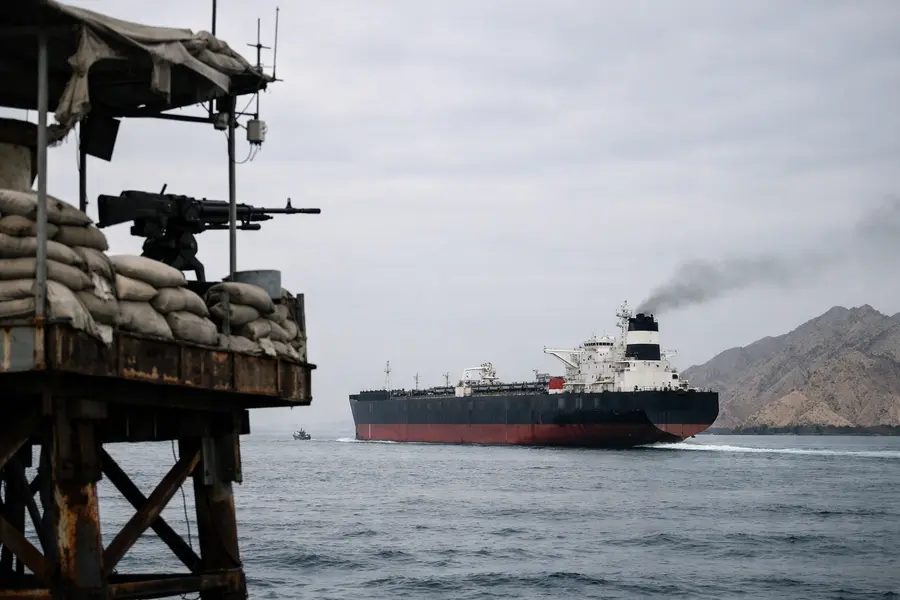
Iran's security chief Mohammad Bagher Zolghadr on Saturday issued six sweeping demands — spanning Lebanon, Palestine, Yemen and Iraq — and declared the Strait of Hormuz will remain closed until the United States changes course.
- Zolghadr's six conditions include a permanent end to US military action, lifting of sanctions, withdrawal of naval forces, and release of frozen Iranian assets.
- War-risk shipping insurance has surged to 15–20% of hull value, from a pre-crisis baseline of 0.02%, effectively suspending commercial transit.
- Brent crude held in the $83–$85 range Saturday as markets priced in a prolonged closure after brief optimism over Oman-mediated talks earlier in the week.
Lead
Mohammad Bagher Zolghadr, Secretary of Iran's Supreme National Security Council, on Saturday publicly expanded Tehran's demands for reopening the Strait of Hormuz, codifying six conditions that reach across four regional theaters and marking a sharp departure from the narrower, sanctions-focused framework that had guided Oman-mediated talks. Brent crude traded at $84.95 per barrel in early Saturday dealings, while daily strait transits remain at roughly five vessels against a pre-crisis average of 95 to 138.What Zolghadr Said
Addressing a public audience and citing what he described as nationwide rallies over the previous six days, Zolghadr framed the six conditions as a reflection of popular will rather than a negotiating opener. His statement — the most formal and comprehensive articulation of Iran's terms since the strait's closure — leaves little procedural ambiguity: each condition must be met before traffic resumes.
The six conditions are:
1. An end to US threats against Iran and what Zolghadr called insults to the country's national and religious values. 2. A permanent end to military operations against Iran and its allies in Lebanon, Palestine, Yemen, and Iraq — an explicit expansion of the conflict's geographic scope in Iranian terms. 3. Lifting of the US naval blockade and full withdrawal of American naval and air assets from the region around Iran. 4. War reparations for damage from what Tehran characterizes as two imposed wars. 5. Removal of all US sanctions against Iran. 6. Unconditional release of frozen Iranian assets.
"The Supreme National Security Council will not retreat from these demands, whether in war or in negotiations," Zolghadr stated. "Until America corrects its behavior, the Strait of Hormuz will not be reopened."
Market Reaction
Oil markets absorbed the statement with contained but firm buying. Brent crude oscillated between $83.51 and $84.95 per barrel on Saturday, recovering from a brief dip earlier in the week when preliminary signals from Muscat had suggested a narrower deal — covering only sanctions relief — might be within reach. West Texas Intermediate held the $79.60–$79.87 range. Shipping markets registered the harder line more acutely. War-risk insurance premiums for vessels entering the Persian Gulf reached 15–20% of hull value, compared with the 0.02% standard rate before hostilities began in late February. On a $100 million tanker, that represents a premium of $15–20 million per voyage. Six major Protection and Indemnity clubs have withdrawn coverage from the Gulf entirely, making uninsured passage commercially impractical for most operators. Container rates on the Shenzhen-to-Jebel Ali corridor rose 35–55% to $8,250–$9,500 per 40-foot equivalent unit.Strategic Context
The Strait of Hormuz — the 21-mile-wide chokepoint between Iran and Oman — carries approximately one-fifth of global seaborne oil. Its closure since late February, following the US and Israeli strikes that opened Operation Epic Fury on February 28, has redirected global energy logistics through longer Cape of Good Hope routing, adding 10–14 days and significant bunker costs to cargoes bound for Europe and Asia.
The expanded scope of Zolghadr's conditions — explicitly naming Lebanon, Palestine, Yemen, and Iraq — signals that Tehran is treating the conflict as a regional war rather than a bilateral US-Iran dispute over nuclear or sanctions issues. Each theater involves Iranian-aligned non-state partners whose operational status Zolghadr has now made a prerequisite for any agreement. That architecture complicates any bilateral channel and effectively gives Tehran multiple veto points over a settlement.
The April 8 conditional ceasefire, which paused the kinetic exchange between US and Iranian forces, did not resolve questions of allied militias or the strait's status. Zolghadr's Saturday statement retroactively formalizes that gap.
Geopolitical Dimension
By anchoring conditions two through four to Iranian allies in Lebanon, Palestine, Yemen, and Iraq, Zolghadr's framework requires the United States to negotiate outcomes in four separate sub-conflicts where Washington does not hold unilateral control. A permanent halt to operations affecting Hezbollah in Lebanon or Houthi forces in Yemen, for instance, involves Israeli and Saudi equities that the US cannot deliver independently.
Condition four — war reparations — introduces a legal and financial demand that no US administration has accepted from an adversary in the post-Cold War era and that would require Congressional action. The inclusion of reparations alongside asset release and full sanctions removal suggests the six-point list functions as a strategic ceiling rather than an opening offer, designed to anchor any eventual negotiation well above where the Oman channel had positioned it.
Condition six, the unconditional release of frozen assets, has been a persistent Iranian demand across multiple negotiating cycles. Its presence here, stripped of conditionality, is a hardening of language compared with earlier frameworks that tied asset access to verified nuclear steps.
What Comes Next
Omani mediators had been expected to carry a revised US counter-proposal to Tehran in the days following the early-August talks. Zolghadr's statement, by publicly codifying Iran's maximum terms, reduces Muscat's room to present a narrower package without Tehran appearing to retreat from stated positions. Diplomatic sources monitoring the Oman channel have not signaled a suspension of contact, but the Saturday statement resets the baseline for any resumed dialogue.
For energy markets, the operative question is whether the strait closure extends into the autumn refinery maintenance season in Asia, which typically drives peak petroleum demand from October through December. A closure of that duration would stress strategic petroleum reserve drawdowns in OECD economies and potentially prompt coordinated IEA releases.
Outlook
Iran's formal articulation of six conditions under Zolghadr's authority marks a structural shift in the negotiating environment: what had been a fluid, Oman-mediated process now faces a public, multi-theater checklist that no US administration can accept quickly or quietly. Brent crude and war-risk premiums are the near-term signal assets. A sustained Hormuz closure into the fourth quarter would accelerate rerouting investments, test strategic reserve policy, and keep energy inflation embedded in the global macro picture well into 2027.
Mentioned tickers: USO, BNO, XOM, CVX, BP, SHEL, TTE, FRO, STNG, DHT, TNK