Pomegra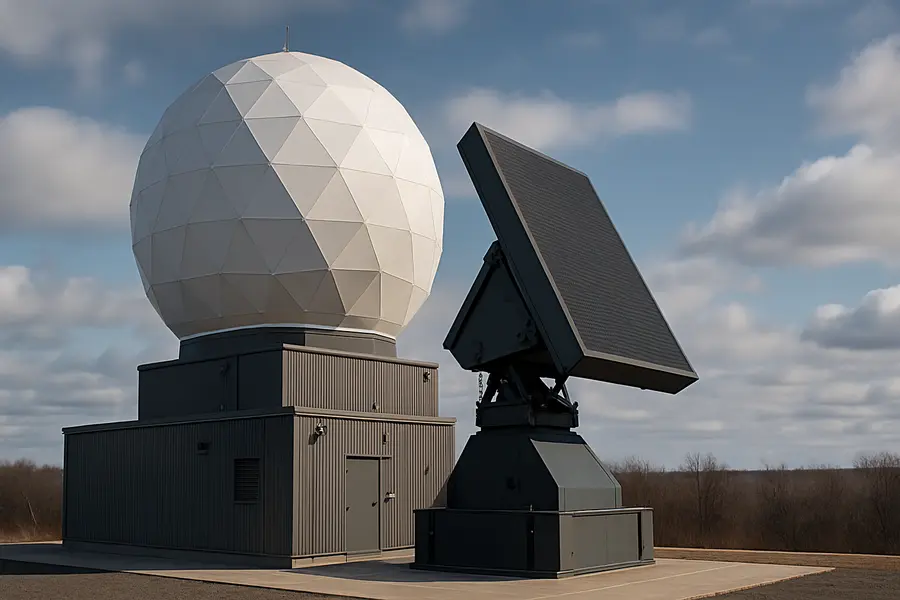
LeoLabs activates Scout-S, its first transportable 3D search radar, in Hawaii to deliver persistent space ops custody over maneuvering LEO objects ahead of Valiant Shield 2026.
- Scout-S uses S-band direct radiating array technology in a 20-foot ISO container, tracking objects from 230 km to 1,000 km altitude within hours of deployment.
- The system will support U.S. Indo-Pacific Command's Valiant Shield 2026 exercise, running June 22–July 1 across Hawaii, Guam, and Japan.
- A second Scout unit is on track for early 2027, with full production scaling to mid-to-late 2027 across a family that includes missile-warning and maritime variants.
Lead
LeoLabs activated its first Scout-S transportable 3D search radar in Hawaii on June 10, 2026, marking the commercial space-tracking firm's entry into expeditionary space domain awareness sensing. The containerized S-band system began observing satellites within hours of arrival and has already tracked Chinese Yaogan military reconnaissance satellites operating between 800 and 1,000 kilometers above Earth, as well as China's reusable spaceplane — extending observation windows from seconds to several minutes per orbital pass.What Happened
The deployment of Scout Hawaii is the first fielded instance of the Scout-S, a new class of sensor designed to be shipped anywhere by land, air, or sea and brought online without fixed infrastructure. LeoLabs announced the activation June 10, 2026, positioning the system as a direct response to what the company describes as a fundamental shift in the orbital threat environment.
Scout Hawaii will participate in experimentation activities during Valiant Shield 2026, a large-scale U.S. Indo-Pacific Command exercise scheduled June 22–July 1 in and around Hawaii, Guam, and Japan, conducted alongside the Japan Self-Defense Forces and allied partners. After the exercise concludes, the radar remains operational for continued real-world testing and ongoing data contribution to LeoLabs' global tracking network, which currently catalogs more than 26,000 space objects across 11 active sensors at seven fixed global sites.
Technical Edge: Inside the 3D Search Radar
Scout-S combines 3D scanning, a direct radiating array (DRA) architecture, and a modular S-band electronic design optimized for low Earth orbit (LEO) and very low Earth orbit (VLEO) coverage. Housed in a standard 20-foot ISO container, the system is designed for rapid setup and rapid teardown — a form factor that eliminates the multi-year site development timelines associated with fixed phased-array installations.
The critical technical advance is persistence. Where legacy systems take periodic snapshots sufficient to predict stable orbital trajectories, Scout-S extends the observation arc for a single pass from a few seconds to several minutes, allowing operators to detect maneuvers, characterize spacecraft behavior, and observe proximity operations in near real time. The radar has demonstrated tracking at altitudes as low as 230 kilometers — a regime increasingly crowded with active payloads from multiple nations.
"Tracking objects periodically to predict orbits is no longer enough," said CEO Tony Frazier. "What matters now is the ability to maintain persistent custody of maneuverable payloads so our customers can respond to emerging threats."
Strategic Context: Space Ops and the Maneuver Problem
The deployment reflects a structural realignment in how the United States and its allies approach space awareness. The proliferation of maneuvering spacecraft — satellites capable of altering orbit on command, rendezvous platforms, and dual-use vehicles such as China's reusable spaceplane — has rendered catalog-based tracking insufficient for operational decision-making. Space ops now requires custody: continuous, high-fidelity knowledge of where a specific object is, where it is going, and what it is doing.
Scout-S is designed to fill that gap at the tactical edge. The Valiant Shield 2026 integration is explicitly an operational test of whether a transportable commercial sensor can be embedded in a live joint-force exercise environment, providing actionable space domain awareness data to warfighters in theater.
Scout-S is the first in a planned sensor family. Scout-X, currently in development, is targeted at missile warning and tracking, while Scout-M addresses maritime surveillance — extending the platform's utility beyond orbital intelligence into broader multi-domain sensing.
Industrial and Government Backing
LeoLabs has secured U.S. Space Force backing through a Tactical Funding Increase (TACFI) award announced in 2025, building on a $60 million Strategic Funding Increase (STRATFI) previously awarded through SpaceWERX, the Space Force's innovation accelerator. The company reported $60 million in total contract awards for 2025, including triple-digit percentage growth in U.S. government contracts.Production of a second Scout article is on schedule for early 2027, with a broader manufacturing ramp planned for mid-to-late 2027. LeoLabs has indicated it anticipates dozens of Scout deployments globally in the coming years, including potential maritime configurations aboard ships and barges for ocean-domain coverage.
Outlook
Scout-S positions LeoLabs at the intersection of commercial space intelligence and government defense demand at a moment when both are accelerating. The Valiant Shield 2026 exercise will provide the first large-scale operational test of a transportable commercial 3D search radar in a joint Indo-Pacific environment, with results likely to shape procurement decisions across the U.S. Space Force and allied partners. The planned ramp to full Scout production in 2027, combined with the Scout-X and Scout-M variants, indicates the company is building toward a mobile, multi-mission sensor network — a commercial architecture with clear government utility as space operations grow more contested.
Mentioned tickers: N/ATechnology