Pomegra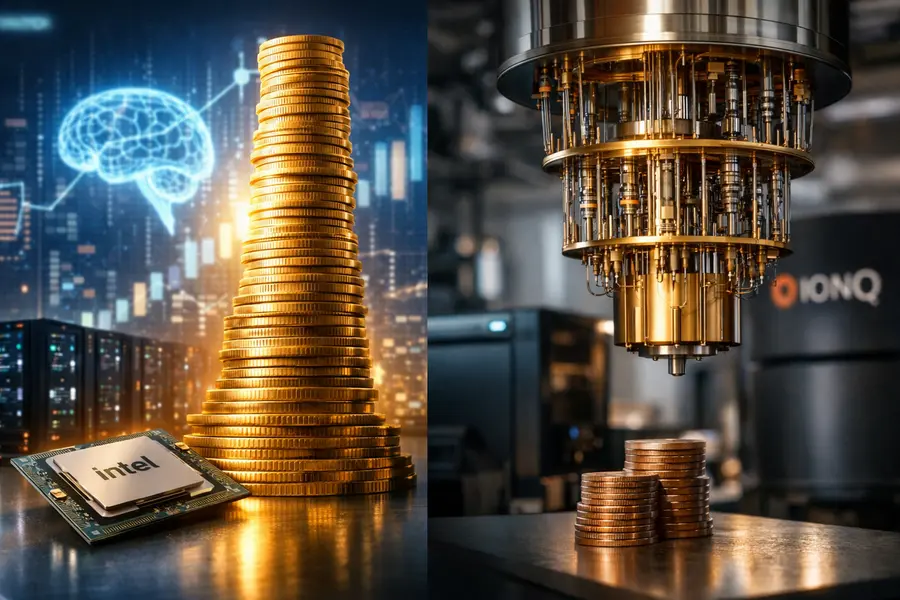
Intel's AI-powered rebound and IonQ's explosive but loss-heavy growth have put two rival technology narratives in direct conflict as Wall Street reassesses where the next decade of compute returns will come from.
- Intel posted Q2 2026 revenue of $16.1 billion, up 25%, its fastest quarterly growth rate since 2011, driven by a 59% surge in data center sales.
- IonQ reported Q1 2026 revenue of $64.7 million, up 755% year-over-year, yet the stock has retreated nearly 60% from its 52-week high as profitability concerns mount.
- Wall Street is actively debating whether quantum computing stocks can sustain premium valuations against a backdrop of widening operating losses and delayed commercial scale.
Lead
Two technology companies, separated by market capitalization, business model, and investment thesis, are now at the center of the sharpest divide in U.S. equity markets: Intel Corporation (INTC) and IonQ (IONQ). On July 23, 2026, Intel reported second-quarter revenue of $16.1 billion, crushing the $14.42 billion consensus estimate, while IonQ—ahead of its own August 5 earnings release—trades around $33 after falling sharply from an $84.64 peak reached earlier this year. The two trajectories are redefining how institutional investors price compute infrastructure in the age of artificial intelligence and the prospect of commercial quantum computing.
What Happened
Intel's Q2 2026 results represented its strongest revenue growth in more than 15 years. The company earned $0.42 per share on an adjusted basis, double the $0.21 consensus estimate. Data center revenue—the segment most directly tied to artificial intelligence workloads—climbed 59% year-over-year to $6.3 billion. Across Intel's business, AI-driven segments are collectively growing more than 70% annually and now account for roughly 70% of total company revenue. Intel lifted third-quarter guidance to a range of $15.8 billion to $16.8 billion, implying continued momentum through the second half.
IonQ, by contrast, closed Q1 2026 with $64.7 million in revenue—triple the company's results from the year-prior period on the back of a 755% year-over-year surge. Remaining Performance Obligations, the forward contracted revenue metric that quantum investors watch closely, reached a record $470 million, up 554% year-over-year. Full-year 2026 guidance was raised to $260 million–$270 million. The company expects Q2 revenue of $65 million–$68 million, with official results arriving August 5 after market close.Market Reaction
Intel shares surged to $113.55 in after-hours trading on July 23 after closing the regular session at $100.23. The post-earnings relief rally interrupted a difficult July for the stock, which had fallen approximately 28% during the month before the print. Despite the intramonth turbulence, INTC stock remains up more than 170% on the year, extending an 84% advance posted in 2025.
IONQ stock has followed a different arc. After reaching $84.64 at its 2026 peak, shares had retreated to roughly $32.96 by July 25, with the stock trading in a $32.56–$34.50 range in the session. The slide has come even as underlying revenue metrics hit successive records, highlighting a growing gap between operational momentum and equity market sentiment.Strategic Context
The core strategic argument separating the two companies is the distance between present revenue and future value. Intel's AI pivot under chief executive Lip-Bu Tan is producing immediate, quantifiable results in its CPU and data center businesses. The company has expanded a multi-year collaboration with Google Cloud to deploy AI capabilities across its manufacturing and enterprise workflows, and management frames its advanced packaging and ASIC ambitions as additional growth vectors within the broader AI infrastructure build-out.
IonQ is operating in a different time frame. The company sells access to quantum computing systems through hyperscaler cloud channels and direct enterprise contracts. Revenue growth of 755% reflects expanding commercial adoption of near-term quantum services, but the business currently projects full-year operating losses of $310 million–$330 million. A significant portion of IonQ's recent topline growth has come from acquired assets rather than purely organic customer wins, a distinction that bears on how investors model the company's underlying growth rate.
The Wall Street Debate
The tension between quantum computing stocks and established AI hardware players has become one of the defining allocation debates of mid-2026. The S&P Kensho Global Quantum Computing Technologies Index gained 69.3% through May 2026, compared with the S&P 500's 10.7% advance over the same period. That outperformance has attracted scrutiny over whether current multiples anticipate a commercial quantum era that analysts broadly place no earlier than 2030.
Proponents of IonQ emphasize its technology lead in trapped-ion architecture, a growing roster of enterprise clients, hyperscaler distribution partnerships, and a deep cash position that can sustain investment through a pre-revenue scaling phase. Critics point to the company's exclusion from a recent $2 billion federal quantum funding allocation, ongoing stock-based compensation dilution, and the concentration of future value in milestones that have not yet been commercially demonstrated at scale.
Intel's bull case is simpler and more immediate: real earnings, real guidance, and an installed base of enterprise hardware relationships positioned directly in the path of accelerating AI capital expenditure.
AI and Technology Angle
The divergence between Intel vs IonQ also maps onto a broader industry question about the sequencing of compute paradigms. Classical silicon—CPUs, GPUs, ASICs—is absorbing the current wave of AI infrastructure investment with proven, deployable technology. Quantum computing occupies an earlier position on that curve, with commercial applications likely concentrated in chemistry, materials science, financial optimization, and cryptography once error-correction thresholds are crossed.
Some technology analysts argue the two paradigms are convergent rather than competitive, with quantum algorithms ultimately serving as accelerants for AI workloads rather than replacements for classical compute. That framing does not resolve the near-term valuation question, but it shapes how longer-duration investors are thinking about portfolio exposure.