Pomegra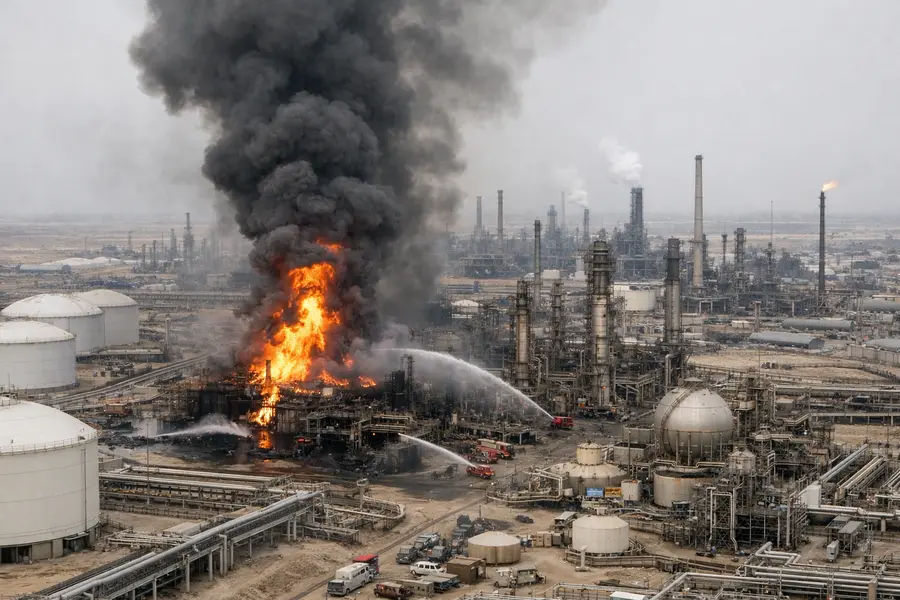
Houthi drone-missile strikes hit Saudi Aramco installations across four southern Saudi cities, wounded 73 workers, and pushed Brent crude $8.61 higher, fueling a second consecutive oil-driven Wall Street selloff.
- Coordinated strikes hit Saudi Aramco energy infrastructure in Abha, Khamis Mushait, Jazan, and Najran - the deepest Houthi penetration of Saudi territory this conflict cycle.
- 73 workers were wounded as fires broke out simultaneously across multiple facilities in what officials described as a multi-vector assault.
- Brent crude surged $8.61 per barrel, driving U.S. equities to a second consecutive oil-driven selloff.
Lead
Iran-aligned Houthi forces launched a coordinated drone-and-missile salvo against Saudi Aramco (2222.SR) energy infrastructure Monday, striking installations across Abha, Khamis Mushait, Jazan, and Najran and wounding 73 workers in the deepest incursion into Saudi territory recorded this conflict cycle. Brent crude surged $8.61 per barrel as markets absorbed the implications of a direct hit on production infrastructure rather than maritime transit lanes - a distinction that sent Wall Street to a second consecutive oil-driven selloff, with the SPY SPDR S&P 500 ETF Trust closing sharply lower on elevated volume.
What Did Houthi Forces Strike?
The attacks simultaneously targeted Saudi Aramco facilities across four cities in the kingdom's southwestern corridor, spanning roughly 400 kilometers from Abha in the north to Najran in the south. The geographic breadth indicates multi-vector launch sequencing designed to divide Saudi air-defense coverage across a wide front. Fires broke out at installations in all four cities; Saudi authorities confirmed 73 wounded in initial casualty assessments. The assault surpasses all prior cross-border strikes in territorial depth, with earlier attacks concentrated on border-adjacent infrastructure rather than mid-kingdom energy nodes.
Why Is This Supply Shock Different From Hormuz Tanker Strikes?
Unlike Hormuz tanker strikes, which disrupted shipping transit without directly touching Saudi production assets, Monday's salvo reached processing and distribution infrastructure inside the kingdom. Tanker incidents raised insurance and freight costs; strikes on Aramco facilities raise questions about upstream output integrity. Markets priced in three compounding risks simultaneously: physical disruption at the targeted installations, the probability of follow-on strikes against higher-value facilities further north - including the Abqaiq complex that handles a substantial share of global crude throughput - and a structural reduction in Saudi Arabia's perceived ability to guarantee supply continuity. The crude oil price response reflects all three layers.
Energy sector equities diverged sharply from the broader tape. XOM (Exxon Mobil) and CVX (Chevron) advanced as non-conflict-zone producers stood to benefit from tightened global supply. XLE, the Energy Select Sector SPDR fund, outperformed all other sector ETFs on elevated volume. Airlines and fuel-cost-sensitive industrials dragged on the broad market for a second straight session, amplifying the SPY selloff.
Geopolitical Dimension
The strikes demonstrate a Houthi strike capability that earlier threat assessments underestimated in both range and simultaneity. The group, armed and advised by Iran's Islamic Revolutionary Guard Corps, has expanded its operational doctrine beyond Yemeni theater attrition campaigns to precision, multi-site infrastructure assaults deep inside Saudi territory. Monday's four-city salvo marks a deliberate shift in targeting logic: prior strikes sought harassment and negotiating leverage; this one sought infrastructure damage at scale.
Saudi Arabia's air-defense architecture - built around U.S.-supplied Patriot batteries - has maintained a strong intercept record against Houthi ballistic missiles but has proved less consistent against coordinated low-altitude drone swarms. That gap drove LMT (Lockheed Martin) and RTX (RTX Corp.) shares higher as investors recalibrated defense procurement expectations for the Gulf theater.
What Comes Next for Oil Prices?
Crude oil prices face sustained upward pressure as long as strikes on Saudi infrastructure remain an executable Houthi tactic. Two scenarios define the near-term range: a contained disruption in which Aramco restores capacity within days and the crude oil price rally fades, or an escalatory cycle in which Iran-backed forces press the attack against higher-value targets, tightening global supply in a market already running below comfortable inventory buffers. OPEC+ spare capacity, concentrated overwhelmingly in Saudi Arabia and the UAE, provides less of a price ceiling than usual when the facilities holding that capacity are themselves under fire. The critical variable is Riyadh's military response and whether it prompts Iranian restraint or further Houthi escalation within the next 72 hours.
Outlook
The Houthi salvo against Saudi Aramco infrastructure marks a strategic inflection in the conflict's energy dimension. With Brent crude up $8.61 and Wall Street recording a second consecutive oil-driven selloff, markets are assigning sustained-disruption probability to the event rather than treating it as a one-session spike. Saudi Arabia's operational response and Aramco's public capacity restoration timeline will set the tone for crude in the sessions ahead. Until both materialize, the premium built into energy prices reflects a conflict that has moved from maritime harassment to direct engagement with the infrastructure underpinning global oil supply.
Mentioned tickers: 2222.SR, XOM, CVX, SPY, XLE, LMT, RTX