Pomegra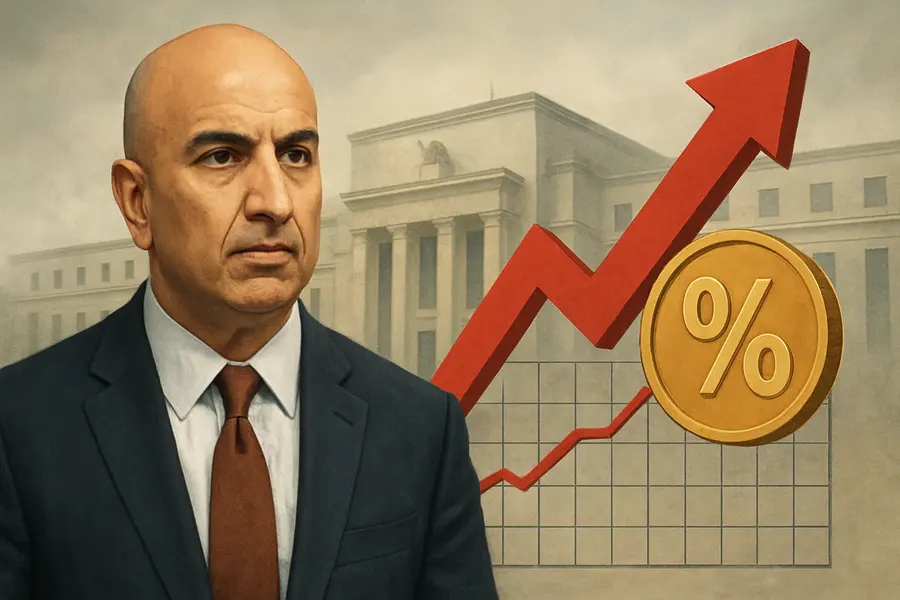
Minneapolis Fed's Kashkari backs a 2026 rate hike as PCE inflation hits 4.1% and the June dot plot shows 9 officials expecting tighter policy ahead.
- Kashkari reversed his March forecast of one cut, penciling in one rate hike for 2026 as Kashkari rate hike odds climb with PCE at 4.1% in May.
- Nine of 18 FOMC officials now project at least one increase this year; Fed interest rates 2026 futures imply a 45% year-end hike probability.
- Core services inflation held at 4.8% in May, with tariffs, energy prices, and data-center investment driving the US inflation outlook higher.
Lead
Minneapolis Federal Reserve President Neel Kashkari, a voting member of the Federal Open Market Committee in 2026, said June 26 that broadening inflationary pressures have led him to pencil in one interest-rate increase before year-end — a sharp reversal from his March projection of one rate cut. The Fed's preferred inflation gauge, the PCE price index, rose 4.1% in the twelve months through May 2026, the fastest pace since April 2023, reinforcing a widening hawkish consensus over FOMC policy.
What Happened
Kashkari disclosed his revised outlook in remarks June 26, citing not only elevated energy prices tied to Middle East tensions but a broader pattern of price acceleration across the economy. Signs of widespread inflation led him to update his dot-plot submission at the June 16–17 meeting, where he had previously sat firmly in the rate-cut camp.
Core services inflation remained the most stubborn component, running at 4.8% in May 2026. Kashkari specifically identified several structural drivers: tariffs increasing the cost of imported goods, disruptions to fertilizer supply routes through the Strait of Hormuz, and the hundreds of billions of dollars flowing annually into data-center construction, where input costs are rising sharply.
FOMC Policy Backdrop
The FOMC voted 12–0 on June 17 to hold the benchmark federal funds rate at its current target range of 3.50%–3.75%. The June economic projections, however, delivered a meaningful hawkish jolt. Nine of 18 officials now forecast at least one rate hike in 2026; six anticipate at least two increases. The median rate projection for year-end rose to 3.8%, up from 3.4% in the March dot plot — the first upward shift in the median in the current cycle.
Officials also revised their US inflation outlook sharply higher. The median core PCE forecast for full-year 2026 rose to 3.3% from 2.7% projected in March; headline PCE moved to 3.6% from 2.7%. The scale of those revisions reflected an official acknowledgment that the disinflation trajectory of recent years has stalled.
Kashkari, who had supported rate cuts as recently as January 2026, now stands as the most prominent voting member to have explicitly pivoted toward tightening. His voting status on the 2026 FOMC makes the shift operationally significant, not merely rhetorical.
Market Reaction
Fed funds futures markets repriced rapidly following Kashkari's comments. Markets now assign approximately a 45% probability of at least one rate hike by December, up from roughly 20% a month earlier. Two-year Treasury yields adjusted accordingly, with front-end rates sensitive to the compressed timeline implied by year-end hike pricing. Growth and technology equities came under pressure as elevated discount rates weighed on valuations, while higher borrowing costs increased financing burdens for leveraged companies. Bitcoin pulled back as risk appetite contracted across speculative assets.US Inflation Outlook: Drivers and Risks
The multi-source character of current inflation complicates the Fed interest rates 2026 calculus considerably. Energy price spikes tied to the Iran conflict represent a classic supply shock that could ease if tensions subside, while services inflation — driven by domestic wage dynamics and sustained investment demand — tends to be structurally stickier and slower to respond to rate moves.
Tariff-driven goods inflation introduces a third dimension that FOMC policy alone cannot cleanly address: tighter monetary conditions reduce aggregate demand but cannot lower the cost of imported inputs subject to trade levies. AI and data-center infrastructure buildouts add a fourth driver, generating concentrated demand for power, land, and specialized labor in ways that push prices higher in specific sectors regardless of the broader rate environment.
The June dot plot effectively absorbed those realities. The revision from 2.7% to 3.6% in the 2026 headline PCE forecast signals that policymakers have abandoned their earlier expectation of a smooth return toward the 2% target within the calendar year.
What Comes Next
The next FOMC meeting is scheduled for late July. June PCE data, due before that gathering, will carry outsize weight: a second consecutive month of elevated readings would likely sharpen the divide between officials still projecting no change and those, like Kashkari, who have already shifted to an explicit hiking bias.
The labor market remains a counterbalancing factor. Employment conditions are described as holding up solidly, which gives the committee room to tighten further without engineering the kind of sharp slowdown that would accompany aggressive policy action into a weakening economy. That dual-mandate cushion is the primary reason officials are still debating one hike rather than signaling a full tightening campaign.
Outlook
The Kashkari rate hike call marks a concrete pivot in the Fed interest rates 2026 debate. With core services inflation at 4.8%, headline PCE at 4.1%, and nine FOMC officials aligned behind at least one additional increase, the probability that the Fed's next move is a hike rather than a cut has risen materially. Incoming June price data and the trajectory of energy markets will determine whether that probability converts into action at the July or September meeting, and whether the single hike penciled in by Kashkari and others remains the ceiling or becomes the floor.
Mentioned tickers: TLT, SPY, QQQ