Pomegra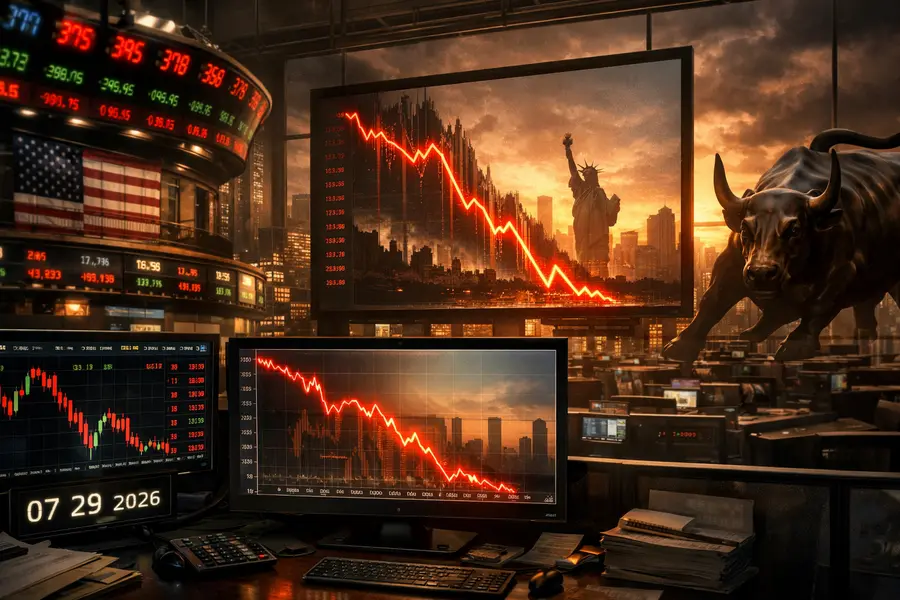
Wall Street faces its highest-stakes single session of the year as a Federal Reserve rate decision, $145 billion AI spending scrutiny, and peak earnings converge on Wednesday.
- The Fed announces its July 29 rate decision at 2 PM ET; Polymarket traders price a 26% chance of a hike.
- Meta and Microsoft report after the bell July 29, with Apple and Amazon following Thursday.
- Bullish sentiment has collapsed from 44.9% to 29.6% in a single week, the weakest reading since September 2025.
Lead
Wall Street is bracing for what analysts describe as the most consequential single trading session of 2026. On Wednesday, July 29, the Federal Open Market Committee delivers its seventh interest-rate decision of the year at 2 PM ET — the second chaired by Kevin Warsh — immediately followed by post-market earnings from Meta Platforms and Microsoft, two companies whose combined 2026 capital budgets have breached $300 billion. The triple convergence of monetary policy, peak-season earnings, and deteriorating investor sentiment 2026 has compressed months of market tension into a single afternoon.
What Happens on July 29
The FOMC's two-day meeting concludes at 2 PM ET with a rate statement, followed by a Warsh press conference at 2:30 PM ET. Economists polled by FactSet expect the committee to hold the federal funds rate in its current 3.50%–3.75% corridor for a fifth consecutive meeting. That consensus, however, conceals a meaningful tail risk: Polymarket traders assign a 26.15% probability to a July hike, rising to 43% by September and 53% by October.
Warsh has provided ample fodder for uncertainty. Testifying before Congress, the chair declared "no tolerance" for high inflation and pledged to make elevated prices "a thing of the past." Speaking at the ECB Forum on Central Banking in Sintra on July 1, he stated simply that "prices are too high" — language markets read as unambiguously hawkish. The Fed's June dot plot reinforced the split: half of voting members penciled in at least one hike by year-end; the other half projected no change.
A hold would remove one near-term pressure point but leave rate-path uncertainty intact. A surprise hike would tighten financial conditions abruptly, pressuring price-to-earnings multiples on growth equities precisely when mega-cap technology companies are releasing results.
Earnings: The $145 Billion Question
Two hours after the Fed statement, Meta Platforms (META) and Microsoft (MSFT) report fiscal-quarter results — and the AI capital expenditure debate arrives at a reckoning point.
Market Volatility Forecast and Sentiment Context
The backdrop for this stock market critical day July 29 is fragile. The S&P 500 has gained more than 8% year-to-date, and the Nasdaq Composite has advanced roughly 11%, buoyed by a 15.2% second-quarter surge — the index's best quarterly performance in six years. Yet the mood has shifted sharply in recent days.
The share of survey respondents expecting the S&P 500 to rise over the next six months dropped from 44.9% to 29.6% in a single week, the weakest bullish reading since early September 2025. Goldman Sachs' US Sentiment Indicator, which bottomed at negative 0.9 in late March before recovering to positive 0.8, faces a retest. Geopolitical cross-currents — including Iran-related risk and a semiconductor sector selloff — kept the S&P 500 little changed Friday.
The market volatility forecast heading into the week reflects this unease. The market is showing zero tolerance for earnings misses among mega-cap technology names, and the combination of rate uncertainty and peak earnings creates an asymmetric setup: a hawkish Fed surprise paired with disappointing AI monetization data could trigger compounding selling pressure in a single afternoon session.
Seasonal and Structural Context
Seasonality provides modest comfort. The S&P 500 has not posted a losing July since 2014 and has averaged a 2.5% gain in the month since 2005 — more than four times the average gain across all other months. However, that record was built in a lower-rate, lower-uncertainty environment. The upcoming market events for the remainder of the week — including Apple and Amazon on Thursday and Friday's GDP and PCE data — mean July 29 is the apex of a compressed macro and earnings schedule, not a standalone event.
The structural debate underneath market volatility forecast concerns the mega-cap AI investment cycle itself. Semiconductor makers have outperformed as AI infrastructure demand drives chip orders; the hyperscalers spending that capital have lagged as investors question the return timeline. Microsoft, Meta, and their peers must begin demonstrating revenue conversion, not just infrastructure ambition, or the divergence between spenders and suppliers is likely to widen.
Outlook
July 29 concentrates the year's most consequential unknowns — monetary policy direction, AI investment payoff, and peak-season earnings credibility — into a single afternoon and evening. A Fed hold combined with strong AI revenue signals from Meta and Microsoft could extend the 2026 rally and restore the bullish sentiment 2026 that eroded sharply last week. A rate hike, or earnings disappointments that mirror Alphabet's reception, would introduce a more challenging setup for the remainder of the year, with the S&P 500's unbroken July winning streak and its 8% year-to-date gain both at risk.