Pomegra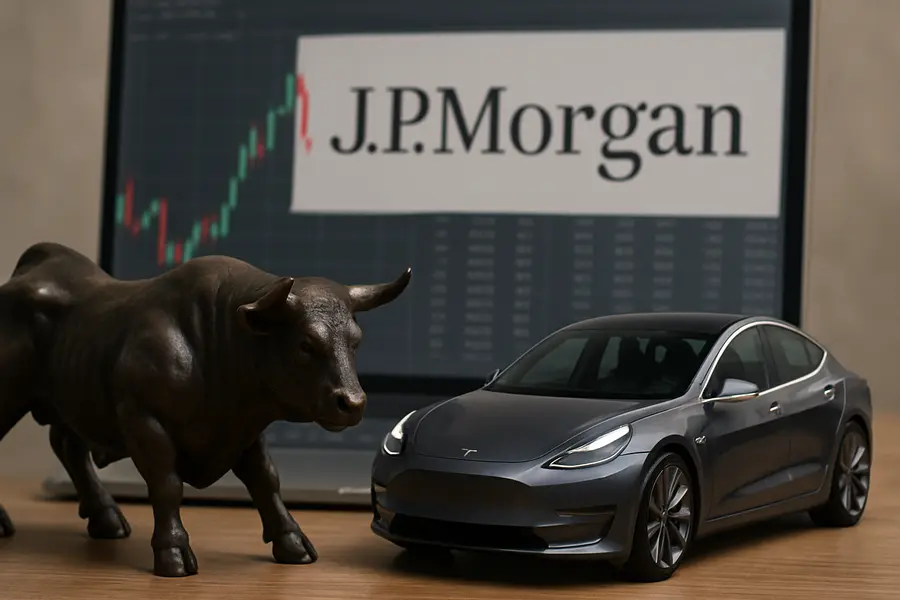
J.P. Morgan upgraded Tesla to Neutral, lifting its TSLA price target 227% to $475, closing a bearish stance held since 2018 through a 1,700% rally.
- JPMorgan raised its Tesla price target from $145 to $475, a 227.6% increase, while upgrading TSLA to Neutral from Underweight.
- The move ends an eight-year bearish stance that survived Tesla's 1,700% rally since J.P. Morgan issued a Sell recommendation in 2018.
- J.P. Morgan now models a $3.9 trillion combined addressable market across Tesla's five emerging segments by 2035.
Lead
J.P. Morgan on Thursday, June 5, 2026, upgraded Tesla (TSLA) to Neutral from Underweight and raised its 12-month price target 227.6%—from $145 to $475—closing a bearish call that had persisted for eight years through one of the most dramatic stock rallies in equity-market history. The revision follows a change in analyst coverage, with Rajat Gupta assuming responsibility for Tesla research from Ryan Brinkman, who had held an Underweight rating through Tesla stock's 1,700% price appreciation since a 2018 Sell recommendation.
What Happened
The upgrade was published ahead of the U.S. market open on June 5. J.P. Morgan's new target of $475 implies roughly 13% upside from recent TSLA price levels—a stark inversion of the 60% downside the firm projected as recently as April 6, 2026, when Brinkman reiterated a $145 target and cited record unsold inventory of approximately 164,000 vehicles, weak deliveries, and compressed margins.
Gupta's initiation note frames Tesla not as an automobile manufacturer subject to conventional industry valuation but as a "physical AI" platform company addressing five distinct, largely untapped markets: automotive, energy storage, robotaxis, humanoid robotics, and infrastructure licensing. The combined potential addressable market across those segments is estimated at approximately $3.9 trillion by 2035.
Strategic Context
The reframing represents a significant departure from JP Morgan Tesla coverage under Brinkman, which centered on vehicle delivery counts, per-unit economics, and near-term free cash flow—metrics that consistently produced bearish conclusions given Tesla's capital intensity and premium valuation multiples.
J.P. Morgan's revised model projects Tesla's annual revenue more than doubling from roughly $95 billion in 2025 to approximately $203 billion by 2030, with nearly half of that growth attributable to services and newer businesses tied to autonomy and robotics. Earnings per share are forecast to inflect after 2028, rising from roughly $1.95 in 2026 to approximately $7.50 by 2030—a near-threefold expansion underpinned by an estimated 50% annual EPS growth rate through the end of the decade.
The bank highlights Tesla's vertically integrated hardware and software ecosystem, industrial-scale manufacturing capacity, and proprietary data advantages as structural moats that distinguish the company from legacy automakers and newer EV entrants.
Robotaxi and Optimus Expansion
Central to the revised bull case is Tesla's robotaxi network, which launched commercially in Austin in June 2025 and has since expanded to Dallas, Houston, and the San Francisco Bay Area. Operating autonomously without safety drivers in expanding geofenced zones, the service has provided commercial-scale validation for Tesla's Full Self-Driving stack that few competitors have matched.
The Optimus humanoid robot program is the second major pillar of the new framework. J.P. Morgan now models Optimus as a revenue-generating product targeting industrial automation and logistics, addressing a labor-replacement market that remains in its earliest stages. Energy storage, which has expanded rapidly alongside grid-scale battery deployments globally, rounds out the diversified revenue base now incorporated in the model.
Market Reaction
TSLA shares declined 1.53% on Thursday as a broader equity market pullback offset the immediate positive signal from the upgrade. The stock had briefly gained 0.3% in pre-market trading immediately after the note published before surrendering those gains into the session close. Shares traded near $420, leaving the new $475 target representing moderate implied upside for a stock that had already recovered sharply from its first-quarter 2026 sell-off—a period during which JPMorgan itself had projected a further 60% decline.A Defining Moment in Sell-Side Coverage
Brinkman's eight-year tenure covering Tesla had become one of the most visible case studies of a major Wall Street institution maintaining a rating at sustained odds with market performance. The original Sell recommendation—issued April 20, 2018—warned of intensifying competition from German premium automakers. Since that date, Tesla stock appreciated more than 1,700%, making the call one of the most costly in recent sell-side history for investors who followed it. Elon Musk publicly mocked the call as the stock continued to climb.
Brinkman's framework, grounded in traditional auto-industry fundamentals, assigned minimal value to Tesla's software stack, energy segment, or autonomous driving ambitions. That approach is now replaced by the multi-segment sum-of-the-parts methodology Gupta has introduced.
Outlook
J.P. Morgan's upgrade formally closes a chapter that spanned nearly a decade of consistent bearish positioning on one of the world's most widely followed equities. The move reflects a broader institutional shift in how JP Morgan Tesla and peer analysts are approaching the company—as a diversified technology and energy platform rather than a premium-priced EV maker competing on vehicle margins and delivery volumes.
Execution remains the key variable. Robotaxi network profitability at scale, Optimus unit economics as production ramps, and the pace at which regulatory frameworks permit broader autonomous deployment will determine whether the 2028 earnings inflection materializes on schedule. Near-term TSLA price performance is likely to track autonomous-technology milestones rather than conventional quarterly delivery metrics.
Mentioned tickers: TSLAAnalysis