Pomegra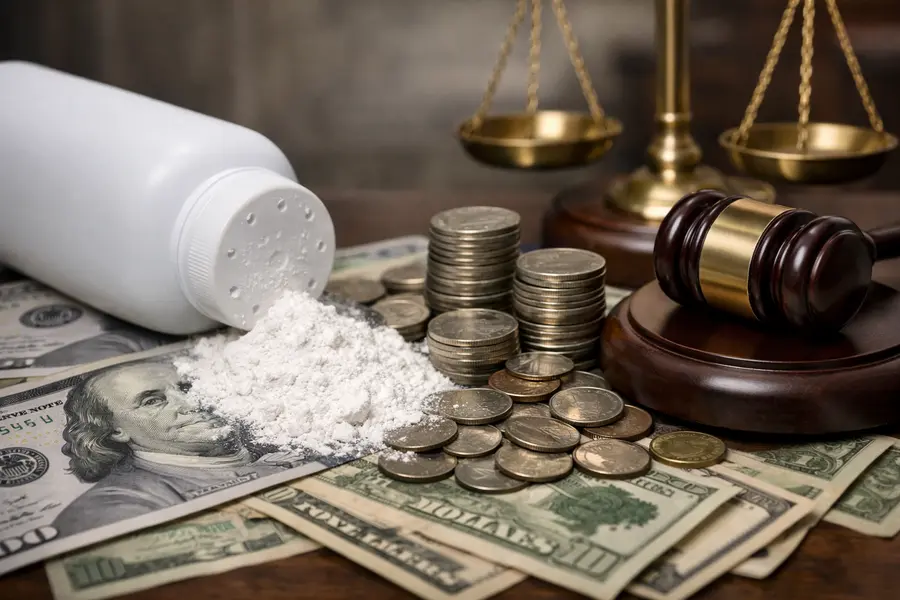
Johnson & Johnson reaches a landmark $6.5 billion agreement to resolve tens of thousands of talc-related cancer lawsuits, drawing a gavel on one of U.S. litigation history's most protracted corporate legal battles.
- J&J will pay $6.5 billion to settle claims that its talc-based baby powder caused ovarian cancer and mesothelioma.
- The agreement resolves more than 60,000 pending lawsuits after two failed attempts to use a subsidiary bankruptcy strategy.
- J&J had already discontinued talc-based johnson johnson baby powder globally in 2023; this settlement clears remaining legal exposure.
Lead
Johnson & Johnson (JNJ) has agreed to pay $6.5 billion to resolve a sweeping body of litigation alleging that its talc-based johnson johnson baby powder caused ovarian cancer and mesothelioma in tens of thousands of plaintiffs. The settlement, which requires court approval, ends years of legal maneuvering that included two rejected attempts to channel the liabilities into a subsidiary bankruptcy filing — a corporate restructuring tactic critics labeled the "Texas Two-Step." The deal represents one of the largest product-liability settlements in U.S. history and removes a significant legal cloud from J&J's balance sheet.What Happened
Litigation against J&J's talc products dates back more than a decade, with plaintiffs alleging that the company's iconic baby powder contained asbestos-contaminated talc linked to serious cancers. J&J consistently denied wrongdoing and maintained that its products were safe, but jury verdicts and mounting lawsuit counts put escalating pressure on the company.
To manage the liability, J&J twice attempted to route the claims through a bankruptcy court by spinning off a subsidiary, LTL Management, to absorb the talc obligations. The Third Circuit Court of Appeals rejected both attempts, ruling that the subsidiary lacked the financial distress required to qualify for Chapter 11 protection. That legal setback forced J&J back to direct negotiations with plaintiffs' attorneys, ultimately producing the $6.5 billion agreement now before the courts.
The settlement covers claimants alleging both ovarian cancer and mesothelioma, with funds distributed according to injury type and severity under a structured allocation framework. A supermajority of affected claimants reportedly voted in favor of the plan, a threshold required to move the agreement toward final court approval under federal mass-tort settlement procedures.
Market Reaction
JNJ shares responded with modest gains following confirmation of the agreement, as investors welcomed the removal of open-ended litigation risk from the company's long-term financial outlook. Analysts had for years flagged the talc liability as an overhang on J&J's valuation, particularly following the 2023 spinoff of its consumer health division into Kenvue (KVUE), which retained limited exposure to the talc claims. With the settlement, J&J's remaining pharmaceutical and MedTech segments gain clarity on the liability ceiling.Strategic Context
J&J had already moved to contain reputational and commercial damage by discontinuing talc-based johnson johnson baby powder in North America in 2020 and globally in 2023, replacing it with a cornstarch-based formulation. The product had been a consumer staple for more than a century. The $6.5 billion figure, while substantial, falls within ranges the company had reserved for over successive fiscal quarters, limiting the immediate earnings impact.
The resolution also removes the distraction of litigation management from J&J's executive bandwidth at a strategically sensitive moment. The company is mid-execution on a pipeline of oncology and immunology drugs it expects to anchor revenue growth through the late 2020s, and has deployed capital toward acquisitions in the cardiovascular and surgical robotics spaces.
What Comes Next
The settlement now moves through a structured court-approval process. A federal judge must certify that the agreement is fair, reasonable, and adequate for the class of claimants — a step that typically involves hearings, objection periods, and review of the allocation methodology. If approved, funds will be distributed through a trust structure administered by an independent trustee, with payments staged over time.
Separately, J&J continues to face a smaller body of talc claims outside the settlement's scope, including cases in international jurisdictions. Those exposures are considered manageable relative to the domestic liability now being resolved.
The case sets a precedent for how courts evaluate the use of subsidiary bankruptcy filings in mass-tort contexts, with regulators and legal scholars watching to see whether Congress or the courts impose additional constraints on the strategy going forward.
Outlook
The $6.5 billion settlement brings formal closure to one of the most consequential product-liability cases in U.S. corporate history. For Johnson & Johnson, the agreement converts an undefined, multi-decade litigation risk into a capped, structured financial obligation — a material improvement to the company's risk profile. Pending court approval, J&J enters its next strategic phase with its balance sheet no longer encumbered by the open-ended gavel of talc litigation.