Pomegra
Oracle's $90-95B capex guidance reconfirmed a sustained hyperscaler build-out, driving HPE and Dell to their biggest single-session gains of 2026.
- Oracle confirmed $90-95B full-year capital expenditure, with the bulk directed at AI rack, cooling, and networking hardware.
- HPE climbed 11% to $61.49 and Dell surged past $567, each posting their largest single-session advance of the year.
- Super Micro added 7%, reinforcing that the AI infrastructure trade remains a multi-vendor story rather than a hyperscaler-only play.
A Single Earnings Call Moves Three Sectors
Oracle (ORCL) delivered first-quarter fiscal 2027 results after the close on September 10, reporting total revenue of $19.3 billion - up 30% year-over-year - with cloud infrastructure revenue surging 121% to $7.4 billion. The headline that reverberated through trading floors the following morning was not the top-line beat but CFO Hilary Maxson's capital-expenditure confirmation: full-year capex of $90-95 billion, with net cash capex capped at approximately $70 billion after customer prepayments and financing arrangements. First-quarter spending alone reached $28 billion, confirming the plan is already in execution.
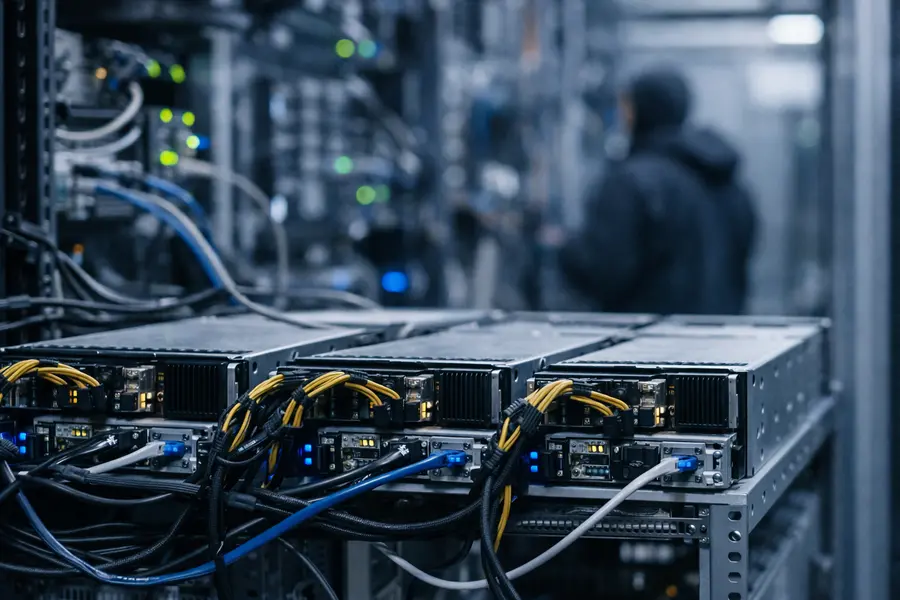
That disclosure reframed the ai stocks trade. Oracle's capital outlays do not stay inside its own balance sheet - they flow outward into physical infrastructure: racks, power and cooling systems, networking switches, and cabling. Within minutes of the opening bell on September 11, Hewlett Packard Enterprise (HPE) and Dell Technologies (DELL) were each registering gains above 11%.
Why Did HPE and Dell Rally This Hard?
Oracle's $90-95 billion annual capex functions as a forward-order signal for every hardware vendor in the supply chain. For HPE, whose server and networking divisions sell directly into hyperscale infrastructure programs, the guidance amounts to a multi-quarter visibility extension. Hewlett Packard Enterprise shares closed at $61.49, up 11%, matching the stock's strongest session of 2026. Management has flagged publicly that it cannot build AI servers fast enough to meet inbound demand - a constraint the Oracle capex figure confirms will persist well into fiscal 2027.
Dell's move was equally sharp. The company carries an $11.7 billion AI order backlog and shipped $8.2 billion worth of AI-optimized servers in its most recent quarter - figures that look conservative against a $90-95 billion Oracle capex year. Dell raised its full-year fiscal 2027 revenue outlook by $25 billion to $192 billion, representing nearly 70% year-over-year growth. Shares climbed above $567, a fresh record.
How Does Super Micro Fit the Picture?
Super Micro Computer (SMCI) rose 7%, a meaningful advance but narrower than its larger peers. The relative gap reflects timing: management had separately disclosed a $60 billion order book, meaning part of Super Micro's positive narrative was already priced in. Still, a 7% single-session gain confirms that AI infrastructure demand is broad enough to distribute gains across multiple supply-chain tiers simultaneously.The pattern underscores a structural reality: Oracle, Microsoft, Amazon, and Google are simultaneously expanding capacity, and their combined capex - estimated at $775-800 billion industry-wide for 2026, roughly 64% above 2025 levels - creates demand wide enough to support HPE, Dell, and Super Micro running in parallel rather than in competition.
Oracle's Complicated Session
The catalyst issuer had a more uneven day. Oracle shares surged as much as 10.3% immediately after earnings but surrendered nearly the entire move, ending up just 0.3% at the close. Q1 AI contract bookings of $30 billion and delivery of 300,000 GPU units at 97.9% utilization were judged strong. The late-day fade likely reflects a stock that had already re-rated substantially ahead of the print. Oracle's role on September 11 was less that of a direct beneficiary and more of the catalyst that unlocked gains across the infrastructure layer beneath it.
Outlook
The AI capital-expenditure cycle shows no sign of decelerating. Oracle's $90-95 billion guidance, Dell's record order backlog, and HPE's supply-constrained production environment collectively signal that hardware procurement will remain the binding constraint on hyperscale AI expansion through at least the first half of 2027. Super Micro's $60 billion order book adds a third data point confirming the durability of the cycle. For vendors positioned across rack, cooling, and networking, near-term earnings visibility is unusually high by historical standards.