Pomegra
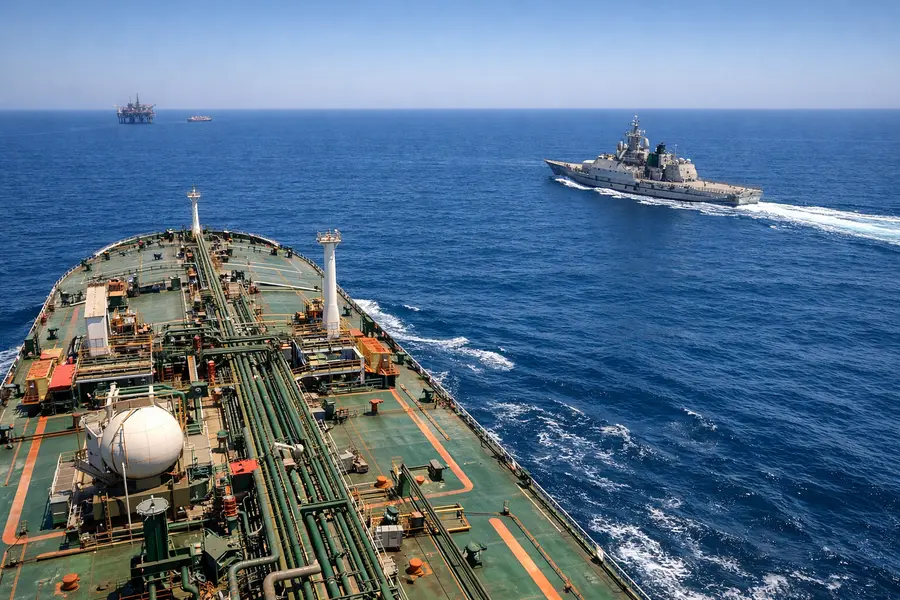
Iran's Revolutionary Guards have declared they will keep the Strait of Hormuz sealed until Washington meets Tehran's full terms, sending LNG prices 51% higher and stranding roughly 20 million barrels of daily oil supply.
- The Hormuz blockade has cut daily vessel transits 94%, from ~130 to just 8–15 ships, disrupting 25% of global seaborne oil trade
- Asian LNG benchmark prices have surged 51% to $20.2/MMBtu at this critical LNG chokepoint, with Qatar's Ras Laffan terminal facing at least three years of repairs
- Tehran's Iran demands center on a $300 billion reconstruction fund, full sanctions removal, and war reparations before any reopening is considered
Lead
Iran's Islamic Revolutionary Guard Corps reiterated on August 9, 2026, that the Strait of Hormuz will remain closed until Washington satisfies the full scope of its terms — anchored by a $300 billion reconstruction fund — a declaration that lifted Brent crude to $84.18 per barrel on August 10 and deepened uncertainty across global energy markets five months into the longest enforced chokepoint disruption in modern maritime history. Iranian Foreign Minister Abbas Araghchi stated unequivocally that conditions must be met before any reopening is considered, offering no timeline.
What Happened
The Hormuz blockade traces to March 2, 2026, when Iran formally closed the strait following U.S. and Israeli strikes that destroyed military infrastructure across the country. Within 48 hours, the IRGC declared complete control of the waterway. What followed was a cascading military and diplomatic sequence: a U.S. aerial campaign began March 19 to force the strait open; a naval blockade of Iranian ports followed on April 13; and a U.S.-escorted convoy operation launched May 4 succeeded in moving limited cargo but did not break the closure.
A Memorandum of Understanding signed June 17 between the Trump administration and Iranian President Masoud Pezeshkian offered a 60-day window for negotiations. That truce collapsed July 8 after Iran struck commercial vessels, returning the Hormuz blockade to full effect.
At the center of the current standoff are Iran demands that the United States deliver a $300 billion reconstruction fund — down from Tehran's initial $400 billion figure — alongside unconditional sanctions relief and war reparations. The Trump administration has indicated no U.S. taxpayer funds would be directed toward such a mechanism, proposing instead that regional Arab states and international investors underwrite any future reconstruction structure. No country has publicly committed capital, and no financing vehicle has been established.
Market Reaction
Energy markets have priced in prolonged disruption. Brent crude settled at $84.95 per barrel for the September contract on August 7 before easing to $84.18 by August 10, still approximately 16% above pre-crisis levels. The 52-week high of $120.88 per barrel, reached April 30, reflected the initial shock before U.S. naval escorts provided partial relief.
The impact on LNG chokepoint markets has been more severe and structurally durable. The Asian Japan-Korea Marker benchmark reached $20.2 per million British thermal units in mid-July, a 51% increase since the strait's closure and more than 60% above year-ago levels. European TTF prices rose 35% to $14.80/MMBtu over the same period. Qatar, the world's largest LNG exporter, operates the Ras Laffan complex at the head of the Persian Gulf; damage to that facility means repairs will take a minimum of three years, according to Qatari officials, cementing the supply disruption well beyond any near-term diplomatic resolution.
Geopolitical Dimension
The IRGC's posture reflects an institutional calculation: the strait's closure is the most powerful economic lever available to Tehran, and releasing it without securing binding commitments would remove the only negotiating instrument that has forced sustained U.S. engagement. Approximately 2,000 commercial vessels carrying an estimated 20,000 mariners remain stranded; 17 seafarers have been killed in at least 64 violent incidents involving commercial ships since hostilities began.
The Hormuz blockade controls passage for roughly 20 million barrels of oil daily — approximately 20% of global consumption — as well as the same 19–20% share of seaborne LNG that made the strait the defining LNG chokepoint for Asian and European importers. Countries from Japan and South Korea to India and Germany face supply squeezes for which no immediate alternative routing exists; the Cape of Good Hope detour adds weeks of transit time and substantially higher freight costs.
The Iran demands carry political complexity within the United States as well. Opposition in Congress to any fund that could be characterized as reconstruction payments to Tehran has grown vocal, constraining the administration's negotiating flexibility even as economic pressure from sustained high energy prices mounts.
Strategic Context
The $300 billion figure reflects Iran's assessment of infrastructure damage, economic losses, and foregone revenue accumulated since the February 28 strikes. Analysts focused on the region note that no postwar reconstruction framework of comparable scale — in absolute terms — has ever been assembled in the Middle East, making the timeline for any credible funding commitment highly uncertain.
Meanwhile, the U.S. naval blockade of Iranian ports, maintained since April, has produced its own economic pressure on Tehran, without yet producing a shift in the IRGC's publicly stated terms.
Outlook
The Hormuz blockade enters its sixth month with no concrete diplomatic breakthrough. Iran demands — particularly the $300 billion reconstruction fund — remain the central obstacle to any settlement, and no financing mechanism has moved beyond a proposed framework. The three-year repair timeline at Qatar's LNG chokepoint infrastructure means that even a negotiated reopening of the strait would leave Asian and European energy buyers managing a supply deficit through at least 2028. Brent crude and Asian LNG benchmarks are likely to remain elevated as long as the IRGC holds its position, and any new diplomatic incident carries the potential to push prices back toward April highs.
Mentioned tickers: USO, BNO, UNG, QAT, LNG, XOM, CVX, BP, SHEL, TTE