Pomegra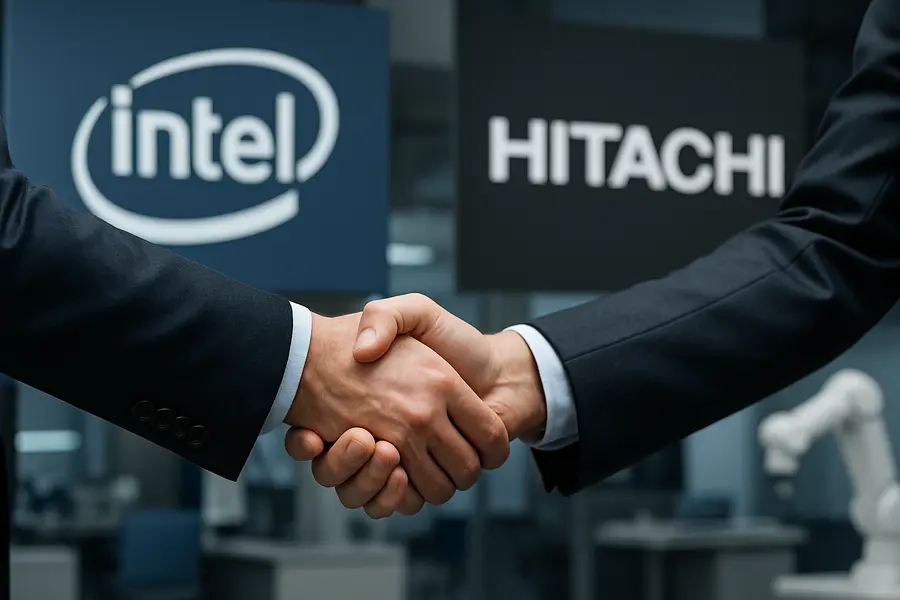
Intel and Hitachi forge a five-pillar strategic alliance spanning physical AI, foundry tools, quantum computing, and energy optimization across global industries.
- Hitachi's ExTOPE platform will apply physical AI to CD-SEM and etching data at Intel fabs to lift yield and cut maintenance costs.
- Hitachi (6501.T) shares gained 2.26% to ¥5,300 on the news; Intel Foundry posted a $2.4 billion operating loss in Q1 2026 and targets segment breakeven by end of 2027.
- The two companies, with more than 40 years of shared history, will extend cooperation into quantum computing, custom silicon, and edge-AI for industrial environments.
Lead
Intel Corporation (INTC) and Hitachi, Ltd. (6501.T) on June 5, 2026, announced a comprehensive strategic collaboration aimed at deploying physical AI across manufacturing, energy, mobility, and other critical industries. Structured around five domains—foundry tools, quantum computing, energy optimization, custom silicon and edge-AI, and factory automation—the agreement represents the most expansive formal partnership in the companies' four-decade relationship.What Happened
The alliance combines Hitachi's deep operational technology and industrial product expertise with Intel's advanced silicon platforms and AI computing infrastructure. Hitachi President and CEO Toshiaki Tokunaga framed the announcement as building on more than 40 years of accumulated trust between the two companies. Intel CEO Lip-Bu Tan described the partnership as uniquely positioned to help industries capture the industrial-scale opportunity represented by physical AI, citing the complementary strengths each company brings to operational environments.
Foundry Tools and Physical AI
The most immediately actionable pillar targets semiconductor manufacturing. Hitachi's integrated platform ExTOPE consolidates high-precision data from its dimension scanning electron microscopes (CD-SEMs) and etching systems. Applying physical AI to that real-time data stream enables predictive diagnostics, maintenance optimization, and process quality improvements—outcomes that translate directly into higher chip yields, shorter time to market, and tighter production control.
For Intel Foundry, which recorded an operating loss of $2.4 billion in the first quarter of 2026 and is guiding toward segment breakeven by end of 2027, AI-driven process efficiency represents a direct financial lever. Intel Hitachi AI integration inside the fab links semiconductor news to a concrete operational pathway, not merely a roadmap commitment.
Energy and Quantum Dimensions
The energy pillar establishes a circular product relationship: Hitachi's HMAX Energy managed-services platform will deploy inside Intel fabrication facilities to handle core power equipment, while Intel will supply high-voltage silicon chips to strengthen Hitachi's own power infrastructure. Both companies gain improved efficiency from the arrangement.
On a longer timeline, the collaboration includes a structured quantum co-development track, with R&D teams from each company working jointly on quantum hardware and application layers. Commercial quantum timelines remain measured in years, but the agreement allows both firms to share development costs and build joint intellectual property across an emerging technology cycle.
Custom Silicon and Factory Automation
The remaining pillars address edge-AI deployments and factory automation. Intel and Hitachi are jointly exploring custom silicon designed for industrial edge environments, where low-latency inference close to the production floor is increasingly critical. Factory automation integration pairs Hitachi's OT and industrial systems knowledge with Intel's compute platforms to optimize throughput and quality in complex manufacturing settings.
Market Reaction
Hitachi (6501.T) shares advanced 2.26% to ¥5,300 on the Tokyo Stock Exchange following the announcement. Intel (INTC), trading between $107.20 and $112.06 on June 5 and up approximately 450% in 2026 on sustained AI demand, was broadly flat on the day—reflecting a deal viewed as strategically coherent rather than a near-term earnings catalyst.
Outlook
Progress will be most visible first inside Intel's fabs, where Hitachi's ExTOPE-driven physical AI tooling begins addressing yield and maintenance costs in direct support of Intel Foundry's breakeven target. Custom silicon, edge-AI, and factory automation work will unfold over a multi-year roadmap, while the quantum co-development track extends the collaboration's horizon further still. The five-pillar structure positions the Intel-Hitachi alliance as a durable strategic platform rather than a narrow technology agreement—a signal that both companies see industrial AI as a sustained growth vector across semiconductors, energy, and advanced manufacturing.
Technology