Pomegra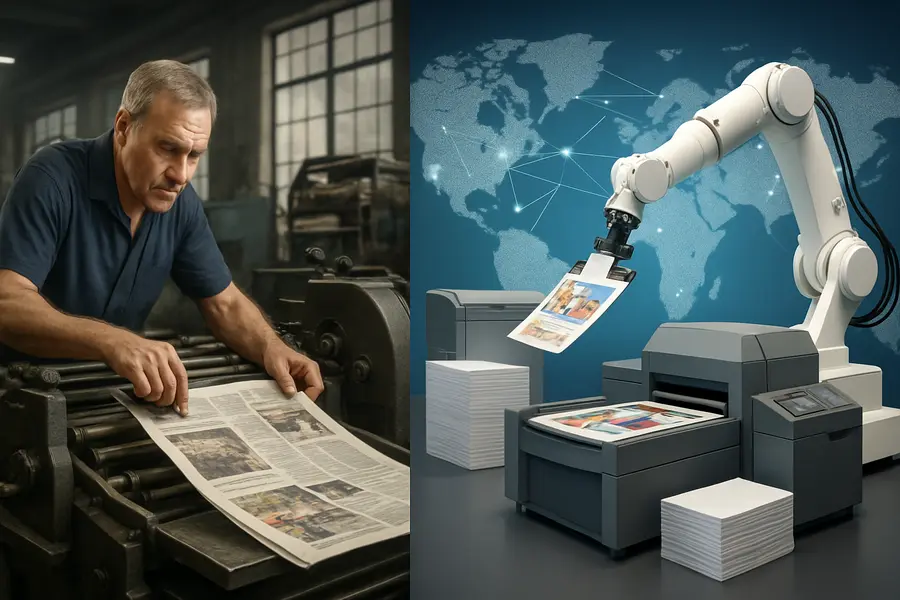
Infigo's 18.2% growth in fiscal 2025 reveals a deepening automation divide in global print, separating AI-driven operators from legacy producers in the $125B U.S. market.
- Infigo posted 18.2% revenue growth in fiscal 2025, onboarding 34 new clients, with nearly 60% sourced from North America.
- Print automation leaders report savings of 50 hours of manual labor per week; operators that resist adoption face market exit within five to ten years.
- Productivity (76.7%), cost control (74.8%), and automation (61.2%) are the print industry's top-ranked priorities heading into 2026.
Lead
Infigo, the enterprise-grade web-to-print software provider, reported 18.2% revenue growth for fiscal 2025 on January 29, 2026, citing surging demand for print automation, digital ordering, and personalization across the $125 billion U.S. commercial print industry. The results underscore a structural split now taking hold globally — an automation divide separating operators that have embedded AI tech into production workflows from those still running manual, multi-touch systems that cannot scale.What Happened
Infigo onboarded 34 new clients since the start of its fiscal year in May 2025, including 18 U.S.-based print providers. Nearly 60% of new customers in 2025 came from North America, reflecting accelerating demand among American and Canadian printers for technology-enabled platforms. The company now operates more than 4,500 active e-commerce storefronts globally, with general commercial print emerging as its fastest-growing segment. Around 70% of its customers run B2B operations.
CEO and Founder Douglas Gibson attributed growth to a fundamental shift in how print manufacturing clients approach production infrastructure. The U.S. commercial print market is growing, but many providers are still operating with manual processes that do not scale. As volume increases and turnaround expectations tighten, automation has become mission-critical to reducing manual effort, minimizing errors, and enabling providers to grow without adding headcount.
The Automation Divide
The "automation divide" captures a widening performance gap between print businesses that have adopted integrated software platforms and those still reliant on legacy workflows. Infigo's client data shows that operators using its platform have reduced as many as 50 hours of manual labor per week through streamlined workflows and system integrations.
Gibson framed the industry as evolving through three core layers — storefront, automation, and intelligence — and argued that legacy workflows unable to meet today's expectations for e-commerce-grade speed, personalization, and print automation face an existential challenge. Printers that fail to adopt software platforms risk being forced out of the market within five to ten years.
The divide is widening as enterprise clients raise the bar on order management, customization, and delivery speed — requirements that manual systems cannot reliably meet at scale.
AI and Technology Angle
Infigo has embedded AI tech capabilities directly into its platform, supported by a 28-person development team that maintains a biweekly software release cadence — an unusually fast cycle within the print software sector. The company describes itself as a technology company for the print industry, with nearly half its total headcount comprising developers and technical specialists.
Notable deployments illustrate the practical application of AI in print manufacturing: LPI, a church bulletin provider serving more than 4,000 congregations nationwide, deployed Infigo's custom automation solution in November 2025, replacing manual weekly production workflows. Superior Packaging and Finishing expanded to 51 live B2B storefronts via an integration with HP Site Flow, serving regulated-industry clients that require rigorous order traceability and workflow control. Infigo also strengthened a reseller agreement with printIQ covering Australia and New Zealand, extending its platform footprint across Asia-Pacific markets.
Strategic Context
A survey of print industry operators ahead of 2026 found productivity (76.7%), cost control (74.8%), and automation (61.2%) ranking as the three most cited business priorities. The data reflects a broad industry consensus that operational efficiency — not volume growth alone — now defines competitive advantage.
The $125 billion U.S. commercial print market remains large and fragmented, with thousands of independent operators still relying on workflows built around manual quoting, job-ticketing, and production handoffs. For platforms like Infigo, that fragmentation constitutes a substantial addressable market as consolidation pressure pushes smaller operators toward technology investment or exit.
Outlook
Infigo enters 2026 with sustained momentum across North America and expanding reach in Asia-Pacific. The automation divide identified in its fiscal 2025 results is expected to deepen as print buyers increasingly favor vendors capable of delivering e-commerce-grade speed and personalization at scale. Operators that have already automated core workflows gain a compounding advantage in throughput, margin, and client retention, while those dependent on manual processes face rising competitive pressure and structural cost disadvantage. The print industry's transition from labor-intensive production to AI-driven manufacturing platforms is accelerating, and the window for late adoption is narrowing.
Mentioned tickers: HPQ