Pomegra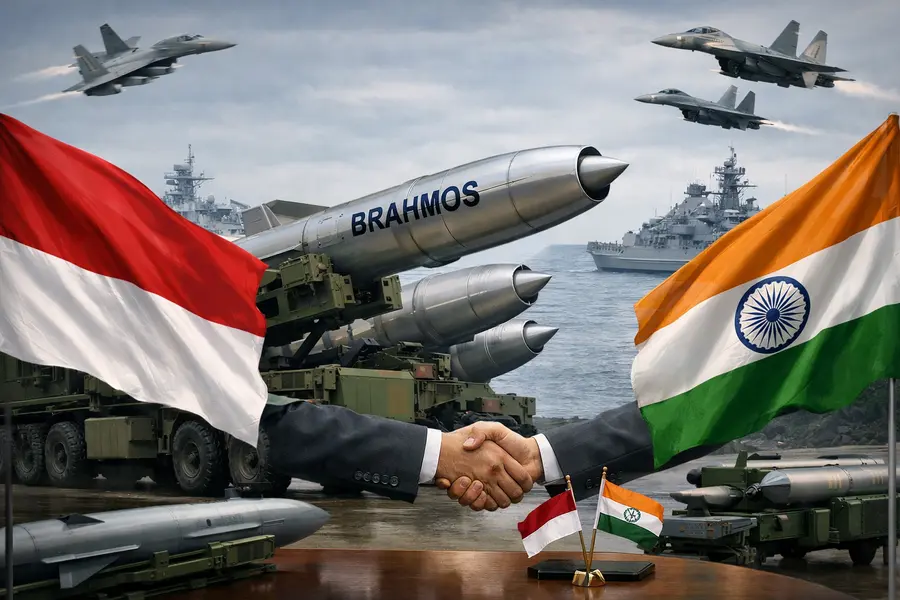
Indonesia and India signed a landmark $200 million BrahMos supersonic cruise missile agreement in Jakarta on July 7, 2026, cementing Jakarta as New Delhi's third Southeast Asian defense partner in a fast-expanding export campaign.
- Indonesia signed a $200M contract for two BrahMos supersonic cruise missile batteries during PM Modi's state visit to Jakarta on July 7, 2026.
- Total defense agreements, including Astra air-to-air missiles, are valued at an estimated $630M — a record bilateral defense commitment.
- Indonesia joins the Philippines and Vietnam as the third BrahMos export customer, extending a layered maritime denial corridor across the South China Sea.
Lead
Jakarta — Indonesian President Prabowo Subianto and Indian Prime Minister Narendra Modi signed a contract on July 7, 2026, under which Indonesia's Defense Ministry will acquire BrahMos supersonic cruise missiles from BrahMos Aerospace Private Limited, the Indo-Russian joint venture behind the system. The agreement, valued at $200 million for two missile batteries, was executed during Modi's state visit to Jakarta and forms part of a broader $630 million Southeast Asia defense pact that also covers Astra air-to-air missiles. The signing marks the single largest bilateral defense transaction between the two nations.What Happened
The formal contracts were exchanged at Halim Perdanakusuma Air Force Base, where Prabowo received Modi on the tarmac — an unusual diplomatic gesture reflecting the significance both governments attach to the deal. Indonesia's Defense Ministry signed directly with BrahMos Aerospace for the cruise missile system, while Bharat Dynamics Limited, India's state-owned guided-weapons manufacturer, concluded a separate cooperation pact with Indonesian defense firm Republikorp covering Astra beyond-visual-range air-to-air missiles.
The BrahMos package covers two full batteries — doubling an earlier single-battery proposal valued at roughly $100 million — and includes 300-kilometer-range surface-to-surface variants, operator training pipelines, maintenance arrangements, and the supporting technical infrastructure required for sustained deployment. Financial terms for the Astra component were not separately disclosed.
The BrahMos System
The BrahMos supersonic cruise missile is a co-development between India's Defence Research and Development Organisation and Russia's NPO Mashinostroyeniya. Flying at speeds exceeding Mach 2.8 — roughly three times the velocity of subsonic missiles used in comparable roles — it is engineered for anti-ship and coastal defense missions where short flight time compresses an adversary's intercept window to near zero. Its combination of speed, low altitude flight profile, and maneuverability in the terminal phase makes it among the more capable platforms in its class currently offered on the export market.
India Defense Exports: A New Tier
The Indonesia deal lands at a moment of historic acceleration in India defense exports. In fiscal year 2025–26, India's defense export revenues surpassed $4 billion for the first time — a 62.7 percent increase over the prior year — with shipments reaching more than 80 countries. BrahMos Aerospace individually recorded revenues of $548 million in the same period, up 48.6 percent, driven by export orders totaling $420 million. The Indonesia India BrahMos deal adds meaningfully to that backlog and signals that a system developed for India's own strategic needs has matured into a commercially competitive export product.
The Philippines became the inaugural foreign customer, receiving its first operational BrahMos battery in 2024 with a second shipment following in April 2025. Vietnam formalized its own purchase — reported at approximately $600 million including training and logistical support — earlier in 2026. Indonesia's signature on July 7 completes a three-country arc of India defense exports across Southeast Asia's most contested maritime geography.
Geopolitical Dimension
Defense planners view the successive agreements as establishing a layered maritime denial corridor stretching across sea lanes connecting the Western Pacific to the Indian Ocean. The South China Sea carries an estimated $3 trillion to $5 trillion in annual global trade, and coastal anti-ship missile batteries positioned along its littoral rim alter the risk calculus for any power projecting naval force into the region.
For Indonesia, the acquisition supports a long-standing doctrine of "minimum essential force" for archipelagic defense across its more than 17,000 islands, while avoiding outright alignment with any single great power. Jakarta has maintained defense procurement relationships with the United States, Russia, France, and South Korea simultaneously. The Indonesia India BrahMos deal extends that pattern rather than replacing it, with Indonesian officials framing the purchase as a sovereign capability investment rather than a geopolitical statement.
For India, the deal advances the "Act East" policy that successive governments have used to embed New Delhi more deeply into the strategic architecture of the Indo-Pacific. Defense co-production agreements, joint exercises, and now missile sales create training pipelines, spare-parts dependencies, and maintenance relationships that sustain engagement well beyond the initial transaction. Indonesia — the world's fourth-most-populous country and Southeast Asia's largest economy — is a particularly consequential partner in that framework.
Market Reaction
Bharat Dynamics Limited shares rose sharply in Mumbai trading on news of the agreements, extending gains accumulated since BrahMos export momentum began building in 2023. BrahMos Aerospace, as a private joint venture, does not trade publicly, but the deal expands revenue visibility for its Indian parent entities and reinforces the government's target of reaching $6 billion in annual defense exports by fiscal year 2028–29.
What Comes Next
Delivery timelines were not disclosed at the signing ceremony, though the phased acquisition structure built into the contract suggests initial battery deployment within 24 to 36 months, consistent with the Philippines' experience. Operator training under Indian technical teams is expected to begin earlier. The two governments also signed a maritime security cooperation agreement covering information-sharing and coordinated patrol frameworks along key shipping corridors — an operational dimension that complements the hardware transfer.
Further BrahMos export discussions are ongoing with additional countries across the Middle East and Southeast Asia, according to statements from Indian defense ministry officials. The Indonesia India BrahMos deal sets pricing and structural precedents that will shape those negotiations.
Outlook
The July 7 agreements position India as a credible arms exporter at scale in the Indo-Pacific and deepen a bilateral relationship that has historically been underweighted relative to the economic size of both nations. For Indonesia, the acquisition of BrahMos supersonic cruise missiles provides a meaningful enhancement to maritime deterrence at a cost manageable within its defense modernization budget. The broader $630 million package — covering both cruise and air-to-air missile systems — represents a strategic commitment that will sustain defense-industrial ties between Jakarta and New Delhi for at least a decade.
Mentioned tickers: BDL