Pomegra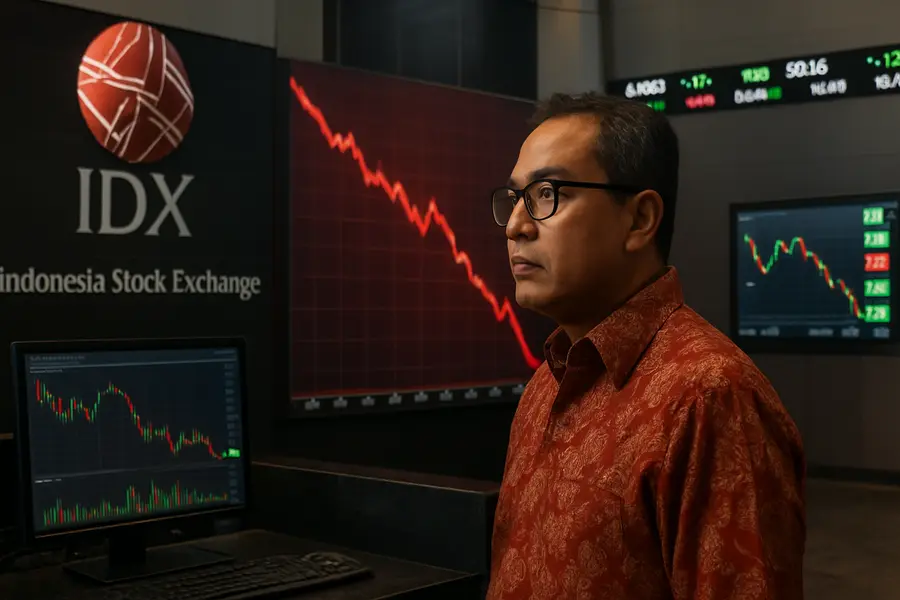
Indonesia's financial regulator names IDX veteran Jeffrey Hendrik to lead the exchange as the IDX Composite ranks among 2026's worst-performing major indices amid a $13 billion MSCI downgrade threat.
- The IDX Composite has declined roughly 31% year-to-date in 2026, placing the Indonesia stock market among the world's worst-performing major benchmarks.
- MSCI reviews on June 18 and June 23 could strip Indonesia of emerging-market status, risking up to $13 billion in forced passive outflows.
- Jeffrey Hendrik, a six-year IDX veteran and former brokerage chief, will be formally ratified as exchange president at a June 29 shareholder meeting.
Lead
Indonesia's Financial Services Authority (OJK) on June 18 named Jeffrey Hendrik as president director of the Indonesia Stock Exchange (IDX), selecting a proven insider to stabilize a capital market that has shed roughly 31% this year and earned the unwelcome distinction of the world's worst-performing major index. The appointment is subject to ratification at an extraordinary shareholders' meeting on June 29 and coincides with twin MSCI classification reviews that will determine whether Indonesia retains its emerging-market standing.
What Happened
Hendrik had already been steering the exchange in an acting capacity since February 1, 2026, when he stepped into the role following the abrupt resignation of former president director Iman Rachman on January 30. Rachman's departure came in the immediate aftermath of the worst single-session collapse in the Jakarta Composite since the 1998 Asian financial crisis — the IDX Composite plunged as much as 10% in a single session, erasing an estimated $80 billion in market value.
The choice of Hendrik is a deliberate signal of continuity over disruption. Before the interim appointment, he had served as IDX's Director of Business Development since 2020, overseeing listing initiatives and the exchange's nascent carbon trading platform. Prior to joining the bourse, Hendrik spent more than two decades at Phintraco Sekuritas, a domestic retail brokerage, where he rose to president director. OJK and the IDX's supervisory board selected him from a pool of 28 director candidates reviewed for the 2026–2030 board cycle — a preference for institutional memory over external reform credentials.
Hendrik will lead a new six-person board through 2030. The incoming team's stated priorities are advancing market transparency, deepening liquidity on both the issuer and investor sides, and completing structural reforms already in motion.
The MSCI Threat
The urgency behind the appointment cannot be separated from MSCI's ongoing scrutiny of Indonesia's capital markets. On January 27, 2026, MSCI froze all upward index moves for Indonesian securities — blocking new inclusions, halting foreign inclusion factor increases, and preventing stocks from migrating upward across size segments — citing transparency and price-discovery concerns.
The consequences materialized in May, when MSCI's semi-annual rebalancing removed 19 Indonesian equities from its Global Standard and Small Cap indexes. Passive fund outflows tied to that rebalancing were estimated at between Rp28 trillion and Rp31.5 trillion, approximately $1.8 billion.
The stakes escalate further this week. MSCI publishes its Global Market Accessibility Review on June 18 and its Annual Market Classification Review on June 23. A reclassification of Indonesia from emerging markets to frontier-market status would compel funds benchmarked to the MSCI Emerging Markets Index to exit Indonesian positions — a forced rotation that analysts estimate could reach $13 billion. For context, the entire exchange carried a market capitalization of roughly $400 billion before this year's slide.
Market Performance
The IDX Composite — also known as the IHSG or Jakarta Composite Index — entered 2026 near 7,200 before tumbling to approximately 6,200 in recent sessions, a year-to-date loss approaching 31% that dwarfs the declines of comparable peers. The MSCI Emerging Markets Index posted a 33.6% gain in 2025; Indonesia shed ground even in that environment. The prolonged divergence has eroded confidence among both domestic retail investors and the foreign institutional allocators the Indonesia economy is working to attract.
Reform Agenda
The IDX and OJK have enacted a series of structural measures designed to address MSCI's concerns and rebuild the Indonesia stock market's credibility with global capital. Minimum free-float requirements are being raised from 7.5% to 15%, targeting the controlling-shareholder structures that have historically suppressed secondary-market liquidity. Ownership disclosure thresholds have been tightened to require public reporting of any stake exceeding 1%, down from the prior 5% threshold. IDX demutualization — transitioning the exchange from a member-owned entity to a for-profit company — is targeted for completion in the first half of 2026.
Pension funds and insurance companies, Indonesia's largest pools of domestic long-term capital, are now permitted to allocate up to 20% of portfolios to equities, up from 8%. The measure is intended to create a domestic anchor that partially cushions any outflows triggered by an adverse MSCI decision.
Outlook
Jeffrey Hendrik inherits an institution under both structural and reputational strain. The near-term trajectory of IDX composite news will be shaped by MSCI's June verdicts: a formal watchlist placement for frontier reclassification would prolong outflows and raise the difficulty of any market recovery. The reform program already in place addresses the transparency gaps MSCI originally cited, and Hendrik's insider standing provides the institutional relationships needed to accelerate implementation. Whether that pace satisfies global index reviewers — and begins to reverse Indonesia's standing among emerging markets finance benchmarks — will become apparent before the end of June.
Mentioned tickers: ^JKSE