Pomegra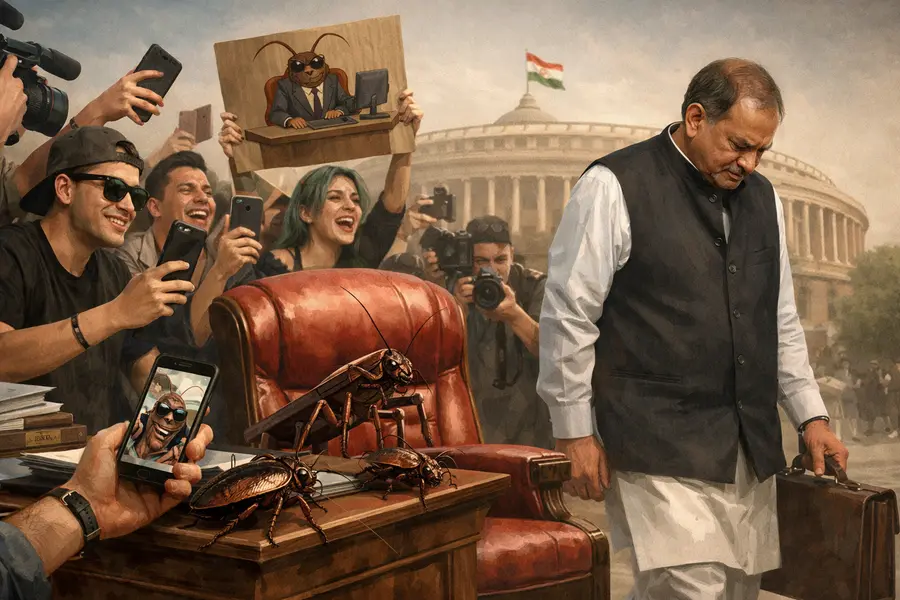
India's Gen Z political culture deployed memes, parody, and mass street action to oust an education minister, marking a generational inflection point in India social unrest.
- India's Cockroach Janta Party amassed 22.5 million followers in weeks, turning a judicial insult into a nationwide youth movement.
- More than 10,000 protesters marched on parliament in New Delhi; police responded with tear gas and baton charges.
- Education Minister Dharmendra Pradhan resigned July 25, 2026, a direct concession to the youth-led protest campaign over NEET exam fraud.
Lead
NEW DELHI — A throwaway remark by India's Chief Justice in May 2026 has cascaded into the most consequential youth-led political crisis of Prime Minister Narendra Modi's third term. The Cockroach Janta Party — a satirical movement born on social media and matured in the streets of Delhi, Pune, Bengaluru, and Lucknow — secured the resignation of Union Education Minister Dharmendra Pradhan on July 25, 2026, after weeks of India protests 2026 that drew tens of thousands and forced a national reckoning with examination fraud affecting 2 million students.
What Happened
On May 15, 2026, Chief Justice of India Surya Kant, during a Supreme Court hearing, compared unemployed young people to "cockroaches" and "parasites of society." The remark detonated across Indian social media within hours. The following day, Abhijeet Dipke — a journalism graduate, Boston University alumnus, and former political communications strategist for the Aam Aadmi Party — announced the formation of the Cockroach Janta Party on X, listing eligibility criteria with deliberate irony: unemployed, lazy, chronically online, able to rant professionally.
By June 6, 2026, the CJP had moved from hashtags to Jantar Mantar, the designated protest ground in central New Delhi. What began as a few hundred demonstrators swelled over six weeks into a movement of 22.5 million social media followers and street marches that eventually brought more than 10,000 people within blocks of India's parliament.
The Meme as Political Weapon
What distinguishes the Cockroach Janta Party from prior Indian youth movements is the sophistication with which Gen Z political culture has weaponized digital irony. Protesters arrived in Spider-Man masks and Batman costumes. Placards echoed the cadence of viral memes. Parody videos depicting education bureaucrats spread faster than any press release. On Instagram and X, self-deprecating humor — leaning into the "cockroach" label rather than rejecting it — created a linguistic identity that proved resistant to official counter-messaging.
Cultural observers have noted that Modi's political apparatus pioneered social media campaigning in India; the Cockroach Janta Party effectively reverse-engineered that playbook. The movement flooded the same platforms with content that reframed state failure as absurdist comedy, transforming India social unrest into shareable spectacle without diluting the underlying political demand.
The Substantive Grievance
Behind the meme architecture sits a concrete policy failure. The NEET-UG 2026 medical entrance examination, administered on May 3, was compromised by a paper leak allegedly sold for as much as 32 lakh rupees per candidate, according to Bihar police findings. The government cancelled the exam and scheduled a re-examination for June 21, a decision that disrupted the plans of roughly 2 million aspiring students and reignited longstanding anger over graduate unemployment and institutional accountability.
The CJP's formal demands included the resignation of Education Minister Dharmendra Pradhan over the NEET leak and separately over CBSE On-Screen Marking irregularities. A concurrent 26-day hunger strike by education reformer Sonam Wangchuk added further pressure. Opposition leader Rahul Gandhi called the examination system a "fraud" in parliament, providing the movement cross-party political cover.
Police Response and Strategic Pivot
The largest march, which targeted parliament directly, ended in confrontation. Police deployed tear gas and carried out baton charges against demonstrators — scenes captured on thousands of smartphones and amplified globally within minutes. Following the crackdown, Dipke announced a tactical suspension of street marches, citing safety concerns: "We will not march again because the police will hurt the youth again."
The pivot did not signal retreat. The CJP maintained its online pressure campaign, and the organizational infrastructure built through Instagram and X continued to coordinate regional chapters in Pune, Bengaluru, and Lucknow. The digital-physical integration — protests seeding content, content seeding protests — proved self-reinforcing even after the street component paused.
Geopolitical and Structural Dimension
The episode exposes a structural tension in India's development model. Despite posting GDP growth rates above 6 percent annually, India has struggled to convert economic expansion into commensurate formal employment for its expanding graduate cohort. The NEET controversy concentrated that diffuse frustration onto a single, visible point of state failure: an examination system gatekeeping access to medicine and engineering for hundreds of millions of families.
For Modi's Bharatiya Janata Party government, the resignation of a senior cabinet minister under direct youth pressure represents a precedent. The India protests 2026 cycle — simultaneous with comparable Gen Z-led movements in Nepal, Morocco, and Bangladesh — reflects a broader generational pattern in which digitally native cohorts translate online organizing into tangible political outcomes faster than traditional opposition structures.
The incoming education minister inherits a mandate to transition NEET to computer-based testing by 2027 and to introduce anti-paper-leak legislation. Both commitments were accelerated by the CJP's campaign.
Outlook
The resignation of Dharmendra Pradhan represents a partial victory for the Cockroach Janta Party, but the movement's stated objectives extend beyond a single ministerial scalp. Graduate unemployment, systemic examination reform, and broader accountability for public institutions remain unresolved. With 22.5 million followers and an organizational model that costs virtually nothing to sustain, the CJP has demonstrated that India social unrest in 2026 does not require conventional party infrastructure to extract concessions from the state. Whether the movement consolidates into a lasting political force or dissipates once its immediate demands are addressed will define the next phase of Gen Z political culture in the world's most populous democracy.
Mentioned tickers: