Pomegra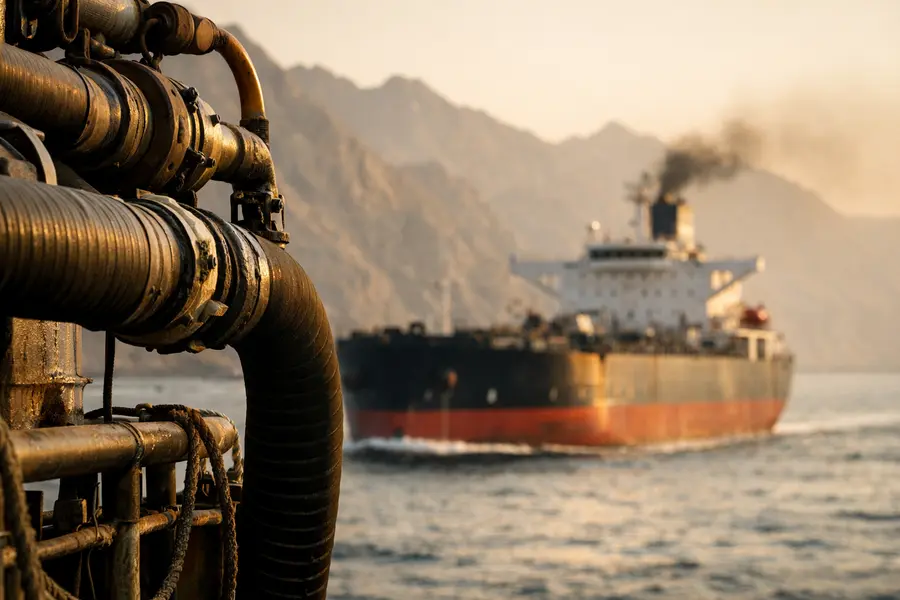
Iran's $1-million-per-ship levy has collapsed Strait of Hormuz transits from 130 to fewer than 15 daily crossings, pushing WTI crude near $130 a barrel as Iran-Oman revenue-sharing talks offer the market's only near-term exit.
- Daily tanker transits through the Strait of Hormuz have fallen from roughly 130 to fewer than 15 since Iran imposed its $1 million per-vessel toll in 2026.
- WTI crude oil price has surged nearly 60 percent from pre-crisis levels, making the Hormuz disruption the dominant supply-side variable in global energy markets.
- An Iran-Oman revenue-sharing framework is the most credible diplomatic path to reopening the strait, but US sanctions relief remains the decisive unresolved condition.
Lead
The Strait of Hormuz, the narrow Persian Gulf passage through which roughly 20 percent of global oil supply once moved daily, has been reduced to a trickle. Iran's enforcement of a $1 million per-ship transit toll in 2026 has driven daily tanker crossings to fewer than 15 vessels -- down from approximately 130 before the conflict began. The crude oil price has responded accordingly, with WTI consolidating near $130 per barrel as of late August 2026, a level that is straining energy budgets across Asia and Europe and reshaping the economics of global seaborne trade. The 2026 Hormuz crisis is now the single largest supply-side risk in energy markets, surpassing prior OPEC+ output disputes and the post-pandemic demand surge in its immediate price impact.
How Did a $1 Million Toll Shut the World's Busiest Oil Chokepoint?
The levy proved economically prohibitive almost immediately. War-risk insurance premiums surged in parallel with the toll announcement, compounding total voyage costs to levels that rendered most Gulf crude shipments commercially unviable at prevailing freight rates. Saudi Arabia, the UAE, and Kuwait -- the strait's three largest volume contributors -- began rerouting cargoes through overland pipelines and longer Red Sea-Cape of Good Hope diversions. Others deferred exports entirely. The arithmetic is stark: a single round-trip voyage through the strait for a very large crude carrier (VLCC) now carries a $2 million toll burden before fuel, crew, and insurance costs are added. With global benchmark prices already elevated, buyers have sourced replacement barrels from West Africa, the US Gulf Coast, and Kazakhstan's Caspian Pipeline Consortium route, each carrying significant freight premiums that feed back into refined-product costs worldwide.
What Is the Iran-Oman Revenue-Sharing Framework?
Negotiations between Iran and Oman center on a structure in which Muscat acts as an authorized intermediary -- collecting transit fees from shipping operators and channeling a negotiated share to Iranian accounts through Omani financial institutions that maintain correspondent-banking relationships with Western clearinghouses. Oman's geographic position at the mouth of the strait, and its decades-long history as a discreet diplomatic interlocutor between Tehran and Western governments, make it the logical and only viable broker for such an arrangement. The framework under discussion would establish fee tiers based on vessel class, with a portion of proceeds directed to a jointly administered escrow account to fund Gulf environmental-monitoring programs -- a face-saving mechanism intended to present the arrangement as a multilateral maritime governance agreement rather than a bilateral revenue deal.
Why Does US Sanctions Relief Determine Whether Any Deal Holds?
Without a formal general license or specific carve-out from the US Office of Foreign Assets Control, international banks and shipping firms operating under US secondary-sanctions compliance frameworks cannot legally process payments that materially benefit Iranian state entities -- regardless of the intermediary structure Oman erects. European and Asian financial institutions that clear in dollars have no viable path around this constraint without explicit Washington authorization. The US administration has signaled conditional openness to a limited, time-bound waiver linked to verified Iranian enrichment freezes at the Fordow and Natanz facilities, but no formal instrument has been issued as of late August 2026. That gap between diplomatic signal and legal instrument is the primary driver of continued crude oil price volatility: markets cannot price a reopened strait until the sanctions architecture actually changes.
Market Reaction
WTI crude has risen approximately 60 percent from pre-crisis levels, with spot prices consolidating near $130 per barrel. Brent crude has tracked within $2 to $3 of WTI, sustaining the tight spread that reflects shared physical tightness rather than regional arbitrage. Energy equities -- led by major integrated producers including ExxonMobil (XOM) and Chevron (CVX) -- have outperformed the broader S&P 500 (SPY) by a wide margin year-to-date. Gold (GLD) has benefited from risk-off positioning, while transportation-intensive sectors -- airlines, chemicals, plastics -- remain under pressure from elevated feedstock costs. The United States Oil Fund (USO) and Energy Select Sector SPDR Fund (XLE) have seen sustained inflows as institutional investors add energy exposure as a geopolitical hedge.Geopolitical Dimension
The 2026 Hormuz crisis intersects three compounding structural pressures. First, the ongoing Iran-US nuclear negotiating track remains entangled with the strait dispute, as Tehran has explicitly linked any transit-fee reduction to sanctions relief -- collapsing the distinction between maritime access and nuclear diplomacy. Second, Gulf Cooperation Council states have accelerated investment in bypass infrastructure -- the UAE's Habshan-Fujairah pipeline, Saudi Arabia's East-West pipeline -- that could eventually reduce their strait dependence, but current capacity falls well short of pre-crisis throughput volumes. Third, China -- the single largest buyer of Gulf crude -- remains exposed: Chinese state refiners account for a disproportionate share of the fewer than 15 daily transits still operating under separate compliance arrangements that are opaque to Western market participants, introducing an additional layer of uncertainty into global crude oil supply accounting.
What Comes Next for Oil Prices?
The trajectory of WTI from current levels is effectively binary. A credible Iran-Oman deal that includes even partial US sanctions relief could return 3 to 5 million barrels per day of stranded Gulf supply to market within 60 to 90 days, given the volume of tanker capacity idling in the region. That scenario represents meaningful downward pressure from $130. A breakdown in talks -- or a US refusal to issue any waiver -- leaves the strait effectively closed through the remainder of 2026, with the next price test above $140 per barrel becoming the baseline before demand destruction and rerouting provide a ceiling. Every week without resolution extends the structural damage to just-in-time refinery supply chains in South Korea, Japan, and India.
Outlook
The 2026 Hormuz crisis has transformed the strait from a logistical constant into an active geopolitical risk premium embedded in the crude oil price globally. The Iran-Oman revenue-sharing framework is the only credible near-term exit, but its durability is conditional on US sanctions architecture that remains formally unchanged. Until Washington acts, the market will continue treating fewer than 15 daily transits -- not 130 -- as the operative baseline for global energy supply.