Pomegra
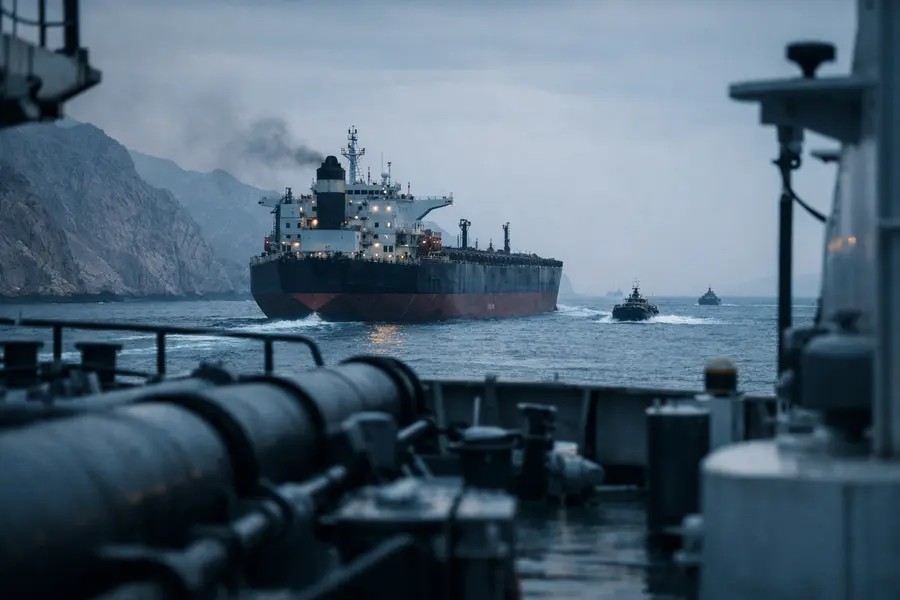
Iran's Revolutionary Guards declared the Strait of Hormuz closed on October 26 as Saudi, Turkish and Pakistani officials met in Tehran, holding Brent near $115 a barrel.
- The IRGC declared the Strait of Hormuz closed on October 26, warning violators they risk being "engulfed in flames".
- Brent crude is holding around $115 a barrel, with WTI near $101 on talks and strike fears.
- Saudi, Turkish and Pakistani officials agreed in Tehran to continue discussions on regional security.
Lead
The Islamic Revolutionary Guard Corps (IRGC) declared the Strait of Hormuz closed on October 26, days after it said it struck four tankers carrying out unauthorised ship-to-ship oil transfers in the northern Persian Gulf. The declaration came as senior officials from Saudi Arabia, Turkey and Pakistan sat down with Iranian counterparts in Tehran to head off a new round of fighting with the United States and Israel. The crude oil price reflects both pressures: Brent is holding around $115 a barrel, its highest range since 2022, as traders weigh a diplomatic opening against reports that Washington is readying a possible major strike.
What Did the IRGC Announce About the Strait?
The IRGC announced that the waterway is closed to vessels that do not comply with its transit rules, and warned that violators risk being "engulfed in flames." The strait normally carries about one-fifth of the world's oil and gas flows.
Daily transits have fallen from a pre-war baseline of about 85 vessels to roughly four, based on IMF PortWatch data. Tehran's Persian Gulf Strait Authority requires ships to register, obtain clearance and use an IRGC-approved corridor near the Iranian coast. Vessels using the US-promoted southern lane are classed as non-compliant.
The latest declaration follows the IRGC's March 27 order closing the strait to shipping bound to and from ports of the United States, Israel and their allies. An April ceasefire ended the initial phase of heavy bombardment, but both sides have since contested control of the passage, and the US has maintained a naval counter-blockade of Iranian ports.
Who Met in Tehran and What Was Agreed?
Saudi Defense Minister Khalid bin Salman, Pakistani army chief General Asim Munir and Turkish intelligence chief Ibrahim Kalin met Iran's security chief Mohsen Rezaei on October 26. Iranian state television said the sides agreed to continue discussions on cooperation, including on regional peace and security.
The agenda covered possible US-Iran negotiations, the Hormuz shipping regime, the US blockade of Iranian ports and Houthi attacks on Saudi Arabia. A Houthi strike on King Khalid International Airport this month killed 13 people and wounded more than 300, and the group has intensified missile attacks on Saudi airports and oil infrastructure. Riyadh has responded with strikes on Houthi targets in Yemen.
The three visiting governments are members of a mutual-defence pact, which gives the Tehran meeting weight beyond routine diplomacy. It offers Iran a channel to Washington through partners that have security ties to the US.
Why Is Brent Holding Around $115 a Barrel?
Brent is holding near $115 because the market is pricing two opposing risks: a physical supply squeeze at Hormuz and a possible US military escalation, offset only partly by diplomacy. WTI has traded near $101, with the roughly $14 spread underscoring how exposed seaborne Atlantic Basin crude is to Gulf disruption.
Prices rose sharply late last week after reports that Washington and Israel had drafted plans for renewed strikes on Iran after the November 3 midterm elections. The IRGC's claim of hitting four ships and Houthi attacks on Saudi sites added to the move. President Donald Trump said he has "a decision to make" on whether to "finish it off" or pursue a deal. Iran has said it would target Gulf oil facilities, subsea cables and data centres if the US and Israel launch a new offensive.
Prices eased intraday when the Tehran talks raised hopes of de-escalation, but the retreat has been shallow. Strategic Petroleum Reserve releases and earlier recoveries in cargoes through the strait toward pre-conflict levels have cushioned the market, though the latest closure undercuts that support.
What Are the Economic Channels?
The immediate channel is energy. A sustained halt to compliant transits would remove a large share of Gulf crude, condensate and LNG from the market. Insurers and charterers have already repriced war risk, raising freight costs for any cargo that still moves. The Bab el-Mandeb Strait, where Houthi activity complicates the Red Sea route, limits the workaround for Saudi exports, and OPEC+ meets on November 1 with Saudi Arabia's quota at 10.5 million barrels a day and little ability to export more through a closed strait.
The second channel is inflation. Oil at $115 feeds directly into fuel, freight and petrochemical costs, complicating the path for central banks already balancing growth against price pressure. Energy importers in Asia and Europe face the sharpest terms-of-trade hit, while US producers benefit from higher realised prices.
What Comes Next for Oil Prices?
The next three to twelve months turn on a short list of dates and decisions. The November 1 OPEC+ meeting comes first, followed by the November 3 US midterm elections, after which the reported strike plans could move from drafting to execution. A decision to strike would likely push Brent beyond its recent peak, given Iran's stated threats against Gulf infrastructure. A negotiated reopening, brokered through the Saudi, Turkish and Pakistani channel, would remove a large part of the risk premium but would require Tehran to ease its transit regime and Washington to relax its blockade of Iranian ports.
Structurally, the episode reinforces a shift in how Gulf exporters, importers and insurers treat the strait: as a contested corridor with a permitting authority, not an open international waterway. That points to higher baseline freight and insurance costs, more strategic stockpiling and continued interest in pipelines that bypass the chokepoint.
Outlook
The IRGC's closure declaration, the collapse in daily transits and the reported US strike planning keep Brent anchored near $115, while the Tehran talks provide the only visible path to de-escalation. Markets will take their cues from the November 1 OPEC+ meeting, the November 3 midterms and any movement on the blockade and transit rules.
Mentioned tickers: XOM, CVX, USO