Pomegra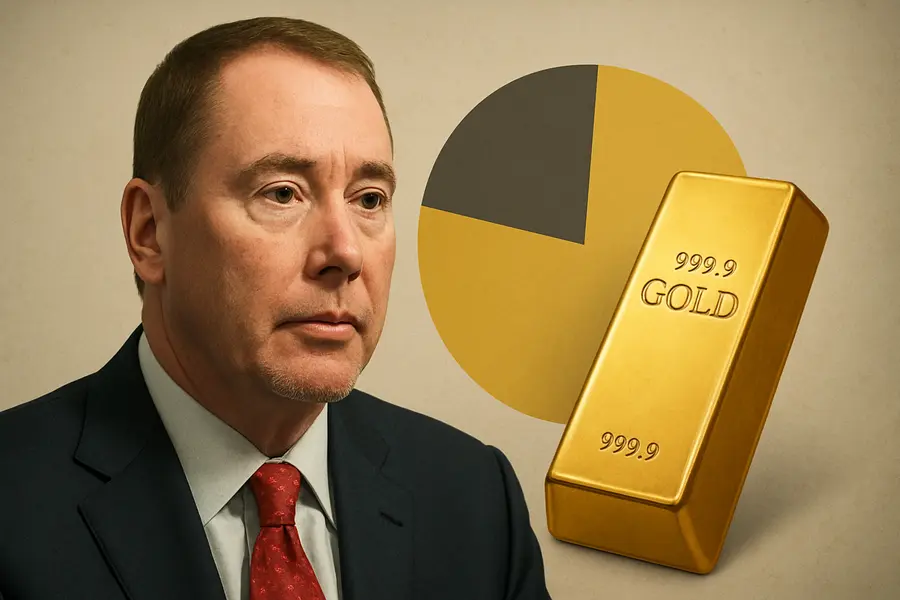
DoubleLine's Gundlach says a 25% gold portfolio share is not excessive as dollar weakness, central bank buying, and inflation risk support precious metals.
- DoubleLine's Gundlach calls a 25% gold allocation "not excessive," describing the position as an insurance policy rather than a speculative bet.
- Spot gold traded at $4,087 per ounce on June 26, 2026 — up 25% year-over-year but 16% below January's record high of $5,589.38.
- Central banks added 244 tonnes of gold net in Q1 2026, extending a structural demand trend that drove 863 tonnes of purchases across all of 2025.
Lead
Jeffrey Gundlach, chief executive and chief investment officer of DoubleLine Capital, which managed approximately $95 billion in assets, reaffirmed that a gold portfolio share as large as 25% is defensible in the current environment, characterizing exposure at that level as a portfolio insurance policy against dollar debasement and fiscal deterioration. Speaking on CNBC, Gundlach stated directly that "a 25% type weighting in gold is not excessive," adding the metal is "in a winning mode because of the weaker dollar." The remarks carry weight across institutional and retail markets as gold holds above $4,000 per ounce and sovereign demand for precious metals remains structurally elevated.What Happened
At DoubleLine's "Gundlach Unlocked" event on June 9, 2026, Gundlach outlined the most defensive portfolio framework in the firm's 17-year history: 30% non-U.S. equities, 30% high-quality bonds, 20% cash, and 20% real assets — with gold anchoring the real-asset sleeve at 10% of total assets, accompanied by a 5% allocation to a broad commodity basket such as the Bloomberg Commodity Index.
The 25% ceiling Gundlach has articulated publicly since late 2025 sets an upper bound investors can reasonably approach without straying into overconcentration. His own positioning has tracked price action: after calling gold's rally to record levels "nosebleed" territory and trimming DoubleLine's direct exposure to roughly 10% in October 2025, he described the subsequent pullback toward $3,900–$4,000 as a "very good entry point" in March 2026 — framing the correction as a second-chance accumulation window for long-term holders rather than a signal to exit.
Market Context
Gold investment in 2026 has navigated extreme swings. Spot prices reached an all-time high of $5,589.38 per ounce on January 28, 2026, before retreating approximately 16% to the $4,000 level by mid-year. As of June 26, 2026, spot gold traded at $4,087 — still roughly 25% above year-ago prices. The metal has declined approximately 8% over the trailing month, pressured by a hawkish tone from Federal Reserve leadership and short-term dollar strength as new Fed Chair Warsh reaffirmed the central bank's focus on controlling inflation.That consolidation has done little to alter the structural backdrop Gundlach has cited throughout his gold investment 2026 thesis: inflation remaining persistently above the Fed's 2% target, a multi-year trend of U.S. dollar weakness, and sovereign demand for precious metals that has not decelerated.
Central Bank Demand and Structural Drivers
Sovereign demand remains the most durable pillar of the gold bull case. Central banks purchased a net 863 tonnes globally in 2025, and the pace has carried into 2026, with institutions adding 244 tonnes net in Q1 alone. The World Gold Council found 95% of central banks expect global gold reserves to expand within the next 12 months, with 43% planning active additions. Gold's share of global central bank reserves has climbed above that of U.S. Treasuries for the first time since 1996.
Poland's National Bank led all buyers in 2025, adding 102 tonnes. Multiple emerging market institutions have continued building reserves as an explicit hedge against dollar-denominated asset risks and sanctions exposure — a structural reallocation that Gundlach describes as a long-term redistribution toward hard assets. His three core drivers — currency debasement, U.S. dollar vulnerability, and central bank accumulation — align directly with this sovereign demand data.
Institutional Consensus Builds
Gundlach's elevated view on gold portfolio share reflects a broader institutional recalibration. Morgan Stanley's chief investment officer has publicly advocated shifting from the traditional 60/40 equity-bond framework to a 60/20/20 structure — equities, bonds, and gold — describing the metal as an "anti-fragile" hedge that complements the bond allocation in a higher-inflation, higher-deficit world.
J.P. Morgan Global Research forecasts spot gold averaging $6,000 per ounce by Q4 2026, underpinned by an estimated 755 tonnes of central bank purchases for the full year. The SPDR Gold Shares ETF (GLD) and iShares Gold Trust (IAU) have both registered sustained inflows throughout 2026 as institutional positioning followed the macro commentary. Gold miners — tracked by the VanEck Gold Miners ETF (GDX) — have lagged the spot-price rally on a relative basis through mid-year, a divergence some allocators have flagged as a potential catch-up opportunity within the broader precious metals complex.Outlook
Gold trades approximately $1,500 below its January 2026 record, and the case Gundlach has consistently articulated for Jeffrey Gundlach gold positioning centers on factors that remain intact: central bank demand at historic rates, a U.S. fiscal trajectory that keeps long-term dollar pressure elevated, and inflation dynamics that have not durably returned to the Fed's target. The 25% ceiling he references represents a meaningful departure from the 5–10% gold weightings that prevailed in most institutional frameworks before 2020. Near-term dollar resilience and Fed hawkishness may extend the consolidation from January's peak, but the structural forces — sovereign accumulation, debasement risk, and real-asset demand — continue to underpin the framework Gundlach has staked out for gold investment 2026 and beyond.