Pomegra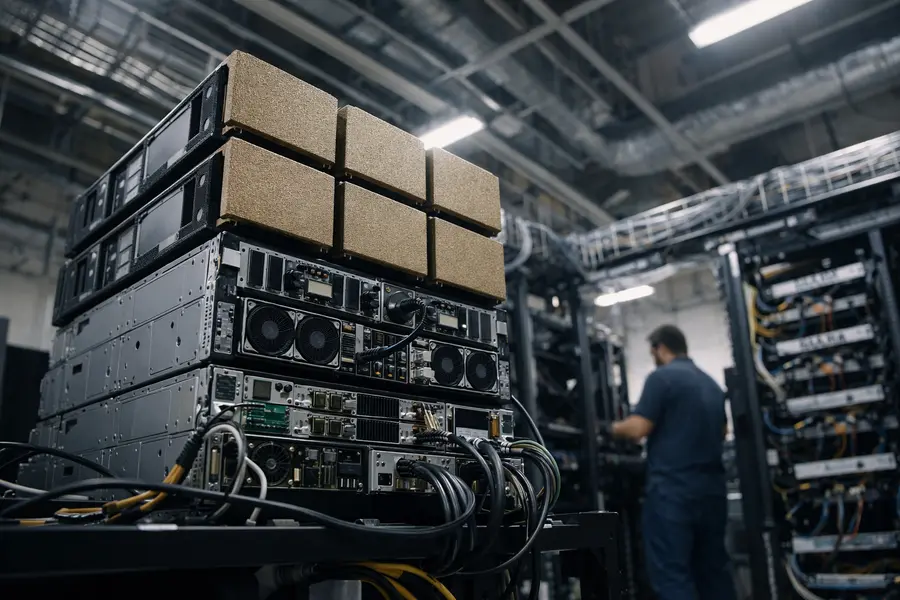
Nvidia's push to own the full AI stack is narrowing the margin window for the very server makers it once depended on — leaving Dell, HPE, and Supermicro to fight over rack assembly while Nvidia captures the high-value design layer.
- Nvidia CEO Jensen Huang has declared the company "a vertically integrated computing company," signaling a permanent strategic shift.
- GB300-generation systems ship as pre-validated, factory-finished compute trays — reducing OEM design freedom to rack assembly and liquid-cooling configuration.
- Analysts flag incremental allocation risk for server partners as Nvidia centralizes production with select certified manufacturers.
Lead
Nvidia is methodically absorbing the most profitable layers of the AI server market. With the GB300 Grace Blackwell Ultra superchip now in mass production and the Vera Rubin platform entering volume output later this year, the company is shipping complete, factory-validated compute trays — preconfigured with CPUs, accelerators, memory, networking, and power — that leave traditional server manufacturers with progressively less to engineer. The pivot, confirmed by CEO Jensen Huang at GTC 2026 as a bid to "own every layer of the AI factory," is rewriting the economics for Dell Technologies, Hewlett Packard Enterprise, Super Micro Computer, and Lenovo at precisely the moment AI server demand is at its strongest.
What Happened
The structural break became visible when Nvidia began shipping its GB300 NVL72 systems — 72 Blackwell Ultra GPUs paired with 36 Grace CPUs, 252 GB of HBM3e, and 496 GB of LPDDR5X — as fully finished L10 compute trays. Partners assemble racks, configure cooling sidecars, and run final certifications. Core hardware design, the historically lucrative step, now belongs to Nvidia.
Wistron's $700 million D1 AI smart facility in Fort Worth, Texas, which opened in July 2026, is the clearest operational signal: the 324,000-square-foot plant is the first U.S. site to mass-produce GB300 Grace Blackwell Ultra Superchips, scaling to tens of thousands of boards per month. Wistron is a contract manufacturer working directly to Nvidia's specification — not an OEM designing its own server architecture.
The forthcoming Vera Rubin VR200, entering volume production in late 2026, extends this logic further. TrendForce analysis projects that value and margin will continue migrating toward certified component makers and high-volume integrators, leaving branded OEMs with narrower differentiation and compressed gross margins.
Strategic Context
Huang has framed the strategy in explicit terms: Nvidia is "vertically integrated but horizontally open" — meaning partners can attach to the platform, but the core stack, silicon, systems software, networking fabric, and increasingly the physical server chassis — is Nvidia's domain. The company's Compute & Networking segment posted $115 billion in fiscal year 2025 revenue; its OEM and Other segment totaled $389 million. The asymmetry tells the story.
The shift did not happen overnight. When Super Micro Computer encountered accounting irregularities and compliance delays in 2024–2025, Nvidia redistributed allocations toward Dell and HPE, demonstrating the leverage it holds over every link in the supply chain. Server OEMs do not have alternative GPU suppliers at comparable performance levels. AMD's Instinct MI300 and Intel's Gaudi line compete at the margins but have not broken Nvidia's commanding share of hyperscale AI deployments.
AI and Technology Angle
The GB300 and the broader Blackwell Ultra architecture represent a generation built for server integration from the silicon layer up. The Grace Blackwell pairing — Nvidia's own Arm-based CPU alongside the accelerator — eliminates the need for third-party host processors in AI training and inference configurations. When Nvidia supplies the CPU, the GPU, the interconnect fabric (NVLink), and the system software (CUDA, NIM microservices), the value proposition of an OEM's own motherboard engineering approaches zero for leading hyperscale buyers.
CoreWeave became the first cloud provider to deploy GB300 NVL72 systems in July 2025, receiving hardware built by Dell to Nvidia's specification rather than Dell's own design. The transaction underscores the new hierarchy: Dell as a certified assembler, not a system architect.
The upcoming Vera CPU, detailed by Nvidia in July 2026, extends the company's footprint into the host-compute layer that AMD EPYC and Intel Xeon currently dominate in AI server racks. Combined with Rubin accelerators, a full Nvidia-designed processing environment becomes commercially viable for hyperscalers seeking supply-chain simplicity.
Market Reaction
Server OEM stocks have reflected the competitive anxiety. Supermicro has faced compounded pressure from its accounting investigation and from Nvidia's demonstrated willingness to redirect allocations. HPE and Dell carry more diversified revenue bases — enterprise IT services, storage, networking — but their AI server divisions are increasingly defined by Nvidia's architectural decisions rather than their own.
Hyperscale demand has remained robust enough to sustain shipment volumes across the OEM tier. Microsoft, Meta, and CoreWeave have signed multi-billion-dollar AI infrastructure agreements anchored to GB300 systems. The volume supports OEM revenues in the near term. The concern among analysts is margin trajectory as Nvidia tightens its hold on system design.
Outlook
The economics of the AI server market are being reset. Nvidia's vertical integration strategy — embodied in the GB300 architecture and accelerating with Vera Rubin — is concentrating design value at the silicon and systems layer while commoditizing rack assembly for traditional OEM partners. Dell, HPE, Supermicro, and Lenovo retain relevance as certified manufacturers and enterprise service providers, but their ability to command premium margins on hardware design is structurally diminished. The competitive differentiation available to server partners is shifting toward AIOps tooling, liquid-cooling expertise, and deployment services — capabilities further from their core engineering heritage. With the Vera Rubin VR200 entering volume production before year-end, the margin pressure visible in current quarters is likely to intensify rather than ease.