Pomegra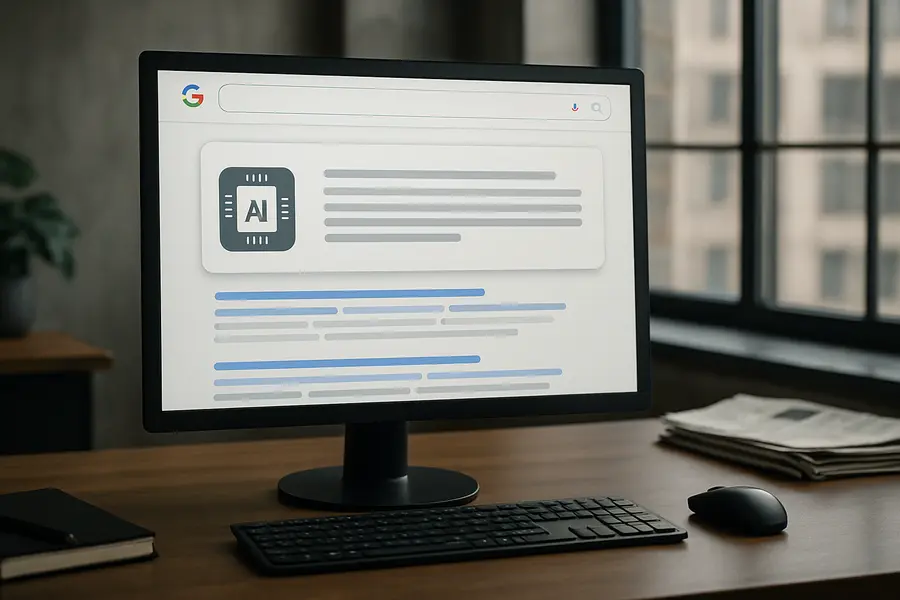
Google's biggest Search overhaul in 30 years makes AI-generated answers the default at Google IO 2026, reaching 1 billion users as organic click rates collapse.
- AI Mode, Google's conversational search engine, crossed 1 billion monthly users in a single year, with a 93% zero-click rate on AI-answered queries.
- Google Search revenue rose 19% to $60.4 billion in Q1 2026 even as organic CTR for SEO-dependent publishers fell 61%.
- Sites cited inside AI Overviews earn 35% more organic clicks than uncited top-10 rankings, redefining what SEO impact means.
Lead
Google (GOOGL) unveiled the most sweeping redesign of its flagship search product in nearly three decades at Google IO 2026 on May 19, replacing the familiar list of blue links with AI-generated answers, visualizations, and autonomous research agents. CEO Sundar Pichai told developers at Shoreline Amphitheatre that AI Mode — the company's conversational search layer — had crossed 1 billion monthly users in its first year, while AI Overviews, the summary panel that appears above traditional results, now reaches 2.5 billion users every month. The announcements mark a structural inflection point for the $200 billion-a-year digital advertising industry and for the decades-old discipline of search engine optimization (SEO).What Happened at Google IO
Pichai opened the keynote by declaring Google "firmly in our agentic Gemini era," a phrase that previewed more than 100 product announcements anchored by a wholesale reimagining of AI search. The redesigned interface, powered by Gemini 3.5 Flash, accepts not just text queries but images, files, video clips, and open browser tabs. Instead of returning ten ranked links, it synthesizes a custom answer page, invites follow-up questions, and can dispatch persistent "information agents" that monitor the web continuously on a user's behalf.
AI Mode is now the global default experience. Traditional organic results remain accessible but are no longer the primary surface Google surfaces for the vast majority of navigational, informational, and transactional queries. The shift is the largest since Google introduced PageRank in 1998.
AI Mode grew roughly tenfold between November 2025 and May 2026 — from 100 million to 1 billion monthly users — as queries more than doubled every quarter. The speed of adoption has no precedent in Google's product history.SEO Impact: A Structural Reckoning
The SEO impact of the transition is measurable and severe for publishers reliant on unpaid traffic. Across all Google searches, 60% now end without a single click to any website; on mobile that share climbs to 77%. For queries routed through AI Mode specifically, the zero-click rate reaches 93%.
Organic click-through rates for pages that previously ranked in the top ten fell 61% — from 1.76% to 0.61% — after AI Overviews became the dominant result format. The decoupling between traditional ranking and AI-surface visibility has widened sharply: in mid-2025, roughly 75% of URLs cited in AI Overviews also appeared in the top 10 organic results; by February 2026 that overlap had collapsed to between 17% and 38%.
The shift has redistributed rather than destroyed value. Brands cited directly inside an AI Overview receive 35% more organic clicks and 91% more paid clicks than uncited competitors on the same results page. Visitors arriving via AI-mediated referral convert 42% better and generate 37% higher revenue per session, reflecting the higher purchase-intent of users whose questions have already been pre-qualified by the AI layer.
Financial and Market Reaction
The overhaul has not impaired Alphabet's core economics — at least not yet. Google Search revenue reached $60.4 billion in Q1 2026, up 19% year-over-year. Alphabet's consolidated revenue for the quarter totaled $109.9 billion, a 22% increase. The company attributed the search outperformance to AI experiences driving total query volume to record highs, even as the revenue-per-query model undergoes fundamental change.
GOOGL shares have absorbed the announcements without sustained selling pressure, as investors weigh near-term monetization strength against the longer-term question of whether AI-native advertising formats can match the economics of keyword auctions. The company's AI infrastructure consumed 3.2 quadrillion tokens per month as of May 2026 — a sevenfold increase year-over-year — signaling the scale of capital commitment underpinning the transition.Strategic Context
The redesign reflects a competitive response as much as an internal evolution. Microsoft (MSFT) integrated OpenAI's models into Bing in 2023; Perplexity and a cohort of AI-native search products have attracted users seeking conversational interfaces. Google's answer is to absorb the conversational paradigm inside its own product rather than cede the format to rivals.
Gemini 3.5 Flash serves as the inference backbone for the new search experience — a deliberate choice of a faster, cheaper model over maximum capability, prioritizing response latency at billions-of-queries-per-day scale. The same model infrastructure supports Gemini's broader consumer applications, now used by approximately 900 million monthly users across Google's product suite.For the advertising industry, the transition raises unresolved questions about attribution, brand safety inside AI-generated summaries, and the pricing of citations versus keyword positions. Google has signaled that sponsored citations within AI Mode are a near-term monetization priority, though detailed formats and auction mechanics remain under development.
Geopolitical and Regulatory Dimension
The consolidation of information retrieval inside a single AI layer controlled by one company has drawn renewed regulatory attention. The European Union's Digital Markets Act and ongoing antitrust proceedings in the United States both scrutinize Google's default status in browsers and operating systems; the AI Mode rollout extends that default logic into a new content format. Regulators in Brussels and Washington are expected to examine whether AI-generated summaries constitute a new form of self-preferencing that disadvantages third-party publishers and rival search providers.
Outlook
The Google IO 2026 announcements confirm that AI search is no longer an experimental overlay but the primary product Google intends to offer its more than 4.5 billion users. For publishers, agencies, and brands, the operating implication is clear: SEO strategies built around ranked links are structurally impaired, while AI citation strategies — producing content authoritative enough to be referenced inside Gemini's answers — represent the new competitive surface. Alphabet's near-term financials suggest the transition is revenue-accretive so far, but the durability of that outcome depends on whether AI-native ad formats can replicate the precision and yield of keyword-based auctions that have underpinned Google's business model for 25 years.
Technology