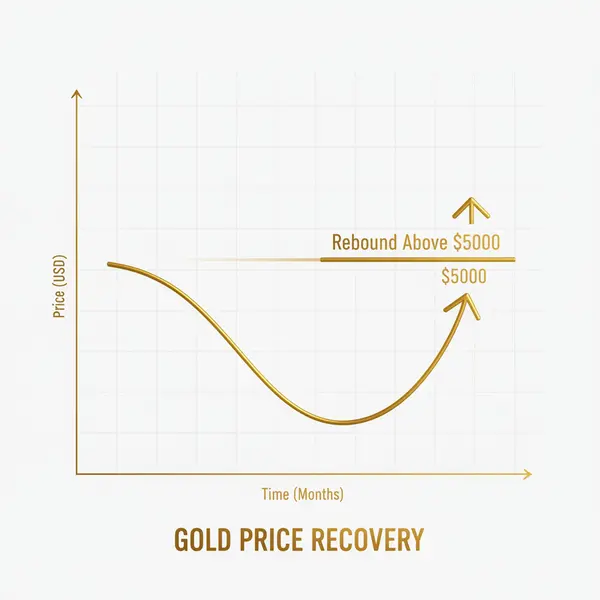
Gold surged back above the crucial $5,000 threshold on February 4, 2026, extending a dramatic two-day recovery following last week's historic collapse from record highs. The precious metal climbed 2.8% to $5,078 per ounce in early Wednesday trading, building on Tuesday's 6% rally.
Powerful Recovery Momentum
Most-active gold futures jumped to $5,078 during Wednesday morning trading, marking the strongest two-day performance in over two decades. The precious metal has recovered approximately 17% from Friday's low of $4,300, when panic selling triggered the biggest single-day drop since 2013.
Trading volume exceeded 180,000 contracts in the first three hours of New York trading, nearly triple the typical morning activity.
Technical Rebound Attracts Buyers
Market technicians noted that gold's bounce from the 50-day
exponential moving average at $4,450 provided critical support for the recovery. The yellow metal broke through key resistance levels at $4,800 and $4,950 before reclaiming the psychologically important $5,000 mark.
Commodity strategists at TD Securities indicated that forced
liquidation has likely concluded, creating conditions for renewed buying interest.
Retail and Institutional Demand Returns
Dip buying activity intensified across multiple investor categories as prices stabilized.
Western retail investors who had been major contributors to January's record rally returned to purchase gold near technical support levels.
Exchange-traded fund flows showed mixed signals, with Chinese gold ETFs experiencing $1 billion in outflows Tuesday while
American gold funds attracted $420 million in new investment.
Dollar Weakness Supports Recovery
The US Dollar Index declined 0.3% to 108.2, providing additional tailwinds for dollar-denominated commodities.
Currency markets reflected reduced safe-haven demand for the greenback as equity markets stabilized.
Federal Reserve policy expectations remained unchanged, with markets pricing in two quarter-point rate cuts by year-end.
Analyst Price Targets Remain Elevated
Deutsche Bank reaffirmed its $6,000 gold price target despite recent volatility, citing structural demand from central banks and
inflation hedging needs.
Goldman Sachs analysts maintained their year-end forecast of $5,400, noting "significant upside risk" to precious metals.
JPMorgan and
UBS project gold reaching $6,200-$6,300 levels by December 2026.
Silver Outperforms with 7.6% Gain
Silver futures surged 7.6% to $88.20 per ounce, outpacing gold's recovery as
industrial demand combined with speculative interest.
Platinum advanced 4.1% to $1,145 while
palladium gained 3.8% to $1,280. The
precious metals complex demonstrated broad-based strength after last week's coordinated selloff.
Options Market Activity Intensifies
Call option volume for February and March gold contracts exceeded 45,000 contracts, suggesting renewed bullish positioning.
Put-call ratios normalized from extreme levels reached during Friday's panic, indicating
market sentiment stabilization.
Volatility measures remained elevated at 28%, double typical levels but down from Friday's peak of 42%.
Market outlook for gold remains constructive despite recent turbulence, with
fundamental drivers including central bank purchasing, geopolitical tensions, and
inflation concerns providing support for higher prices. The successful defense of technical support levels has reinforced confidence among
commodity investors that the longer-term uptrend remains intact.
Mentioned tickers: GC=F, SI=F, DX-Y.NYB
 Pomegra