 Pomegra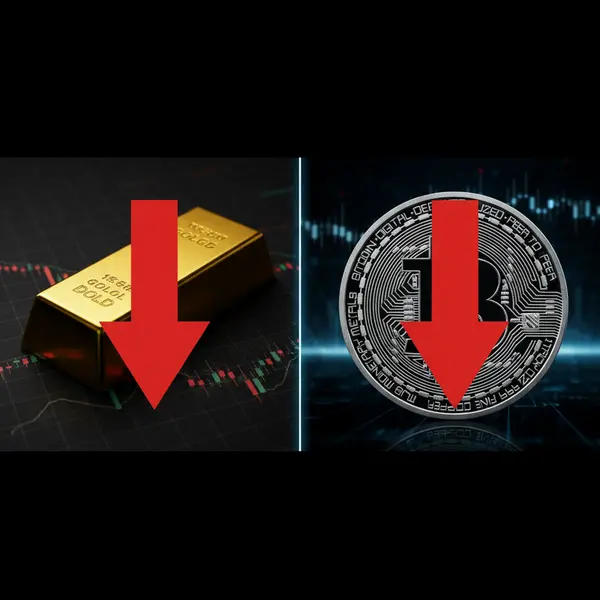
A Synchronized Retreat From Hard Assets
Simultaneous capital outflows from both Bitcoin ETFs and gold ETFs in May 2026 are pointing to the unwinding of one of Wall Street's most prominent macro strategies of the past two years. JPMorgan strategist Nikolaos Panigirtzoglou, who first identified and popularized the "debasement trade" concept in October 2024, declared on May 28, 2026 that investors have now moved on from the theme entirely. Bitcoin (BTC) traded near $72,779 on Thursday, down more than 4.9% month-to-date, while gold slid 2.3% in Shanghai trade before rebounding from a fresh 9-week low in London — still off 5.3% in May.
- US spot Bitcoin ETFs lost $2.26 billion in cumulative net outflows over two weeks in May 2026, including a single-day record exit of $635 million on May 13.
- Global physically backed gold ETFs posted $12 billion in record outflows in March 2026; renewed selling resumed in May after a partial $6.6 billion recovery in April.
- JPMorgan cites growing expectations of a U.S.–Iran diplomatic deal and cooling inflation hedging demand as the primary drivers of the joint pullback.
What Is the Debasement Trade?
The debasement trade is Wall Street shorthand for positioning in hard assets as a hedge against government fiscal expansion and currency erosion. The underlying thesis is straightforward: persistent sovereign debt accumulation, combined with accommodative monetary policy, gradually erodes the purchasing power of fiat currencies, elevating demand for scarce stores of value like gold and Bitcoin. The trade gained significant traction amid the geopolitical shock of renewed Middle East conflict beginning at the end of February 2026, which sent oil prices higher and rekindled inflation fears across global markets.
The trade's cultural footprint was substantial at its peak. The media-monitoring platform Factiva tracked 502 published articles referencing the debasement trade in October 2024 alone. By April 2026 that figure had dropped to just 27, recovering only modestly to 34 in May — a signal that the market narrative has shifted decisively.
ETF Flow Data Tells the Story
The scale of the capital withdrawal is significant. US spot Bitcoin ETFs hemorrhaged $635 million in a single session on May 13 — the largest single-day outflow since January 29 — and cumulative two-week net outflows from the segment reached $2.26 billion. BlackRock's iShares Bitcoin Trust (IBIT) and Fidelity's FBTC accounted for the most substantial share of those withdrawals.
Gold ETFs are experiencing parallel pressure. Global physically backed gold funds saw record outflows of $12 billion in March 2026, with North American investors alone responsible for $13 billion in redemptions. An April rebound of $6.6 billion in net inflows offered temporary relief, but renewed selling re-emerged across parts of May. Gold's monthly price trajectory showed its steepest decline since May 2021, outside of March 2026's 11.8% collapse — the worst single-month performance since the gold crash of spring 2013.The depth of the Bitcoin price correction over late 2025 into early 2026 provides additional context. BTC fell 36% during that period, yet Bitcoin ETF holdings contracted by only 3.6%, suggesting that structural institutional conviction in the asset held up even as prices declined sharply. The current outflow cycle therefore represents a more deliberate macro-driven repositioning rather than panic selling.
Institutional Futures Positioning Weakens
The retreat is not limited to exchange-traded funds. Panigirtzoglou highlighted that institutional positioning in CME Bitcoin futures — the primary vehicle through which large allocators have expressed the debasement view — has also softened materially over the same two-week period. Gold futures positions on CME have weakened in parallel. Momentum-driven traders, who had accumulated length in both assets, have reduced exposure.
Critically, JPMorgan's analysis finds no evidence that investors are rotating capital out of Bitcoin and into gold. Both inflation hedges are losing allocation simultaneously, which the bank characterizes as a coordinated macro hedge unwinding rather than a tactical rebalancing between asset classes.
Iran-U.S. Diplomacy and a Shifting Macro Backdrop
The trigger for the debasement trade's unraveling appears to be a confluence of geopolitical de-escalation signals and evolving macroeconomic data. JPMorgan's report points to growing market expectations of a U.S.–Iran peace deal, brokered through Pakistan-mediated talks. With a diplomatic resolution potentially reducing the oil price shock that initially accelerated inflation fears, the core rationale for holding debasement hedges is diminishing.
The macro picture, however, is not uniformly risk-positive. The US PCE inflation index for April rose 3.8% year-on-year — the highest level since 2023 — while US GDP growth for Q1 2026 was revised down 0.4 percentage points to a 1.6% annualized rate. Durable goods orders surged 7.9% in April, but initial and continuing jobless claims beat analyst forecasts on the high side. These stagflationary crosscurrents complicate the picture even as investors step back from classical debasement positioning.
The US dollar DXY index has gained approximately 1% on a trade-weighted basis since the start of the Iran conflict, offering marginal macro support. ING currency strategist Francesco Pesole noted that "hot US inflation data continues to feed through rates and FX, keeping Fed expectations stickier on the hawkish side whenever oil sells off." That dynamic, alongside mounting peace deal speculation, is redirecting institutional flows from hard assets toward yield-bearing instruments.
The Long Arc Remains Intact
Despite the near-term outflow cycle, the decade-long performance of both gold and Bitcoin underscores the structural case for each asset independent of the debasement narrative. Gold has quadrupled in value over the past decade. Bitcoin, which traded near $500 ten years ago, remains well above $72,000 even as it sits roughly 42% below its 2025 peak of $126,173. The current ETF outflow cycle reflects a tactical cooling of a macro theme, not an abandonment of the underlying asset class.
President Donald Trump reinforced his administration's pro-crypto stance on May 28, declaring on social media that "America is now the CRYPTO CAPITAL of the WORLD" and pledging that digital asset market structure legislation would be codified and made permanent.
As geopolitical risk premiums compress, and with the Federal Reserve holding a hawkish posture against a backdrop of sticky inflation and slowing growth, institutional capital is recalibrating its macro hedge toolkit. For now, both gold and Bitcoin are bearing the cost of that recalibration in equal measure.
Mentioned tickers: BTC, GC, IBIT, FBTC, DXY