Pomegra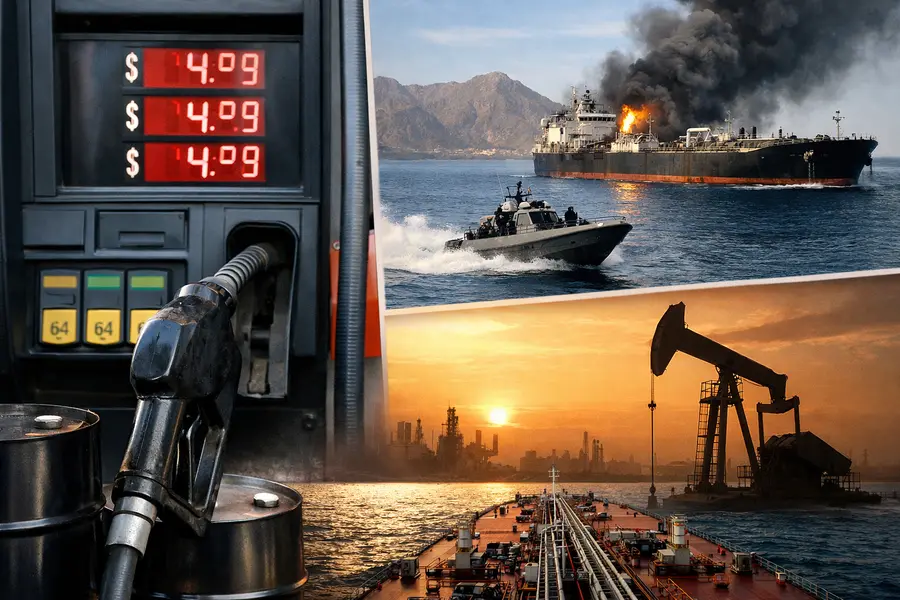
The U.S. gas average hit $4 a gallon July 20 as renewed airstrikes on Iran collapse the Islamabad ceasefire and effectively halt commercial tanker traffic through the Strait of Hormuz.
- National average regular gasoline climbed to $4.00/gallon on July 20, up from $3.87 last week; diesel jumped to $5.10.
- U.S. forces struck more than 80 targets inside Iran over July 12–13, ending the June 17 Islamabad Memorandum ceasefire.
- Brent crude extended above $90/barrel Monday; roughly 230 loaded oil tankers remain stranded inside the Persian Gulf.
Lead
American drivers are paying $4 a gallon for regular gasoline for the first time since mid-June, as a resumption of U.S. military strikes on Iran over the July 12–13 weekend ended a fragile ceasefire and choked renewed commercial passage through the Strait of Hormuz. The national average, which had fallen to $3.79 on July 7–8 while the Islamabad Memorandum appeared to hold, climbed back to $4.00 on Monday—its sharpest weekly rise since the war's opening days in late February 2026.
What Happened
The Islamabad Memorandum, signed June 17 by President Donald Trump and Iranian President Masoud Pezeshkian, had paused more than 100 days of open hostilities between the United States, Israel, and Iran. Under the agreement, the U.S. naval blockade of Iranian ports was to wind down and the Strait of Hormuz reopen to international shipping.
That framework disintegrated when U.S. forces struck more than 80 targets inside Iran over the July 12–13 weekend. Iran's Islamic Revolutionary Guard Corps responded by closing the Strait of Hormuz once more. On July 13, President Trump announced a new 20% cargo toll on any vessel transiting the waterway—a measure that has further deterred commercial operators from testing Iranian defenses.
Tanker traffic fell sharply. Just six vessels crossed the chokepoint in a 12-hour window on July 11, against 18 to 22 transits per day before fighting resumed. Roughly 230 loaded oil tankers are now stranded inside the Persian Gulf, unable to deliver their cargo to global markets.
Market Reaction
Brent crude climbed above $90 per barrel on Monday, extending the prior week's gains and trading roughly 30% above its July lows. West Texas Intermediate (WTI) rose in tandem, gaining nearly 8% to $77.10 in the most recent session. Crude is up more than 14% in the current week alone.At the pump, the effect arrived quickly. The national average for regular gasoline hit $4.00 on July 20, up from $3.87 a week earlier. Diesel jumped to $5.10 per gallon from $4.87. California, Hawaii, and Washington are all at or near $5.00 per gallon for regular grade. War-risk insurance premiums for Persian Gulf shipping routes have spiked, with most commercial carriers now requiring military escort to enter the contested waterway.
The Hormuz Chokepoint
Before the February 2026 outbreak of hostilities, the Strait of Hormuz served as the transit corridor for approximately 20–25% of the world's seaborne crude oil and 20% of global liquefied natural gas. The original closure following the war's opening strikes stranded production across Kuwait, Iraq, Saudi Arabia, and the United Arab Emirates, collectively cutting output by an estimated 10 million barrels per day by mid-March. Brent crude had surged above $120 per barrel before the June ceasefire allowed cautious resumption of tanker traffic and helped prices ease toward $80.
The collapse of the Islamabad Memorandum has effectively reset that disruption, with vessel operators and insurers unwilling to transit a waterway actively contested by Iranian naval and aerial forces.
Strategic Context
The broader conflict traces to failed nuclear negotiations in Geneva in late 2025 and an earlier 12-day Israeli-Iranian air exchange. The February 28 launch of a U.S.-Israeli air campaign against Iran's nuclear and military infrastructure marked the formal onset of hostilities that have now lasted nearly five months.
Renewed fighting dims the prospects for the peace deal that negotiators had described as nearly finalized. Iran's Foreign Ministry has stated it received fresh proposals from international mediators, while simultaneously declaring the ceasefire effectively collapsed—a pattern of deliberate ambiguity designed to preserve Tehran's negotiating leverage over both the U.S. naval posture and any final nuclear accord.
The sustained surge in gas prices today arrives against an already strained U.S. macroeconomic backdrop. Personal consumption expenditure inflation was running well above the Federal Reserve's 2% target through the first half of 2026, and a renewed oil spike compounds the central bank's task.
What Comes Next
Energy markets broadly expect that restoring pre-war price levels will require far more than a renewed ceasefire. The roughly 230 tankers stranded in the Gulf must be cleared, production across Gulf states must restart—a step producers are reluctant to take until a durable peace is established—and global inventories must be rebuilt from depleted levels. That process could extend well into 2027.
OPEC member states have not called an emergency session, constrained by their own production disruptions and uncertainty over whether any agreement will hold. The US Iran war news cycle now moves faster than energy infrastructure can respond.Outlook
The return of $4-a-gallon gasoline reflects a conflict still in active escalation. With Brent crude above $90, Strait of Hormuz shipping all but halted, and roughly 230 tankers stranded inside the Gulf, sustained oil market volatility is the baseline scenario for as long as U.S. and Iranian forces continue to exchange strikes. Peace talks remain nominally alive but structurally fragile—and markets are no longer giving diplomacy the benefit of the doubt.
Mentioned tickers: XOM, CVX, USO, OXY, HAL