Pomegra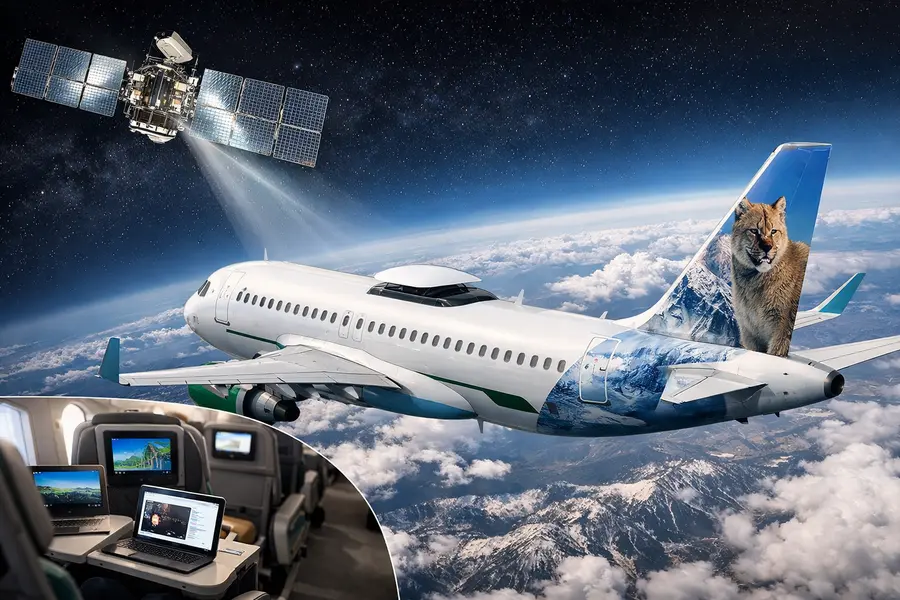
Frontier Airlines announced a deal with SpaceX's Starlink to bring high-speed inflight Wi-Fi to its fleet beginning in early 2027, joining nearly every major U.S. carrier in the Starlink aviation wave.
- Frontier, one of the last U.S. holdouts on inflight Wi-Fi, will debut SpaceX Starlink aviation service on its first aircraft in early 2027.
- The deal spans five Indigo Partners-backed airlines targeting Starlink installs on more than 1,000 aircraft combined.
- Frontier has not confirmed whether high speed inflight Wi-Fi will be offered free to passengers, unlike peers United and Alaska.
Lead
Frontier Airlines announced on July 14, 2026 that it will deploy SpaceX Starlink satellite internet across its fleet of approximately 176 Airbus single-aisle aircraft, with the first equipped plane set to enter service in early 2027. The Denver-based ultra-low-cost carrier becomes the latest U.S. airline to commit to Starlink aviation connectivity, ending years as one of the industry's most notable Wi-Fi holdouts. The announcement covers Frontier and four fellow carriers — Mexico's Volaris, European budget operator Wizz Air, Chile's JetSMART, and the Philippines' Cebu Pacific — all linked through private equity firm Indigo Partners, which plans to retrofit more than 1,000 aircraft across the group.What Happened
Frontier Chief Executive Jimmy Dempsey said the system will give customers "the flexibility to work, stream, browse, and stay connected throughout their journey." Beyond passenger service, the Starlink installation will extend gate-to-gate connectivity to pilots, flight attendants, maintenance crews, and ground operations — positioning the technology as an operational tool as much as a consumer amenity.
The carrier will be the first U.S. airline to offer passengers access to Starlink through an internet portal managed directly by the satellite provider, rather than through a third-party reseller arrangement. Financial terms of the deal were not disclosed. Frontier has not confirmed whether the service will be free to passengers; a spokeswoman declined to comment on pricing.
Strategic Context
Frontier's move closes one of the most visible capability gaps at a major U.S. carrier. Former CEO Barry Biffle had signaled reluctance to retrofit planes with earlier Wi-Fi hardware, citing aircraft weight concerns — a meaningful factor for a carrier whose business model is built around fuel efficiency and ancillary revenue. Starlink's lower-profile, lighter terminal equipment has since shifted the calculus, enabling budget operators to adopt the technology without the payload penalty of legacy satellite systems.
The Starlink deal arrives alongside a broader repositioning at Frontier. The airline has introduced first-class seating and expanded its Frontier Miles loyalty program, signaling a partial retreat from the pure ultra-low-cost model toward a more bundled product offering. High speed inflight Wi-Fi fits that trajectory, adding a tangible amenity that previously distinguished premium and legacy carriers.
Airline Industry Technology Landscape
The Frontier announcement underscores how thoroughly SpaceX Starlink aviation has reshaped the airline industry technology market for inflight connectivity. United Airlines leads U.S. deployments with more than 423 aircraft already equipped and a target of 1,000 planes by the end of 2026. Alaska Airlines and Hawaiian Airlines have jointly outfitted approximately 150 aircraft, offering the service free to eligible loyalty members. Southwest Airlines, which announced its Starlink partnership in February 2026, is beginning installations this summer with complimentary access for Rapid Rewards members. American Airlines committed to Starlink on more than 500 aircraft in May 2026.
The one conspicuous exception among large U.S. carriers is Delta Air Lines, which bypassed Starlink in favor of Amazon's connectivity platform — a deployment not expected until 2028 and covering only a portion of its fleet.
For Indigo Partners, the coordinated five-airline deal represents a scale play that improves negotiating leverage and enables a standardized rollout across geographically diverse markets spanning North America, Europe, Latin America, and Southeast Asia. Shared hardware specifications and a centralized Starlink-managed portal lower the integration burden for each individual carrier.
Outlook
Frontier's entry into high speed inflight Wi-Fi via Starlink closes the last meaningful gap between the airline and its low-cost peers on connectivity. Whether the carrier monetizes access through fees or follows industry peers toward complimentary service for loyalty members will determine how the product contributes to ancillary revenue. Starlink's direct management of the portal gives it greater influence over the passenger-facing experience than in traditional airline Wi-Fi arrangements. With installations commencing in early 2027 across the Indigo Partners network, the aviation connectivity market continues its rapid consolidation around the SpaceX platform.
Mentioned tickers: ULCC