Pomegra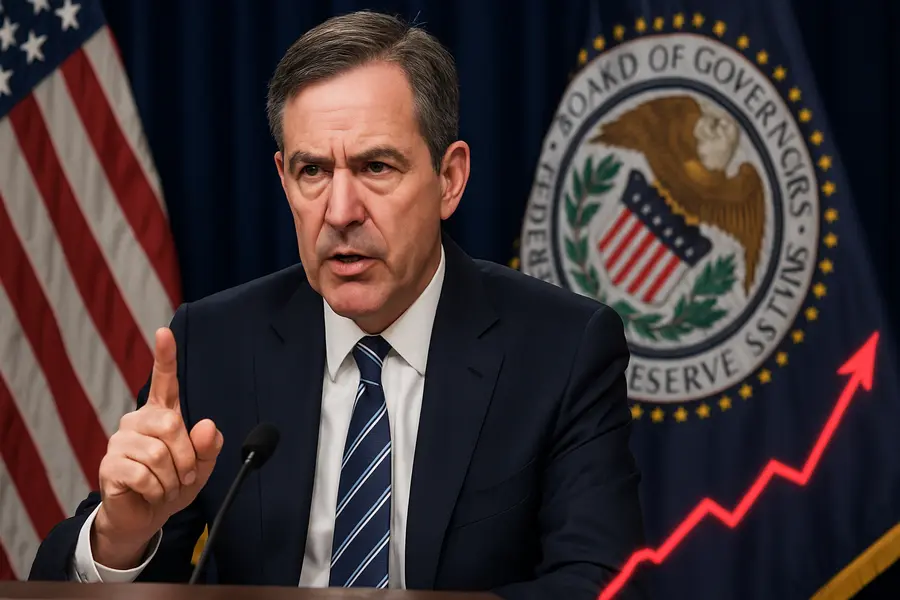
The Federal Reserve held rates at 3.50%–3.75% on June 17 but signaled possible 2026 hikes, sending Treasury yields higher and rattling Wall Street banks and foreign investors worldwide.
- Fed held rates at 3.50%–3.75%; nine of 18 FOMC members now project at least one rate hike in 2026.
- The 2-year Treasury yield jumped 11 basis points to 4.153%; the S&P 500 fell 1.2% on the hawkish signal.
- Goldman Sachs and JPMorgan have abandoned 2026 rate-cut forecasts; traders price in a hike as early as October.
Lead
The Federal Open Market Committee voted unanimously on June 17 to hold its benchmark overnight borrowing rate in the 3.50%–3.75% range, but the meeting delivered a sharply hawkish Fed decision that wrong-footed markets positioned for eventual easing. The updated dot plot — the grid showing individual policymakers' anonymous rate projections — pushed the median year-end 2026 federal funds rate estimate to 3.8%, up from 3.4% in March, as nine of 18 participating officials backed at least one rate increase before December. Wall Street Fed news teams and trading desks spent much of the session repricing risk across asset classes.
What Happened
New Federal Reserve Chair Kevin Warsh, making his debut at the helm of the FOMC, overhauled the post-meeting statement format and formally abolished traditional forward guidance. Warsh told reporters that financial markets function most efficiently when they react directly to incoming economic data rather than to central bank signals — a structural departure from the communication framework his predecessor built over a decade.
The statement itself was dramatically shorter and stripped of language indicating a bias toward future cuts. The dot grid erased the previous March projection of one 2026 cut entirely, deferring any reduction to 2027 or 2028. Eight participants penciled in no change for the remainder of the year; one retained a cut; nine called for at least one hike.
FOMC interest rates remain at their fourth consecutive pause level, but the internal distribution of projections was the hawkish shock that markets had not fully priced. Headline inflation remains sticky, and labor market data released ahead of the meeting continued to outperform expectations, narrowing the Fed's path to easing and widening the debate over whether a 2026 hike is plausible.Market Reaction
The immediate selloff was broad and orderly. The S&P 500 dropped 1.2%, the Nasdaq 100 fell 1.0%, and the U.S. dollar index strengthened as investors priced out residual cut expectations. Treasury markets bore the sharpest repricing: the 2-year yield — most sensitive to near-term policy expectations — climbed nearly 11 basis points to 4.153%, while the 10-year yield added 4 basis points to 4.469%. The 30-year Treasury yield crossed above 5.0%, a level that historically signals elevated term premium.
Overnight, Asian equities and bonds faced fresh headwinds. Bloomberg flagged that the hawkish tone was set to pressure regional government bonds at the open, particularly in markets with high concentrations of U.S. dollar-denominated debt. Foreign investors, already cautious about dollar-hedging costs at current levels, face a deteriorating carry environment if the Fed proceeds with a 2026 hike.
Traders are now pricing a potential rate increase as early as October, according to federal funds futures markets — a dramatic shift from the start of 2026, when consensus called for two 25-basis-point cuts by year-end.
Wall Street Divide
The bond market outlook on Wall Street split along a familiar fault line. Goldman Sachs Asset Management's global co-head of fixed income described the results as reflecting a strong labor market and inflation backdrop that justifies half the committee expecting hikes this year. Goldman Sachs economists revised away their 2026 cut forecasts following stronger-than-expected June employment data and now push the bank's first easing call to June 2027. Their base case holds that the Fed narrowly avoids hiking, but they acknowledge the incoming inflation data will carry unusually high stakes.
JPMorgan takes a slightly more structured view, maintaining that the Fed holds through year-end with a first hike of 25 basis points arriving in September 2027. Both institutions have effectively converged on a no-cut, no-hike baseline for the remainder of 2026, leaving October as the key event risk that could break the stalemate.Foreign Investor Pressure
The hawkish pivot adds complexity for international capital flows into U.S. Treasuries. Foreign demand for long-dated U.S. debt has been a structural pillar of the market, but a more unpredictable Fed — one that has now abandoned explicit forward guidance — raises the uncertainty premium that overseas buyers must absorb. Dollar strength post-decision increases hedging costs for Japanese, European, and emerging-market holders of dollar-denominated assets, compressing returns on an already thin-margin trade.
Treasury International Capital data will be closely watched in coming weeks for evidence of a shift in foreign allocation, particularly from East Asian reserve managers who have historically absorbed the bulk of long-duration issuance.
Warsh's New Playbook
Beyond the rate decision itself, the FOMC announced the formation of task forces to overhaul major Federal Reserve operational frameworks — from balance sheet strategy to its policy review cycle. Warsh has made clear that the era of highly scripted, guidance-heavy central banking is over. That unpredictability, strategists note, may itself function as a form of tightening: uncertainty raises the required return on risk assets and restrains credit extension without a single basis-point move.
Outlook
The June FOMC interest rates decision marks a definitive turning point for the 2026 policy calendar. With nine officials backing hikes, no cuts signaled before 2027, and a new chair who has explicitly retired forward guidance, Wall Street banks and foreign investors are navigating the most open-ended Fed environment in years. The bond market outlook hinges on the next two CPI prints before the July meeting: a third consecutive above-consensus inflation reading would bring an October hike into mainstream forecasts. Until then, elevated yields, a firm dollar, and compressed risk appetite are likely to persist as the dominant market regime.
Mentioned tickers: SPX, NDX, TNX, TLT, DXY, GS, JPM