Pomegra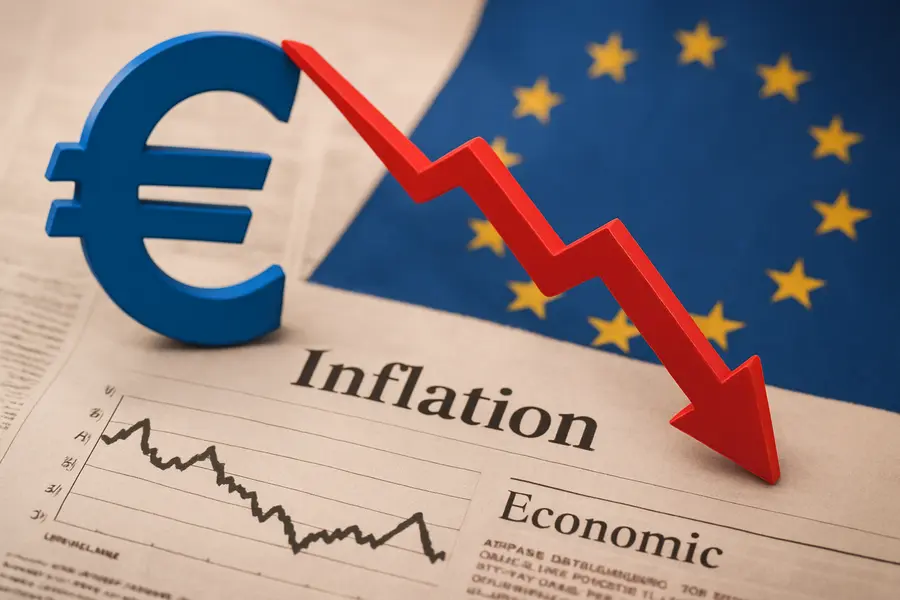
Now I have sufficient data. Writing the article.
- Euro zone inflation declined in June for the first time since the Iran war erupted in early March 2026, breaking a sequence that peaked at 3.2% in May.
- Energy costs, which posted annual gains above 10% since the conflict, are easing as oil prices fell roughly 20% from 2026 highs on U.S.-Iran ceasefire optimism.
- The ECB raised its deposit rate 25 basis points to 2.25% in June 2026 and does not project inflation to return to its 2% target until 2028.
---
Euro zone inflation slowed in June for the first time since the Iran war began in March, marking the first step toward the ECB's 2% inflation target after four months of accelerating prices.
Lead
The euro zone recorded its first Eurozone inflation slowdown since the United States and Israel struck Iran in early March 2026, according to Eurostat's June flash estimate released Friday. The reading ended a four-month sequence of accelerating consumer prices driven overwhelmingly by the Iran war economic impact on global energy supply chains. Annual headline inflation had reached 3.2% in May—its highest point since the conflict's outbreak—before retreating in June as oil benchmarks pulled back sharply from their 2026 peaks.
What Happened
The economic shock arrived almost immediately after the first airstrikes on March 2. Oil benchmarks surged 10–13% within hours, and Dutch TTF natural gas futures—the European economy's principal gas price reference—nearly doubled to more than €60 per megawatt-hour by mid-March. The disruption was amplified by Europe's structural vulnerability: natural gas storage stood at just 46 billion cubic metres at end-February 2026, sharply below the 60 bcm on hand a year earlier and well short of the 77 bcm recorded at the same point in 2024.
From a baseline of 2.1% in December 2025, euro zone annual inflation accelerated to 3.0% in April 2026 and climbed to 3.2% in May. Energy drove the surge, posting an annual rate of 10.9% in May. Services inflation rose to 3.5%, reflecting second-round cost pass-through. Non-energy industrial goods, by contrast, remained contained at 0.9%, and food, alcohol, and tobacco eased to 2.0% from 2.4% in April.
The June flash estimate marks the first break in that sequence. Brent crude has retreated roughly 20% from its 2026 highs as investors priced in a durable ceasefire between Washington and Tehran, announced by U.S. President Donald Trump on April 7–8. Traffic through the Strait of Hormuz—through which approximately one-fifth of global oil flows travel—has partially resumed, though tanker volumes remain well below pre-war levels.
ECB's Dilemma
The ECB inflation target of 2.0% became an effective medium-term aspiration rather than a near-term anchor from the moment the energy shock hit. At both its March and April 2026 meetings, the European Central Bank held its three key rates steady at 2.0%, treating the surge as a supply-driven shock that monetary policy could not resolve and that it expected to fade. By June 11, however, with services inflation proving stickier than projected, the Governing Council moved, raising the deposit facility rate by 25 basis points to 2.25%, the main refinancing rate to 2.40%, and the marginal lending facility to 2.65%.
The ECB's June 2026 Eurosystem staff projections embody the challenge ahead. Headline inflation is expected to average 3.0% across the full year, easing to 2.3% in 2027 before returning to the 2% target only in 2028. Core inflation—excluding energy and food—is seen averaging 2.5% in both 2026 and 2027, underscoring the breadth of cost pressures that have moved beyond the energy sector.
Geopolitical Dimension
Despite the ceasefire, the Iran war economic impact on the European economy has not been fully unwound. EU Energy Commissioner Dan Jørgensen stated publicly that a return to pre-war energy market conditions is not foreseeable in the near term even under a lasting peace. Chemical and steel manufacturers across the bloc have imposed input-cost surcharges of up to 30% to offset surging electricity and feedstock costs, rippling across industrial supply chains. Germany and Italy—the region's most energy-intensive major economies—face elevated risk of a technical recession in the second half of 2026.
European institutions have responded with structural measures: the Commission is accelerating a review of strategic gas reserve mandates and emergency procurement frameworks, while several member states have extended the operational life of coal-fired capacity and fast-tracked new liquefied natural gas terminal projects. The International Energy Agency characterised the disruption caused by the conflict as the greatest global energy security challenge in the history of oil markets.
Market Reaction
European sovereign bonds rallied modestly on the June flash release, with the German 10-year Bund yield pulling back as markets trimmed expectations for further ECB tightening in the near term. The euro strengthened against the U.S. dollar. Energy-intensive equities in chemicals and automotive sectors outperformed broader indices as investors reassessed peak cost exposure. European energy majors trading on Amsterdam, London, and Paris exchanges saw limited moves, as the oil price decline had already been partially reflected in prior sessions.
Outlook
The June reading represents a first relief, not a resolution. The Eurozone inflation slowdown is contingent on three conditions holding simultaneously: oil prices sustaining their retreat from 2026 highs, Strait of Hormuz transit recovering toward normal volumes before winter, and European gas storage rebuilding at an adequate pace for the 2026–2027 heating season. The ECB's own projections set the return to the ECB inflation target no earlier than 2028, with substantial upside risk tied to geopolitical developments over which the Governing Council has no influence. For households and businesses across the European economy, the worst of the inflation shock may have passed—but the path back to price stability runs through two more years of above-target readings.