Pomegra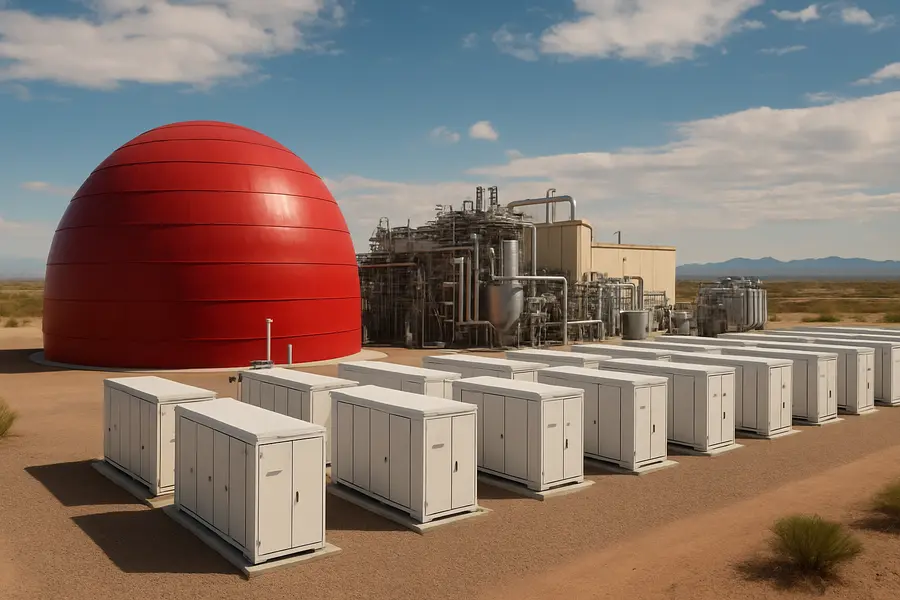
Energy Dome and Salt River Project signed a 20-year deal to deploy a 19 MW CO2 battery in Arizona, backed by Google as part of its 2030 carbon-free energy push.
- Energy Dome and SRP signed a 20-year tolling agreement for a 19 MW, 10-hour CO2 battery at Coronado Generating Station in St. Johns, Arizona.
- Google, a strategic investor in Energy Dome since July 2025, is co-funding the Coronado project through a capital cost-sharing arrangement.
- The installation marks the first utility-scale CO2 battery deployment in the United States, offering a non-lithium alternative for long-duration storage.
Lead
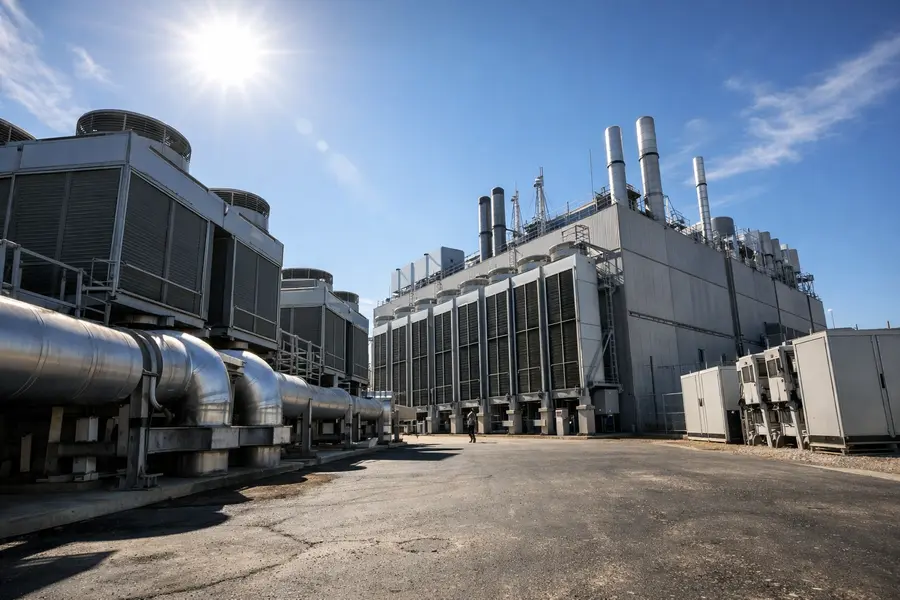
Energy Dome and Salt River Project (SRP) announced on June 15, 2026 a 20-year tolling agreement to deploy a 19-megawatt, 10-hour-duration CO2 battery at SRP's Coronado Generating Station in St. Johns, Arizona. The project—co-funded by Google—extends a commercial partnership first signed in July 2025 and places the first utility-scale CO2 battery on a U.S. grid, advancing the case for long-duration storage as a viable alternative to lithium-ion systems.What Happened
Under the agreement, Energy Dome will own and operate the storage facility while SRP retains dispatch rights over its output, sufficient to power roughly 4,275 homes for 10 consecutive hours. The system relies on a closed-loop thermomechanical process: surplus grid electricity compresses carbon dioxide, which is later released through a turbine to regenerate power on demand. The cycle produces no chemical byproducts, avoids cell degradation, and removes lithium and cobalt from the supply chain entirely.
SRP issued a competitive request for proposals in 2024 specifically targeting non-lithium, long-duration storage with a minimum 10-hour duration. Energy Dome won the selection over rival technologies including compressed air, gravity-based systems, and thermal storage.
Google's Role
Google formalized a strategic commercial agreement with Energy Dome in July 2025 and simultaneously took an equity stake in the company. Under the expanded arrangement disclosed alongside the SRP deal, Google is contributing to the capital cost of the Coronado project through a cost-sharing structure. The commitment sits inside Google's overarching goal to match all electricity consumption with carbon-free energy on a 24/7 hourly basis by 2030—a target that requires dispatchable long-duration storage capable of balancing solar and wind generation well beyond the two-to-four hour window covered by conventional battery cells.The Coronado facility functions as Google's flagship U.S. demonstration within a broader CO2 battery deployment program spanning Europe, the Americas, and Asia-Pacific.
Strategic Context
The project arrives as utilities and corporate energy buyers face growing pressure to move beyond renewable energy certificates toward verified, around-the-clock clean power. Lithium-ion batteries dominate short-duration grid storage but face fundamental limits on multi-hour discharge economics. Competing long-duration storage technologies—iron-flow, compressed air, gravity-based—have struggled to clear the threshold from pilot to commercial scale.
Energy Dome's CO2 battery, which operates at ambient temperature using a commodity gas in a sealed loop, is designed to sidestep the materials cost and degradation constraints that have limited rival chemistries. The 20-year tolling term reflects SRP's and Google's confidence in the technology's durability across a full commercial asset life.
SRP, one of the largest public power utilities in the United States, is converting Coronado—formerly a coal-fired station—into a renewable energy grid modernization hub. A separate 50 MWh iron-flow battery pilot announced in March 2026 with ESS Tech at SRP's Copper Crossing Energy and Research Center in Florence, Arizona, signals the utility hedging across multiple long-duration storage chemistries simultaneously.AI and Technology Angle
The Energy Dome Google partnership reflects the accelerating electricity demand of hyperscale data center and AI infrastructure. Continuous, uninterruptible power is a fundamental requirement for AI training and inference workloads—a profile that intermittent renewables cannot fulfill without storage. By co-funding dispatchable capacity through partners like Energy Dome and anchor utilities like SRP, Google is building a portfolio of clean firm power assets tied directly to its infrastructure footprint.
The CO2 battery's modular architecture also reduces permitting friction: unlike pumped hydro or compressed-air storage, deployments require no specific geological conditions, making them compatible with a wide range of data-center-adjacent sites on the renewable energy grid.
Outlook
Construction and commissioning at Coronado will proceed under SRP's dispatch timeline, with the 20-year revenue agreement providing Energy Dome a long-dated anchor as it scales deployments internationally. For SRP, the project is a concrete step in the transition from legacy generation toward a resilient, diversified renewable energy grid. For Google, each megawatt-hour of contracted dispatchable storage narrows the gap between stated 24/7 carbon-free ambition and operational reality—making the Energy Dome Google partnership one of the most substantive long-duration storage commitments on record for a corporate energy buyer.