Pomegra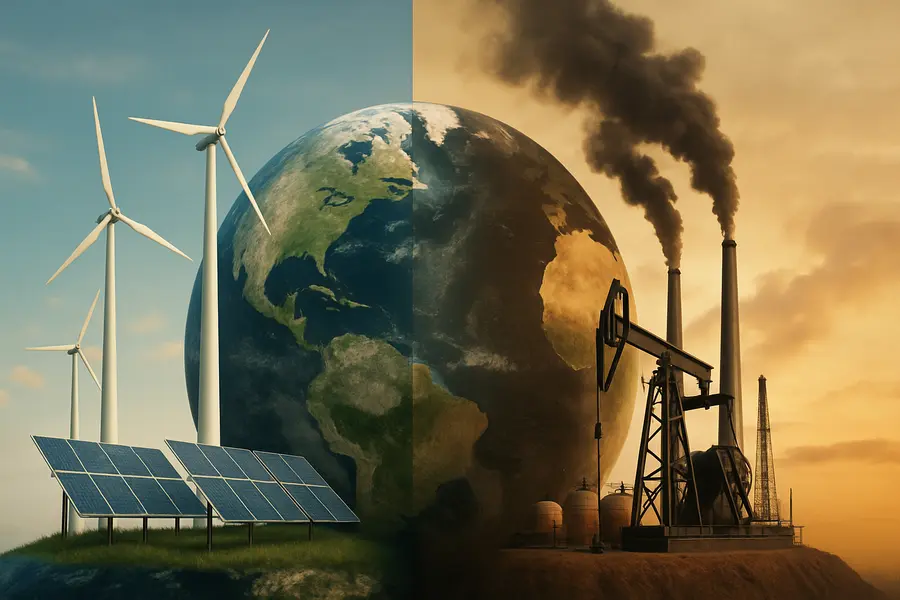
https://upload.wikimedia.org/wikipedia/commons/thumb/b/b8/Photovoltaik_Dachanlage_Hannover_-_Schwarze_Heide_-_1_MW.jpg/1280px-Photovoltaik_Dachanlage_Hannover_-_Schwarze_Heide_-_1_MW.jpg
- Renewables overtook coal in global electricity generation for the first time in over a century, reaching a 33.8% share versus coal's 33.0% in 2025.
- Global energy investment is set to hit $3.4 trillion in 2026, with clean energy commanding $2.2 trillion — nearly double fossil-fuel capital.
- The Paris Agreement's 1.5°C target is no longer achievable; Africa draws just 3% of global clean-energy capital despite holding 60% of the world's best solar resources.
The 2026 energy report cycle documents record clean-power investment and a century-first milestone in electricity generation, while exposing an accelerating divergence between wealthy and developing economies in the pace and reach of the global energy transition.
Lead
A cluster of major reports released in the first half of 2026 — the IEA Global Energy Review, Ember's Global Electricity Review, the RFF Global Energy Outlook, and BloombergNEF's Energy Transition Investment Trends — has produced the most comprehensive accounting yet of the global energy transition, and its findings are unambiguous on two counts: the structural shift in electricity generation is real and accelerating, and the path toward an equitable, coordinated decarbonization is fracturing along geographic and financial lines. Global energy-related CO2 emissions reached a record 38.4 billion tonnes in 2025, even as renewables claimed a historic plurality of world electricity supply.
What Happened
The year 2025 represented a structural inflection point in global power. Solar and wind together met nearly 99% of net growth in global electricity demand. Solar capacity additions hit a record 647 gigawatts, with the technology alone contributing 75% of total renewable capacity growth and meeting more than a quarter of global primary energy demand growth — the first time in recorded history that a single modern renewable source drove the largest share of annual demand expansion.
Ember's global data place renewables at 33.8% of global generation (10,730 terawatt-hours), narrowly ahead of coal's 33.0% (10,476 TWh) — the first time since the industrial revolution that coal has ceded the global electricity lead. Total fossil-fuel generation fell a marginal 0.2%, the first decline outside the COVID-19 lockdown year of 2020.
Battery storage was the fastest-growing power technology of 2025: capacity additions rose approximately 40% to nearly 110 gigawatts, exceeding the highest-ever single-year additions from natural gas. The combined share of low-emissions sources — renewables and nuclear — reached 43% of global electricity, the highest level in fifty years.Climate Policy: The 1.5°C Reckoning
Despite the deployment records, climate policy targets are drifting out of reach. Global energy-related CO2 emissions rose 0.4% in 2025 to 38.4 billion tonnes, a new high driven principally by natural gas, which contributed nearly half of the 185-million-tonne increase from fuel combustion. Oil added a further 60 million tonnes. Energy demand growth, amplified by the explosive expansion of data centers, outpaced clean-energy additions in absolute emissions terms.
The RFF Global Energy Outlook 2026, published in April under the title How the World Lost the Goal of 1.5°C, marked the first major mainstream research institution to declare the Paris Agreement's primary benchmark definitively unachievable. Multi-year average surface temperatures have already breached the threshold. The sub-2°C objective remains technically open, the report states, but only if governments enact substantially more ambitious national climate policies — a political ask that current trajectories do not support.
One regional contrast is notable: advanced economies recorded faster growth in energy-related emissions (up 0.5%) than emerging markets (up 0.3%) in 2025 for the first time in nearly three decades. China's energy-related CO2 declined roughly 0.5%, reflecting structural gains in grid decarbonization and industrial efficiency. India's emissions were flat for the first time since the 1970s, driven partly by strong monsoon effects and partly by the structural expansion of renewables on the subcontinent.
Investment: A $2.2 Trillion Clean Divide
The global energy investment picture is the most asymmetric in recorded history. The IEA projects total energy sector capital flows of $3.4 trillion in 2026, up 5% from 2025. Of that sum, $2.2 trillion goes to clean energy — covering grids, renewables, storage, nuclear, efficiency, and electrification — against $1.2 trillion for oil, gas, and coal. For every dollar committed to fossil fuels in 2026, $2.50 is directed toward low-carbon alternatives.
BloombergNEF's full-year 2025 data recorded energy transition investment at a record $2.3 trillion, up 8% year-on-year. Electrified transport led at $893 billion, followed by renewable energy at $690 billion and grid build-out at $483 billion. China remained the largest single market at $800 billion, though it registered its first decline in renewable-specific funding since 2013 following regulatory shifts in domestic power markets. The European Union grew 18% to $455 billion; U.S. investment edged up 3.5% to $378 billion, reflecting continued project momentum even as federal clean-energy incentives faced legislative pressure.
Geopolitics and the Emerging-Market Gap
Geopolitics are reorganizing the global transition architecture. The shift from integrated supply chains to fragmented trade blocs — driven by export controls, foreign direct investment screening, and strategic industrial policy — is raising the cost and complexity of deploying clean-energy hardware across borders. Competition for critical minerals underpinning batteries, solar panels, and electric drivetrains has drawn export controls and investment standards into the same policy toolkit as climate frameworks.Energy-price asymmetries are deepening strategic divergence. Europe and Asia faced significant gas-price volatility during the 2025–26 winter, while the United States benefited from domestic supply insulation. European governments are accelerating renewable buildout explicitly as an energy security hedge, not merely a climate measure — a shift in political framing with durable policy implications.
The most structurally significant finding across the 2026 report cycle is the financing gap in emerging and developing economies. Africa receives approximately 3% of global clean-energy investment despite containing 60% of the world's highest-quality solar resources. High financing costs, currency exposure, institutional fragility, and immature power-market frameworks act as compounding barriers that no technology cost reduction alone resolves. The IEA frames this divergence as the single most binding constraint on a globally equitable energy transition through the rest of this decade.
Outlook
The evidence from the 2026 report cycle is consistent: the energy transition has crossed a threshold in the electricity sector, with investment and deployment locked into a trajectory that continues to displace fossil fuels in power generation. Yet record clean-energy capital flows coexist with record CO2 emissions, a formally abandoned 1.5°C target, and a financing divide that concentrates the transition's benefits in a handful of high-income economies. For policymakers and institutional investors, the defining challenge through 2030 is no longer whether the transition is happening — it is whether the gap between the world's two emerging energy paths can be closed before the sub-2°C window closes with it.