Pomegra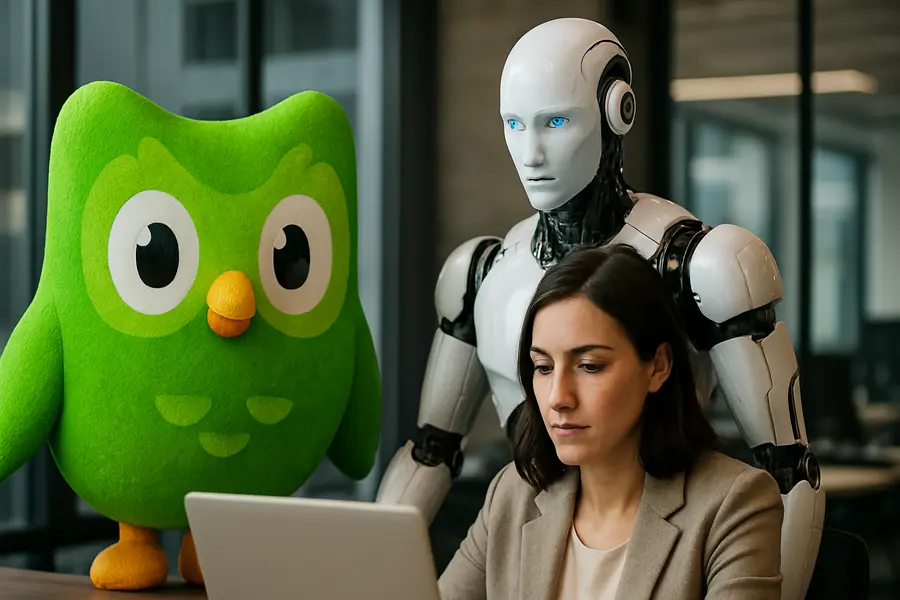
Duolingo CEO Luis von Ahn says artificial intelligence has made full-time employees four to five times more productive without triggering a single layoff, as the edtech company reports over $1 billion in 2025 revenue.
- Duolingo CEO Luis von Ahn reports AI-driven content output at 4–5x prior capacity with no full-time headcount reductions.
- The company's 2025 revenue reached $1.04 billion, up 38.7% year-over-year, with adjusted EBITDA exceeding $300 million.
- Duolingo phased out contractors for AI-replaceable tasks while continuing to grow its full-time engineering and product workforce.
Lead
Duolingo (DUOL) chief executive Luis von Ahn stated in September 2025 that the Pittsburgh-based language-learning platform's embrace of artificial intelligence has enabled the same number of full-time employees to produce four to five times as much course content in the same period — a productivity acceleration the company achieved without dismissing a single permanent staff member. The disclosure arrived five months after Duolingo publicly committed to an AI-first operating model in April 2025, a move that drew widespread scrutiny over what it would mean for the workforce.What Happened
Von Ahn described the productivity shift in concrete terms: teams that previously required months to develop language, math, music, and chess lesson content can now complete comparable volumes within weeks. Humans remain in the loop, directing AI systems to produce the right outputs, but each employee is able to oversee substantially more work than before.
The shift was operationalized through a company-wide memo von Ahn posted publicly in April 2025, outlining a strategy to stop using contractors for any task AI in business workflows could handle and to limit new hiring to roles that could not be automated further. Critically, that policy drew a sharp distinction between contractors — a category where Duolingo did begin to reduce its engagement — and full-time employees, whose headcount the company maintained and continued to add to through the year.
Duolingo's AI productivity gains were enabled largely by integration of large language model technology, including GPT-4–powered conversational agents, into its content creation pipeline. The same infrastructure underpins Duolingo Max, its premium subscription tier, which deploys generative AI for immersive spoken-language practice and in-app video call simulations with AI tutors.
Strategic and Financial Context
The AI productivity initiative coincided with a period of accelerating financial performance. Duolingo closed 2025 with revenue of $1.04 billion — an increase of 38.7% compared to $748 million in the prior year — and reported adjusted EBITDA exceeding $300 million for the first time. Net earnings for the full year reached $414 million, a 367% increase year-over-year, reflecting both revenue growth and the early operating leverage benefits of AI-assisted content production.
Paid subscribers climbed to 10.9 million in the second quarter of 2025, up from 8 million a year earlier, while daily active users surpassed 50 million by year-end. Gross margins expanded 90 basis points year-over-year in the fourth quarter, partly driven by high-tier Max subscriptions carrying stronger unit economics.
The tech workforce trends embedded in Duolingo's model are being watched closely across the broader technology and media industries. Von Ahn was explicit that the ambition was not cost reduction but capacity expansion — the ability to build more products, enter more language markets, and deepen content quality with a workforce that grows modestly rather than exponentially.
AI and Technology Angle
Duolingo's deployment illustrates a version of AI adoption that has remained relatively rare in public corporate disclosures: measurable output multipliers at the team level without immediate full-time headcount displacement. The company's structure — where content generation is a core, high-volume, repeatable workflow — made it particularly well-suited to capture early gains from generative AI applied at scale.
The model also revealed internal friction. After Duolingo announced it would evaluate employees partly on their use of AI tools, employees raised concerns about whether they were being compelled to use AI for its own sake rather than for substantive reasons. Von Ahn reversed that element of the policy in April 2026, removing AI usage from formal performance reviews. The episode highlighted a recurring tension in corporate AI in business adoption: the gap between top-down strategy directives and the practical realities of individual workflows.
Outlook
Duolingo's AI-first trajectory delivered measurable output and financial gains through 2025 while preserving its full-time workforce, a combination that distinguishes it from peers that pursued AI-driven efficiency primarily through headcount reductions. The reversal on AI performance metrics signals that the next phase of Duolingo AI integration will be shaped as much by cultural dynamics and employee trust as by technical capability. With revenue on track for continued double-digit growth, the company enters 2026 testing whether productivity gains at the team level can translate into durable margin expansion and sustained subscriber growth beyond the 50-million daily active user threshold.
Mentioned tickers: DUOL