Pomegra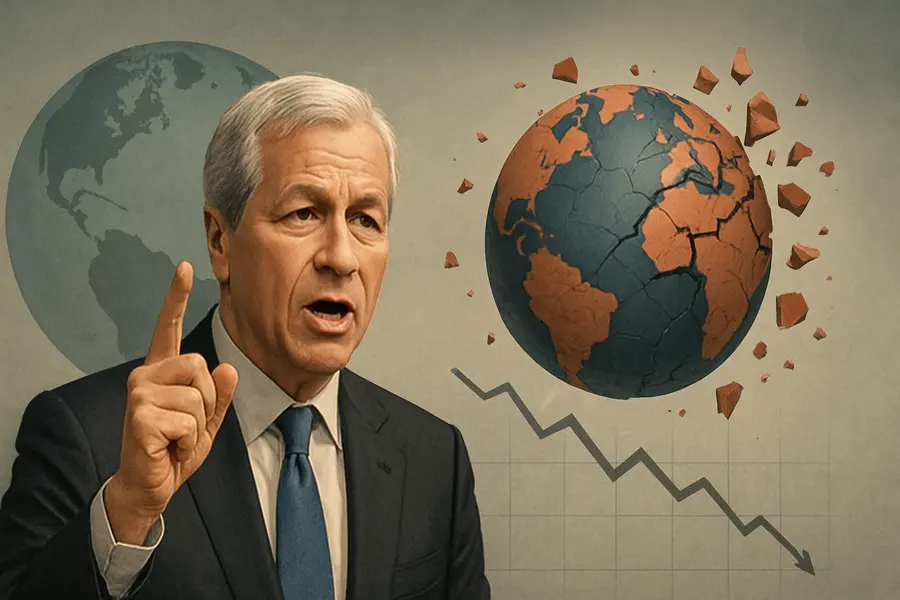
JPMorgan's Jamie Dimon issued stark warnings about economic fragmentation and global trade risk in 2026, flagging bond crises and Western alliance strain as institutional investors watch key risks build.
- Dimon warned that global fragmentation "is precisely what Russia and China wants," urging the West to hold its economic and military alliances together.
- JPMorgan posted Q1 2026 net income of $16.5 billion, up 13%, yet Dimon cited an "increasingly complex" risk environment including trade uncertainty and active geopolitical conflicts.
- The IMF trimmed its 2026 global growth forecast to 3.1%, citing tariff-driven supply-chain disruption and weakening multilateral cooperation.
Lead
JPMorgan Chase Chairman and CEO Jamie Dimon delivered a pointed warning on global fragmentation to institutional investors in Oslo on April 28, 2026, speaking at the Norges Bank Investment Management annual conference. Dimon cautioned that a failure to preserve Western economic and military alliances could one day be recorded in a history he feared reading — a volume titled How the West Was Lost. The remarks extended a months-long series of signals from the head of the world's largest bank by market capitalization that global trade risk has moved beyond near-term cyclical disruption into territory with generational structural consequences, and that markets have not fully priced the shift.What Happened
Dimon's Oslo appearance crystallized a message developed since his annual shareholder letter on April 6, in which he described the moment as "defining for global order." At the Norges Bank conference he was explicit: "The worst thing we can do is fragment it. What we should be doing is trying to make sure we keep the Western world together."
He stressed that economic fragmentation extends well beyond tariff schedules, encompassing investment policy, regulatory norms, and the foundational rules of the World Trade Organization. "Economic relations are not just tariffs," he said, and the current realignment "is precisely what Russia and China wants." The comments represent his broadest public articulation yet of how a fracturing global economic order — not any single policy or conflict — poses the deepest long-term threat to Western prosperity.
In the annual letter, Dimon also flagged wars in Ukraine and Iran as active threats to commodity markets and supply chains, and identified inflation — specifically the risk of it rising rather than continuing to fall — as the "skunk at the party" for 2026, a scenario he believes equity and bond markets have not adequately discounted.
Bond Crisis Warning
On the same day as his Oslo remarks, Dimon added a separate but related caution: rising sovereign debt levels could trigger a bond-market rupture. "There will be some kind of bond crisis, and then we'll have to deal with it," he said, pointing to widening fiscal deficits, elevated energy prices, and unresolved geopolitical tensions as the catalyst mix. He called on policymakers to act before financial markets force their hand.
The warning resonates beyond American borders. The IMF's April 2026 World Economic Outlook flagged that nontariff measures targeting critical inputs — including rare-earth minerals — risk amplifying supply bottlenecks across major economies, compounding pressure on sovereign balance sheets already stretched by pandemic-era spending and defense buildups.
Market Reaction and Q1 Performance
Investors absorbed Dimon's risk warnings against a backdrop of operationally strong results. JPMorgan Chase reported Q1 2026 net income of $16.5 billion, up 13% year-over-year, on revenue of $49.8 billion, a 10% increase. Earnings per share of $5.94 beat consensus estimates of $5.46. Return on tangible common equity reached 23%, with fixed-income trading revenue surging 21% to $7.08 billion and investment-banking fees climbing 28% to $2.88 billion.
Despite the beat, shares slipped approximately 0.8% in pre-market trading following the April 14 release. The tepid response reflected investor focus on a downward revision to full-year net interest income guidance — trimmed from $104.5 billion to approximately $103 billion — alongside Dimon's own observation that markets are exhibiting an "exuberance" difficult to reconcile with the prevailing global trade risk environment and the prospect of inflation re-accelerating.
Geopolitical Dimension
The structural backdrop of Dimon's Jamie Dimon warning 2026 campaign is a multipolar shift in the global economic architecture. The IMF projects global growth at 3.1% for 2026, constrained by tariff costs and diminished trade elasticity. The Fund's spring report observed that "fraying alliances, new conflicts, and waves of inward-looking policies undermine cooperation and growth," directly echoing Dimon's concerns.
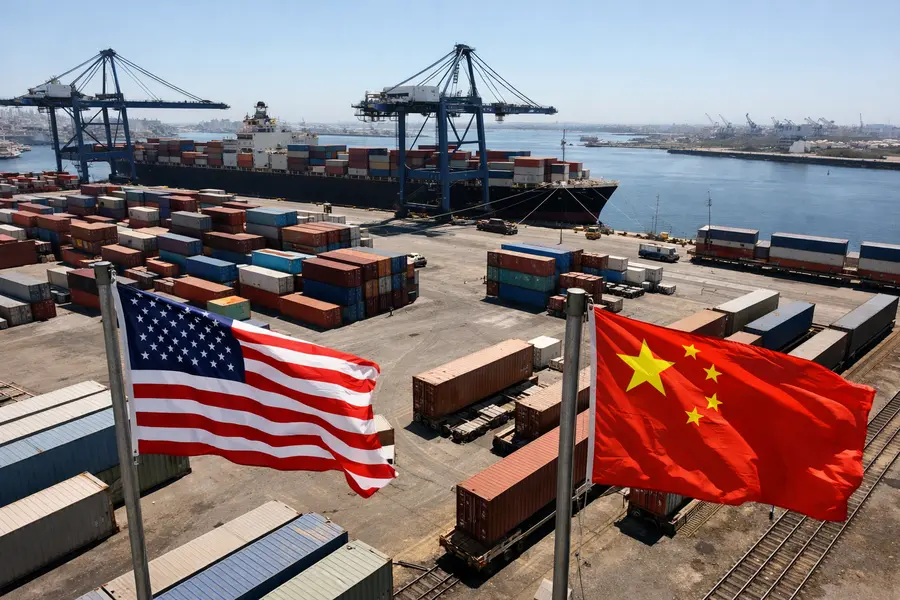
U.S. trade policy under President Trump's second term — featuring broad tariff schedules across dozens of categories and trading partners — has accelerated the realignment. Dimon acknowledged some of the tariff shock has been absorbed through fiscal support and favorable financial conditions, but warned "the trade battles are clearly not over," with nations across Asia, Europe, and Latin America actively recalibrating bilateral and multilateral trade arrangements.
Semiconductor supply chains represent a particular flashpoint in the fragmentation debate. JPMorgan's market outlook for 2026 flagged Taiwan's centrality to global chip supply as a concentration vulnerability exceeding the oil market's dependence on the Strait of Hormuz — a comparison that underscores the stakes embedded in any deepening of geopolitical fault lines.
Strategic Context
JPMorgan's 2026 research framework identifies three macro forces shaping the investment cycle: artificial intelligence, fragmentation, and inflation. Dimon's public commentary has progressively tilted toward fragmentation as the structural risk with the longest tail, even as he disclosed that cyber threats have displaced geopolitics as his single highest near-term operational concern for the bank.
The distinction matters to long-horizon capital allocators: cyber risk is acute and operationally manageable; economic fragmentation is a slow-moving structural fracture that compounds across decades of reduced trade elasticity, misallocated capital, and duplicated supply chains. Sovereign wealth managers and pension fund trustees present in Oslo understood the stakes — and the implicit message that portfolio construction built around a unified global trading system may require revision.