Pomegra
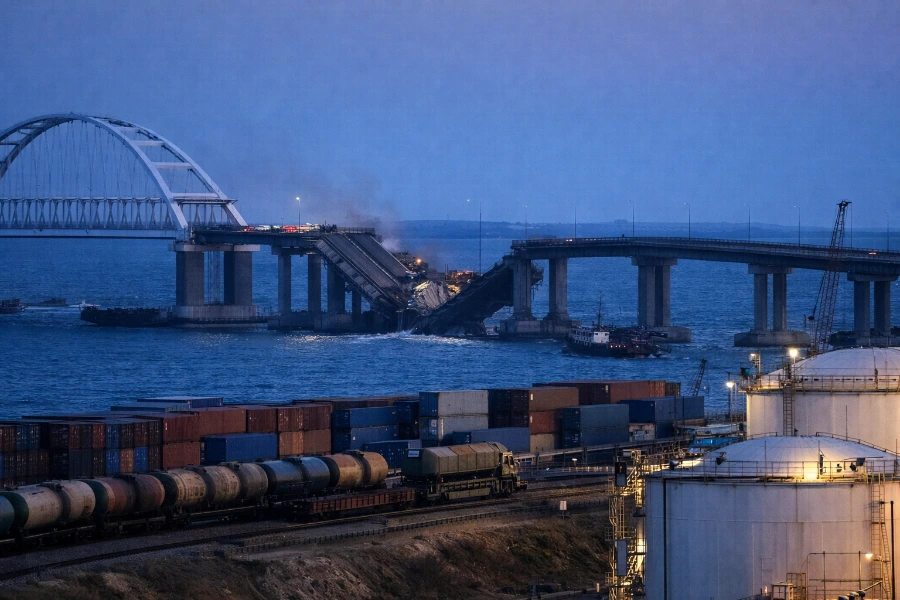
Ukrainian drone and missile strikes collapsed the Kerch Bridge road span on Nov. 17, cutting Crimea's main road link and straining Russian supply routes.
- A Nov. 17 strike dropped a road arch and about 200 to 270 metres of deck into the Kerch Strait.
- A Nov. 19 strike on the parallel rail bridge briefly halted trains. Oil moved only 1.14%.
- Putin ruled out talks with Kyiv after the strikes, and Moscow has promised repairs.
Lead
Ukrainian forces destroyed the central road arch of the Kerch Bridge on Tuesday, Nov. 17, 2026. The structure is the 19-kilometre road and rail link between Russia and occupied Crimea. Three strikes in four days, from Nov. 16 to Nov. 19, left the roadway impassable and the railway operating on a single track. The Moscow-listed MOEX Russia Index has shown no bridge-driven selloff. It closed up 1.21% at 2,381.62 points on Monday, Nov. 23, a rebound attributed to oversold stocks.
What Happened to the Crimea Bridge?
A combined drone and missile attack brought down one metal arch and the road span beneath it on the night of Nov. 16-17. Ukrainian officials said the operation used domestically built drones, Neptune and Flamingo cruise missiles, and Ruta missiles. Earlier stages of the operation targeted Russian air defences and radar around the strait.
Russia's Transport Ministry said no one was killed. The Investigative Committee called the attack a "terrorist act." A second strike two days later hit the railway section. It briefly stopped trains on the remaining line, though the rail arch stayed standing and limited service resumed.
The bridge opened in 2018 at a cost of about $3.7 billion. It was designed for roughly 40,000 vehicles a day and has been hit before, in 2022 and 2023. The latest damage is the most severe.
How Does the Damage Affect Russia's Supply to Crimea?
The loss of the road span forces Russian traffic onto the overland route through occupied Donetsk and Zaporizhzhia, which Ukrainian drones have targeted for months. From April to mid-November, 278 vehicle strikes were documented along those roads. Passenger boats cannot carry cars or cargo, and few working vehicle ferries remain.
A Ukrainian Navy spokesman put the timeline for shortages of fuel, drones and aviation supplies at one to three weeks, roughly Nov. 29 to Dec. 13, as stocks run down. The collapsed arch also obstructs freighter passage through the strait, which restricts grain and steel shipments from southwestern Russia and occupied territories.
Moscow has formed a government commission on repairs and alternative cargo routes. Kremlin spokesman Dmitry Peskov said the bridge would be rebuilt "even better than before." Ukrainian officials say Russia lacks the technical capacity for a quick fix. Rebuilding a collapsed arch over open water typically takes far longer than patching a deck.
Why Did Oil and Russian Markets React So Little?
Crude oil barely moved because the bridge carries military and civilian traffic rather than crude exports. On Nov. 17, Brent rose 1.14% to $93.49 a barrel, and WTI gained 0.30% to $84.66.
Energy markets are watching Ukraine's refinery campaign more closely. Eight major Russian refineries were hit in about two weeks after Oct. 30. Industry estimates put the lost refining capacity near 30%, well below Kyiv's claim of more than half. Six Russian regions have imposed fuel purchase limits. Because refinery damage cuts Russian demand for crude and output of refined products, it does not remove crude from the market, which keeps the oil price response contained.
The same logic holds in Moscow. The MOEX Russia Index trades in a 2,300 to 2,400 range, and falling oil prices are capping the recovery. Russian equities have been weak since June, when they hit their lowest level since March 2023.
Geopolitical Dimension
The timing overshadowed a rare three-way summit between Donald Trump, Vladimir Putin and Xi Jinping in Shenzhen on Nov. 19. The meeting produced no agreement on Ukraine. Putin said afterward that Russia would not negotiate a limited ceasefire or hold direct talks with Kyiv following the bridge strike. He promised a severe response.
For Kyiv, the strikes show that long-range precision weapons can reach Russia's most heavily defended infrastructure. The bridge is a symbol of the 2014 annexation. It is also a working logistics asset, and its loss tests Russia's ability to sustain forces in the south.
Some military researchers question the bridge's value as a target. They argue that cutting the land corridor would do more to isolate Crimea than a single, rebuildable structure.
What Comes Next for the Kerch Strait?
The next three to twelve months turn on three variables: how fast Russia restores road capacity, whether the overland corridor holds under drone pressure, and how Moscow retaliates.
Temporary measures such as pontoon crossings and expanded ferry service are the likeliest near-term fixes. Each of them is exposed to further strikes. A longer closure would raise Crimean fuel and food costs and push more freight through ports and rail lines already under attack.
The Black Sea carries about 17% of traded grain. Continued strikes on shipping and ports raise freight and insurance costs, and wheat prices have risen about a fifth over the past 12 months. A wider campaign around the Kerch Strait would add to that pressure on importers in Africa and the Middle East.
Outlook
The Nov. 17 collapse changed the logistics picture for Russia's southern front, and a rapid repair is unlikely. Markets have so far treated the bridge as a security story rather than a commodity one. Oil, grain and Russian equities will respond more to refinery damage, Black Sea shipping and any escalation after Putin's vow of retaliation.
Mentioned tickers: None