Pomegra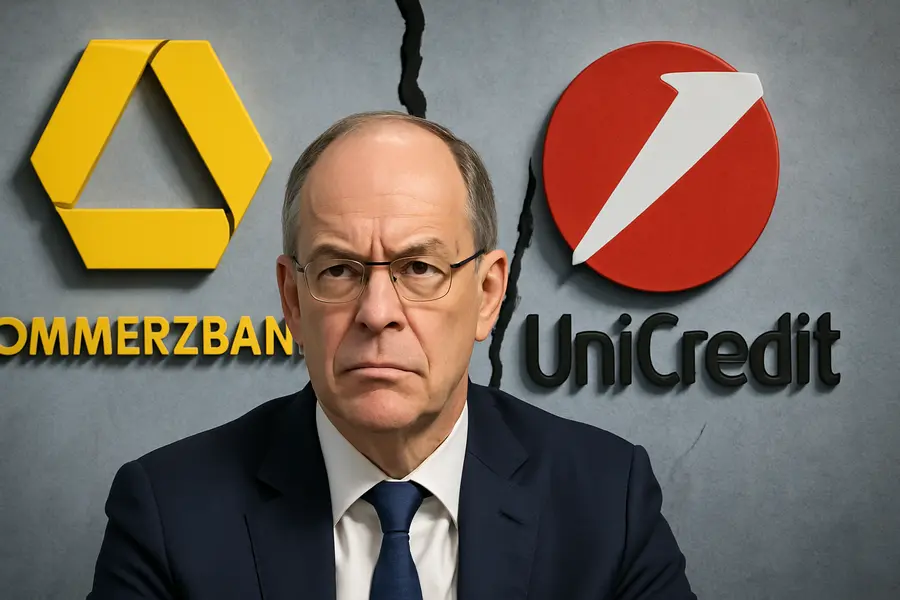
Commerzbank CEO Orlopp warns a 40-50% UniCredit stake would create governance deadlock as the hostile €35bn takeover bid draws scant shareholder support.
- CEO Orlopp describes a 40-50% UniCredit stake as a "messy scenario" lacking the 75% threshold needed to force structural changes at Commerzbank.
- UniCredit's direct stake stands at 34.4%, yet independent investors have tendered only approximately 1.1% of shares; retail participation is 0.05%.
- Germany's BaFin is probing UniCredit's derivative-linked tender tallies after Commerzbank flagged the data as potentially misleading.
Lead
Commerzbank Chief Executive Bettina Orlopp escalated the rhetoric against UniCredit's unsolicited €35 billion takeover bid this week, warning that a partial victory for the Italian lender could leave both institutions trapped in prolonged governance limbo. Speaking publicly as UniCredit's tender offer nears its June 16 deadline, Orlopp described a scenario in which UniCredit controls between 40% and 50% of Commerzbank's shares but falls short of the 75% supermajority required to implement structural reorganisation as a "messy scenario" — one she said would destroy value for all parties.What Happened
UniCredit formally launched its hostile all-share bid on May 5, offering 0.485 new UniCredit shares per Commerzbank share — a ratio that, at prevailing prices, amounts to a discount to Commerzbank's market value. The Italian lender has since raised its aggregate direct stake to 34.4% through open-market purchases, crossing the 30% threshold that would ordinarily trigger a mandatory offer under German takeover rules, though regulatory treatment of the derivative structures underpinning part of that position remains contested.As of the latest interim tally published June 2, UniCredit reported that shares representing 7.58% of Commerzbank's capital had been formally tendered. Commerzbank immediately challenged that figure, arguing that the bulk of those declarations originated from banks connected to UniCredit through derivative counterparty relationships. Nomura alone accounted for approximately 2.06 percentage points of the tendered position. Retail shareholder participation stands at just 0.05%, a figure Orlopp cited as evidence that ordinary investors do not regard the offer as fair.
Germany's financial regulator BaFin has confirmed it is reviewing whether UniCredit's public characterisation of tender support accurately reflects genuine independent shareholder backing.
Governance Deadlock Risk
Orlopp's "messy scenario" warning centres on German corporate law thresholds. A stake of 25% or above grants blocking minority rights, sufficient to veto major decisions. A stake of 50% plus one share confers majority control of the supervisory board. The decisive 75% threshold — the level Orlopp referenced — is required to push through a domination agreement or profit-transfer agreement that would allow UniCredit to fully integrate Commerzbank operationally and extract synergies.
If UniCredit ends the acceptance period with, say, 45% of Commerzbank shares, it would control the bank in practice but lack the legal tools to restructure it, creating an indefinite standoff that Orlopp argued would deter corporate clients, destabilise staff, and erode franchise value at both institutions.
Commerzbank's Defence
Commerzbank's board and supervisory board have unanimously recommended that shareholders reject the offer. The bank unveiled a revised standalone strategy in early May, pledging to cut approximately 3,000 positions by 2030 and to accelerate an AI-driven transformation of its retail and corporate banking operations. Management contends the plan, benchmarked against projected earnings through 2030, generates more value for shareholders than UniCredit's discounted all-share offer.The German government, which retains roughly a 12% stake in Commerzbank following its 2008 bailout rescue, has described the hostile approach as "unacceptable" and indicated it would not tender its shares. Chancellor Friedrich Merz has publicly labelled UniCredit's conduct as aggressive.
Strategic Context
The bid represents one of the largest attempted cross-border banking mergers in Europe since the 2008 financial crisis and has crystallised long-running debates about whether the continent can achieve the economies of scale needed to compete with US megabanks. UniCredit CEO Andrea Orcel acknowledged on May 5 that taking outright control of Commerzbank is "not the expected scenario," suggesting the Italian lender may settle for a large minority position — precisely the "messy" outcome Orlopp has warned against.
Regulatory approvals, including sign-off from the European Central Bank and potentially the German government, mean closing of any transaction is not expected before 2027 regardless of the outcome of the current offer window.
What Comes Next
The regular acceptance period expires at midnight Frankfurt time on June 16, with preliminary results due June 19. A further extended window would then run from June 20 to July 3. The BaFin review of derivative-linked tendering adds a layer of regulatory uncertainty that could affect the final tally. Institutional shareholders, who typically hold back until the closing days, will determine whether UniCredit crosses meaningful thresholds — or is left holding a large, expensive stake with limited structural leverage.
Outlook
The low retail take-up and Orlopp's governance-deadlock warning have shifted momentum toward Commerzbank's standalone defence. Whether the revised profitability plan proves sufficient to hold institutional shareholders through the final days of the offer window is the critical variable. A failure to reach operationally meaningful thresholds would reinforce Commerzbank's position while leaving UniCredit as a large, constrained minority holder — the very outcome both sides say they wish to avoid.
Mentioned tickers: CBK, UCGAnalysis