Pomegra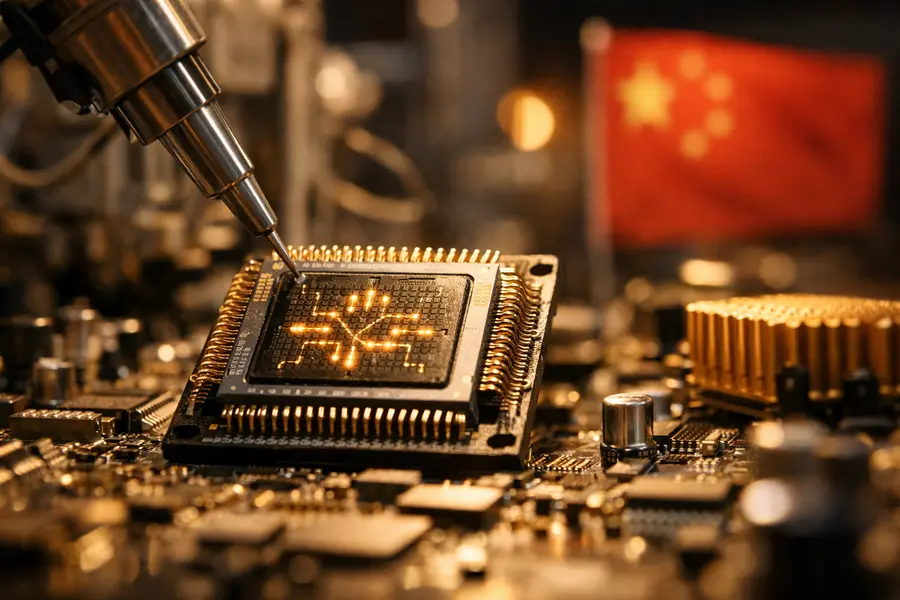
China redirects its vast capital markets toward artificial intelligence development, signaling a structural pivot from state subsidies to market-based financing as Beijing accelerates its technology race with Washington.
- China's $28 trillion capital markets are being systematically channeled into AI, with direct finance now surpassing bank loans for the first time.
- CSRC Chairman Wu Qing unveiled expanded STAR Market rules at the Lujiazui Forum, allowing pre-profit AI firms to list with as little as $591 million in market cap.
- Chinese chipmaker CXMT debuted on the Shanghai Stock Exchange with a 466% surge, reaching a $488 billion market cap in the most high-profile indicator of the shift.
Lead
Shanghai, August 2026 — China has begun redirecting the full weight of its $28 trillion capital markets into artificial intelligence, executing a structural departure from the state-subsidy model that defined its technology policy for the prior decade. The pivot, formalized at the annual Lujiazui Forum in Shanghai's financial district in June, marks the most consequential reorientation of Chinese capital allocation since the country's WTO accession — and positions China AI development on a market-driven footing that rivals the venture and public-markets machinery of Silicon Valley.What Happened
At the Lujiazui Forum on June 17, China Securities Regulatory Commission Chairman Wu Qing announced the expansion of the Shanghai Star Market's Fifth Listing Track to include artificial intelligence large-model developers and quantum technology companies. The rule change eliminates profitability requirements entirely, demanding only a $591 million market capitalization threshold and government attestation of core technology.
The announcement opened the door for a generation of loss-making China AI champions — Zhipu AI, MiniMax, Moonshot AI, and DeepSeek among them — to access the A-share market for the first time. For years, these companies financed growth primarily through venture capital rounds denominated in foreign currency. The new framework gives them a domestic path to public capital at scale.
The regulatory shift arrived alongside a coordinated policy framework spanning the People's Bank of China, the CSRC, and the Ministry of Finance. The three institutions aligned bond market reforms, bank lending mandates, and long-term institutional investment vehicles to funnel capital toward technology and AI sectors. Chinese technology companies are currently borrowing at an average bond coupon of 1.9% annually — approximately 300 basis points below U.S. peers — compressing the cost of capital for AI infrastructure build-out to levels unavailable to American competitors relying on private credit markets.
Market Reaction
The first major beneficiary of the policy alignment was CXMT, China's state-backed DRAM chipmaker and the world's fourth-largest producer of dynamic random-access memory. The company raised between 57.9 billion and 66.6 billion yuan ($8.6 billion to $9.8 billion) in its July Shanghai debut, then surged 466% on its first trading day to a market capitalization of 3.3 trillion yuan ($488 billion) — overtaking every other A-share listed company and signaling institutional conviction in China's semiconductor roadmap for AI data centers.
Broader market indicators confirm the sectoral rotation. The CSI 300 telecom and technology gauges advanced more than 60% in the first half of 2026. Chinese technology companies collectively raised roughly $217 billion over the prior two years through IPOs and bond issuances, a pace of capital formation with no recent precedent in the A-share market.
Strategic Context
The capital markets mobilization follows and amplifies a parallel physical infrastructure program. The National Development and Reform Commission is overseeing a five-year, 2 trillion yuan ($295 billion) nationwide AI data center construction initiative, with an 80% domestic technology sourcing mandate — effectively guaranteeing demand for Huawei's Ascend processor ecosystem. The data center program is integrated into the broader "Six Networks" initiative, a 7 trillion yuan ($1 trillion) infrastructure package announced for 2026 that includes computing power networks and next-generation communications grids.
Beijing's policy calculus is explicit. The 15th Five-Year Plan references the "AI Plus" initiative — China's most comprehensive AI diffusion blueprint — more than 50 times. The program targets deep AI integration across six major economic sectors by 2027, with the core AI industry valued at 1.2 trillion yuan in 2025 and a government projection of 10 trillion yuan by 2030.
The strategic rationale extends beyond competition with Washington. Chinese policymakers have explicitly framed China AI development as a structural response to the country's two most pressing domestic challenges: slowing economic growth and accelerating demographic decline. AI-related exports contributed 1.1 percentage points to nominal GDP growth in the first four months of 2026 — nearly triple their 2025 share — providing a nascent but rapidly scaling economic dividend.
Geopolitical Dimension
The capital markets pivot carries direct implications for the U.S.-China technology rivalry. Washington's export control regime, which restricts access to advanced Nvidia processors and ASML lithography equipment, was designed in part to constrain China's ability to build AI infrastructure. The CXMT IPO and the accompanying data center program represent Beijing's answer: absorb the constraint at the chip layer by financing domestic alternatives through public markets, then compress AI development timelines through the most abundant resource China controls — domestic savings and institutional capital.
The Shanghai financial district and its Lujiazui hub are positioned as the operational center of this strategy. The Lujiazui Forum has historically served as Beijing's venue for announcing major financial liberalization milestones; its 2026 edition now marks the moment China AI financing formally graduated from government grant to capital markets instrument.
Chinese technology companies borrowing at sub-2% coupon rates — while U.S. AI infrastructure companies access high-yield credit at 5% or above — creates a structural cost-of-capital asymmetry that could accelerate China's data center and model training capacity in ways that export controls on chips alone cannot offset.
Outlook
The 2026 Lujiazui Forum marks an inflection point: for the first time, direct market financing has surpassed bank loans as the primary channel for technology capital formation in China. If the trajectory of the STAR Market reforms, the Six Networks program, and the AI data center build-out are sustained, China's investable AI infrastructure will expand by an order of magnitude before 2030 — funded not by government transfers but by the savings of 1.4 billion citizens channeled through reformed equity and bond markets. The gap between Chinese AI ambition and American export control enforcement will be tested not only in semiconductor fabs, but on trading floors in Shanghai.
Mentioned tickers: CXMT, 688981.SS, 688599.SS