Pomegra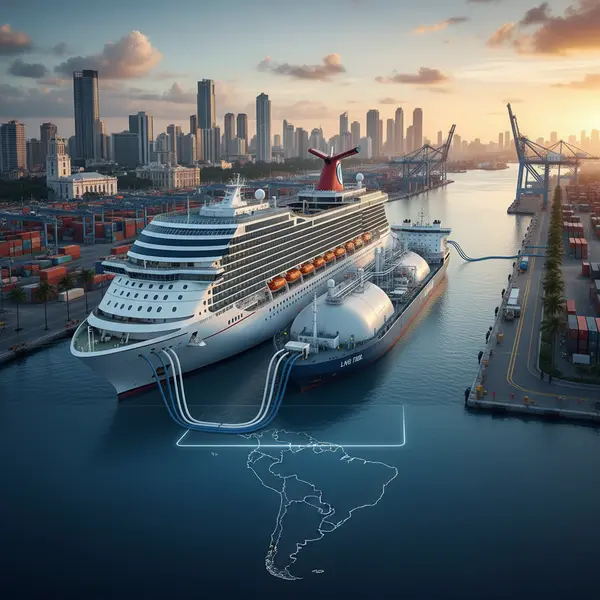
Carnival Corporation completes the cruise industry's first LNG bunkering in Latin America, refueling Carnival Jubilee at Honduras' Isla Tropicale in a historic ship-to-ship transfer.
- Carnival Jubilee received the cruise sector's first LNG Caribbean bunkers via ship-to-ship transfer at Isla Tropicale, Roatán, Honduras.
- Carnival LNG fleet now spans 11 vessels, with seven more due by 2033, supporting a 2050 net-zero target.
- LNG cuts direct carbon emissions up to 20% and nearly eliminates sulfur oxides, nitrogen oxides, and particulate matter.
Lead
Carnival Corporation & plc completed the cruise industry's first liquefied natural gas bunkering operation in Latin America and the Western Caribbean on June 1, 2026, refueling the Carnival Jubilee at Isla Tropicale — the company's private destination in Roatán, Honduras. The ship-to-ship transfer, executed via a mobile LNG fueling solution, marks a structural advance in both sustainable cruise operations and regional maritime infrastructure.What Happened
The operation delivered LNG directly to the Carnival Jubilee, an Excel-class vessel running on Carnival LNG propulsion since its entry into service in December 2023. The first-ever ship-to-ship LNG bunkering at the Roatán port was coordinated with government and industry partners, including Stabilis Solutions — which holds a multi-year marine bunkering contract for the Jubilee — and Seaside LNG, which supports Gulf Coast operations from the Port of Galveston, where the ship is homeported.
Carnival Corporation pioneered LNG propulsion in the cruise sector in 2018 and now leads the industry with 11 LNG-capable ships in active service. Seven additional LNG vessels are scheduled for delivery by the end of 2033, expanding the fleet to 18 LNG-powered ships across the company's nine global brands.Strategic Context
Roatán's geographic position in the Western Caribbean makes it a natural mid-itinerary fueling waypoint for vessels departing Gulf of Mexico homeports. By establishing LNG Caribbean bunkering at Isla Tropicale, Carnival Corporation allows LNG-capable ships to refuel with minimal disruption to sailing schedules, reducing deviation costs and improving voyage efficiency. The mobile fueling approach requires no fixed onshore infrastructure, lowering the barrier to replication at other regional port destinations.
The Roatán milestone extends an LNG supply chain that Stabilis Solutions and Seaside LNG had previously built for Galveston-based operations, stretching that network southward into Central American waters for the first time.
Environmental and Economic Dimension
LNG reduces direct carbon emissions by up to 20% relative to conventional marine fuel and nearly eliminates nitrogen oxide, sulfur oxide, and particulate matter — advantages that align with tightening International Maritime Organization emissions standards. The Roatán operation advances Carnival Corporation's commitment to net zero greenhouse gas emissions by 2050.
At the destination level, Isla Tropicale earned Honduras's Blue Flag Award in 2024 and 2025, receiving one of only two five-star ratings in the country for environmental management, water quality, safety, and accessibility. Since the site opened in 2009, Carnival Corporation has invested $93 million in Isla Tropicale, which has attracted close to 9 million visitors and generated approximately $750 million in cumulative economic impact for Roatán, sustaining more than 1,300 local jobs.
Outlook
The Roatán LNG Caribbean bunkering operation positions the Western Caribbean corridor as an active node in the sustainable cruise industry's clean-fuel supply network. As Carnival Corporation adds LNG tonnage through 2033, demand for mid-itinerary refueling points will grow, creating commercial incentives for additional LNG infrastructure investment across Caribbean and Central American ports. For the broader cruise news environment, the milestone reinforces LNG's near-term primacy as the leading decarbonization pathway for large cruise vessels, ahead of alternative fuels — methanol, ammonia, hydrogen — that remain at earlier stages of maritime-scale deployment.