Pomegra
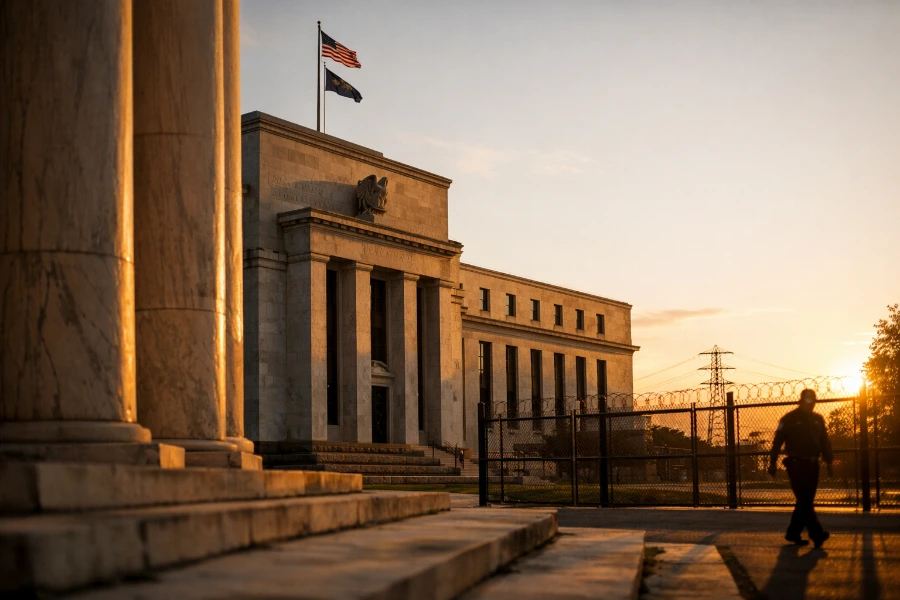
Treasury Secretary Bessent says the Fed risks overtightening as stocks slide into correction and a December fed rate hike looms ahead of Wednesday's PCE data.
- Bessent said the Fed "may be making a policy mistake" by overtightening and pointed to fragility in the financial system.
- The S&P 500 fell 3.7% Friday and 8.6% on the week, entering correction territory.
- A 25 basis point December hike is priced at roughly 84%, with Wednesday's PCE report the last major input.
Lead
Treasury Secretary Scott Bessent warned on Sunday that the Federal Reserve risks damaging the U.S. economy by tightening too far in response to recent inflation readings. He pointed to signs of fragility in the financial system. The warning came 10 days before the Fed's December meeting and three days before the October personal consumption expenditures report, due Wednesday, November 25. The comments landed after the S&P 500 fell 3.7% on Friday to 6,910.39, ending its worst week in more than 18 months.
What Did Bessent Say About the Fed?
Bessent said on CBS's "Face the Nation" that many people believe the central bank "may be making a policy mistake if they overtighten." He cited a "significant tightening in financial conditions over the past few months" and said the financial system is already showing signs of fragility.
He also referred to a run of hawkish remarks from Fed officials in recent weeks. The Treasury chief argued against raising the fed rate aggressively while the economy absorbs an energy supply shock. The remarks put the administration at odds with a committee that has moved toward further tightening.
Why Did Markets Sell Off?
Markets sold off because an AI-driven deleveraging wave collided with growing concern over a more hawkish Fed. On Friday the Nasdaq Composite lost 5.28% to 22,617.73, and the Dow Jones Industrial Average fell 949.73 points, or 1.93%, to 48,147.33. Funds tracking the benchmarks, including SPY and QQQ, fell in line.
For the week, the S&P 500 dropped 8.6%, the Nasdaq 10.0% and the Dow 8.0%. The S&P 500 and Dow both closed more than 10% below their record highs, which confirms a correction. The Nasdaq erased its 2026 gain. The S&P 500 also logged its seventh straight daily loss, its longest losing streak since February 2020.
The 10-year Treasury yield ended the week at 4.912%, down about 24 basis points. Investors moved into government debt as equities fell. The dollar index rose 0.42% to 103.84.
How Does This Affect the December Fed Rate Decision?
The sell-off complicates, but has not removed, the case for a December hike. Futures price roughly 84% odds of a 25 basis point increase. Some traders trimmed those bets after Friday's slide, and the probability of a half-point move has climbed above 12%. Governor Christopher Waller has said a 50 basis point hike deserves consideration.
The federal funds target range stands at 3.75% to 4.00%. The Fed held rates at that level on October 28 in a 10-2 vote, with Governor Lisa Cook and Cleveland Fed President Beth Hammack dissenting in favor of an immediate quarter-point hike. The pause followed a September increase.
Fed Chair Kevin Warsh offered no forward guidance at the October press conference. He said the 2% inflation target is measured by PCE and that "we will deliver price stability, no ifs, ands or buts." On financial conditions, he said they are tighter overall but that he is "unwilling and unable to call them tight." That framing is the opposite of Bessent's. The Treasury Secretary sees a system already under strain, while the chair sees room for further restraint.
What Will Wednesday's PCE Report Show?
Wednesday's report will show whether inflation is cooling enough to ease pressure for a larger move. September PCE inflation rose 0.5% on the month and 3.6% from a year earlier, up from 3.4%. Core PCE inflation, which strips out food and energy, rose 0.3% on the month and 3.1% annually, up from 3.0%.
A hotter October print would reinforce the pricing for a December hike and could revive the case for 50 basis points. A softer reading would give traders reason to pare bets, particularly with equities in correction and yields lower on the week. Some forecasts lean toward a softer outcome, though the energy shock keeps headline readings volatile.
Market Context
Higher interest rates are tightening conditions through several channels at once. Equity valuations have compressed, long-term borrowing costs remain elevated, and the dollar has firmed. The AI-linked selloff has concentrated losses in the technology stocks that led the market's gains this year. That raises the question of whether lower stock prices alone will do the Fed's tightening work, which is the core of Bessent's argument.
The Fed's own record points the other way. Warsh has stressed that policy works through financial conditions, and he has said he will not dilute the 2% target. Two dissents at the last meeting show the committee's center of gravity leans toward action, not patience.
Outlook
The December 9-10 decision now hinges on Wednesday's inflation data and on whether Friday's equity rout deepens or stabilizes. Markets lean toward a quarter-point increase. The size of any move, and the tone Warsh takes toward a financial system the Treasury calls fragile, will determine whether the correction spreads or eases.
Mentioned tickers: SPY, QQQ