Pomegra
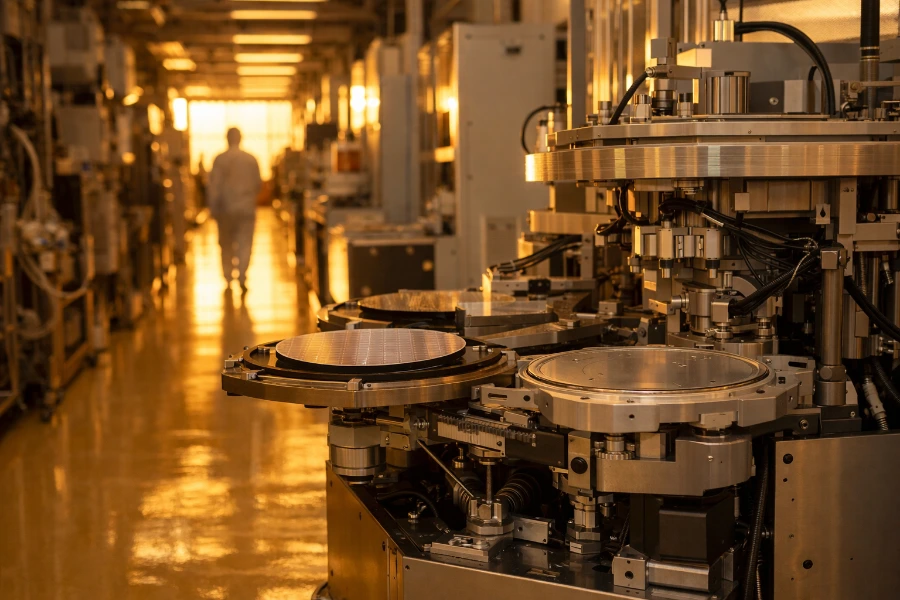
Applied Materials (AMAT) posted record fiscal Q4 revenue of $10.4B, up 53%, and guided Q1 to $11.1B on AI chip demand, but shares slipped after hours.
- Q4 revenue hit a record $10.41B, up 53% year over year; non-GAAP EPS rose 92% to a record $4.16.
- Q1 guidance of $11.1B, plus or minus $500M, tops the $10.89B consensus estimate.
- The stock still slipped in extended trading despite the beat-and-raise.
Lead
Applied Materials reported record fiscal fourth-quarter revenue of $10.41B on Thursday, Nov. 12, 2026, up about 53% from a year earlier. It guided first-quarter revenue to $11.1B, plus or minus $500M, above the $10.89B Wall Street estimate. Non-GAAP earnings per share reached a record $4.16, against a consensus of about $4.06. The shares slipped in after-hours trading anyway. The reaction suggests that expectations for the largest U.S. chip-equipment maker were already elevated going into the print.What Did Applied Materials Report for Q4?
Applied Materials reported record revenue, operating income and cash generation for the quarter ended in October.
- Revenue: $10.41B, a record, and 53% above the year-earlier quarter.
- Margins: Non-GAAP gross margin was 50.6%, up 250 basis points year over year. GAAP gross margin was 50.4%. Non-GAAP operating margin was 35.3%.
- Earnings: GAAP EPS was $3.40, up 43%. Non-GAAP EPS was $4.16, up 92%.
- Cash: Operating cash flow reached a record $3.30B. The company returned $2.42B to shareholders, including $2.00B in buybacks, its largest quarterly repurchase in more than eight years, and $421M in dividends.
- Full year: Fiscal 2026 revenue came to a record $34.45B.
Why Is AI Driving Equipment Demand?
AI is pulling chipmakers toward more advanced logic, high-bandwidth memory and advanced packaging, all of which require more equipment per wafer. CEO Gary Dickerson described AI as driving a multiyear expansion in semiconductor demand.
Memory is the clearest example. DRAM, which feeds the high-bandwidth memory stacked beside AI accelerators, rose to 33% of Semiconductor Systems revenue from 28% previously. The company expects advanced packaging revenue to grow about 90% in calendar 2026. It projects Semiconductor Systems revenue growth of more than 40% this year and wafer fab equipment market growth above 30% in 2027.
The Q1 guide implies roughly 58% year-over-year revenue growth and non-GAAP EPS of $4.35, plus or minus $0.20, up about 83%. For investors screening ai stocks, the chip-equipment makers sit upstream of the accelerator and memory suppliers. Their orders show how much capital the industry is committing to AI capacity.
Why Did the Stock Slip After Hours?
The shares slipped because the results and guidance had been anticipated by buyers who had already pushed expectations well above the prior consensus. A beat of about 2% on the Q1 revenue guide, $11.1B against $10.89B, left little margin for surprise at current valuations.
Three other factors weighed on sentiment:
- China exposure: China accounted for 25% of Q4 revenue, behind only Taiwan at 28%. Management said it expects China to fall below 25% of the business in 2027 as investment elsewhere grows faster. The company said it is gaining share in China through mature-node investments. Export-control policy remains a swing factor for that segment.
- Capacity limits: The CFO said clean room capacity is a gating factor for how much equipment the industry can absorb. That limits how quickly demand converts into shipments.
- Prior volatility: The stock had fallen sharply over the preceding month, which left positioning sensitive to any hint of a growth ceiling.
How Is Revenue Distributed Across Regions?
Revenue was spread across Asia's major chip-making hubs, with Taiwan, China and Korea accounting for 70% of the quarter. Taiwan led at 28%, followed by China at 25%, Korea at 17%, the United States at 13%, Japan at 6%, Southeast Asia at 6% and Europe at 5%. The concentration ties the company's results closely to capital spending at leading foundries and memory makers.
Strategic Context
The quarter shows an equipment cycle driven by leading-edge logic, memory and packaging rather than by a broad recovery in consumer electronics. The service business adds a recurring base: the installed base of Applied tools keeps generating spares and upgrade demand even when new-tool orders fluctuate.
Outlook
Applied Materials closed fiscal 2026 with record revenue of $34.45B and guided to $11.1B for the next quarter, above consensus. The company expects wafer fab equipment spending to grow more than 30% in 2027, with DRAM and advanced packaging the main drivers. Clean room capacity, export-control policy and a shrinking China share are the main variables for the coming year. The after-hours decline reflected elevated expectations rather than weaker fundamentals.
Mentioned tickers: AMAT