Pomegra
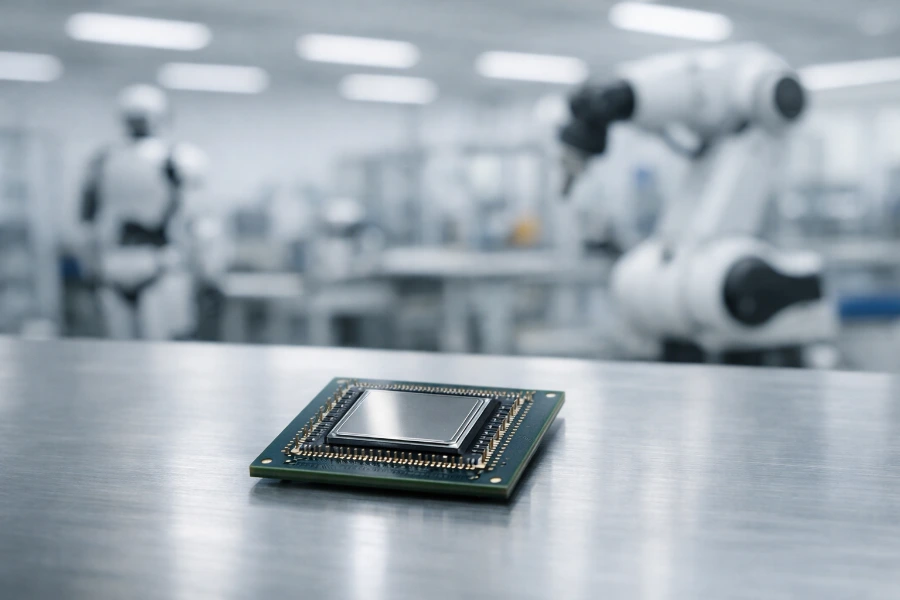
XILECT, the UBTECH and MetaX chip venture, raised an RMB 500 million angel round led by GGV Capital and Matrix Partners China at a RMB 4 billion valuation.
Key Takeaways
- XILECT closed a RMB 500M angel round at a RMB 4B post-money valuation, co-led by GGV Capital and Matrix Partners China.
- The Wuxi venture was founded in May 2026 by MetaX and UBTECH, which hold 35.01% each.
- Development platforms are due in 2027 and the first SoC in 2028, aimed at beating NVIDIA's Thor.
Lead
XILECT, a Chinese chip company building system-on-chip processors for humanoid and industrial robots, announced on November 12, 2026 that it had closed a RMB 500 million angel round. GGV Capital and Matrix Partners China co-led the financing at a post-money valuation of RMB 4 billion. The company was incorporated in Wuxi in late May 2026, so the round came roughly five months after formation. Other participants included investors linked to SAIC, via Hengxu Capital, and to CDH, plus additional domestic venture groups. The company did not name them all.
Who Is Behind XILECT?
XILECT is a joint venture of GPU designer MetaX and humanoid maker UBTECH, with a third backer, Fenglong. The operating entity is Xixuan Chuangzhi Technology (Wuxi) Co., Ltd. MetaX and UBTECH each hold 35.01%, and Fenglong holds 4.7%.
MetaX chairman Chen Weiliang chairs the venture. UBTECH founder and CEO Zhou Jian is vice chairman. Yang Xianbo, formerly a senior vice president at H3C and president of its industry business group, serves as CEO.
The split of duties is plain. MetaX brings GPU design and a software ecosystem, while UBTECH brings robot hardware and field deployment experience.
What Is XILECT Actually Building?
XILECT is building a single SoC that handles both high-level reasoning and real-time motion control in a robot. The company calls this a "large-and-small-brain" design, covering the cerebrum for perception and planning and the cerebellum for low-latency actuation. Robot makers today typically split these jobs across separate chips, often pairing an NVIDIA module with a dedicated motion controller.
The stated design goal is to surpass NVIDIA's Thor platform. The roadmap is long. Development and verification platforms reach industry partners in 2027 for adaptation and testing, and the first SoC and an accompanying embodied-intelligence solution are scheduled for 2028. The company says it will define the chip around the physical tasks robots perform, which it expects to shorten the path from chip verification to module delivery.
How Will the Money Be Used?
The RMB 500 million goes to four areas: core chip and computing-platform R&D, software tooling for deploying AI models on robots, expansion of the research team, and joint validation with robot manufacturers and industrial customers. Given the timeline, most of it will likely be spent before any product ships. A 2028 tape-out schedule for a new SoC is not unusual, but it leaves little margin if the first silicon needs a respin.
Is the RMB 4 Billion Valuation Justified?
The valuation rests on parentage and demand, not on product. At a RMB 4 billion post-money value, the RMB 500 million round implies new investors own about 12.5% of the company. That is a rich price for a five-month-old firm with no silicon and no disclosed revenue.
Two factors support it. First, the founding shareholders are a listed GPU designer and a listed robot maker, which gives XILECT a technical base and a likely first customer. Second, Chinese robot makers have strong reasons to seek domestic compute, given export controls on advanced NVIDIA parts. The counterargument is concentration risk. If UBTECH is the main buyer, the chip may be tuned to one company's robots, and independent manufacturers may hesitate to depend on a chip owned partly by a competitor.
What Comes Next for Robot Chips in China?
The next test is the 2027 development platform. If outside robot makers adopt it, XILECT can argue it is a merchant supplier. If only UBTECH uses it, it will look closer to a captive design house.
NVIDIA's roadmap will also move before 2028, so the Thor benchmark is a target that keeps shifting. A follow-on round is likely once silicon milestones appear, and it will show whether the angel valuation holds. Early backing from two large venture firms signals appetite for robot compute, but the product has to arrive first.
Outlook
XILECT starts with strong shareholders, a well-funded angel round and a clear but distant timeline. Its 2027 platform and 2028 SoC will decide whether the RMB 4 billion valuation reflects a real supplier or an expensive in-house project.