Pomegra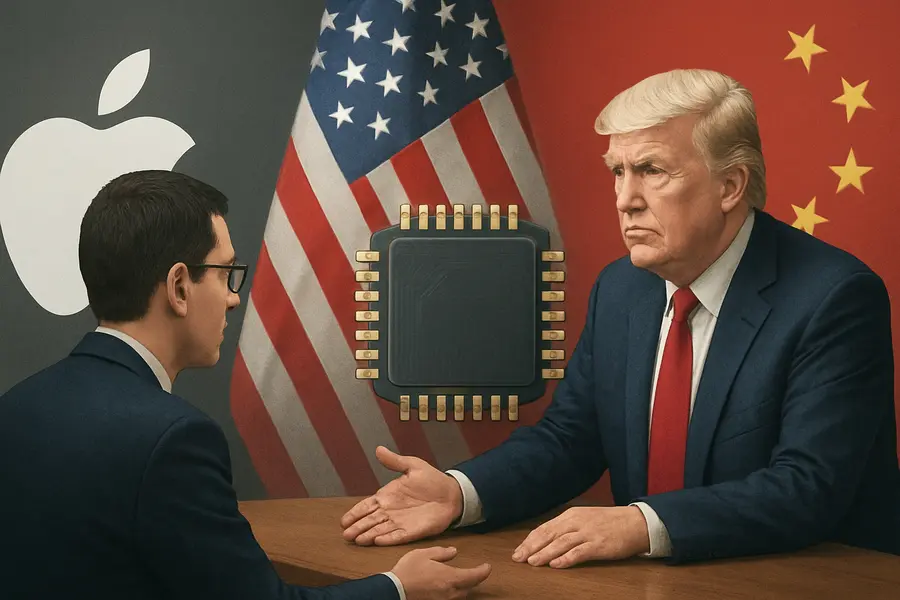
Apple is pressing the Trump administration for clearance to buy DRAM from Pentagon-blacklisted Chinese supplier CXMT, a direct consequence of the global memory shortage driving up Apple supply chain costs and forcing rare product price increases in mid-2026.
- Apple has lobbied the Commerce Department and other agencies for assurances that CXMT will not be placed on the Entity List.
- Mac and iPad prices rose $100–$500 in late June 2026, the company's broadest price increase in years, citing an unprecedented memory cost surge.
- AAPL fell 6.15% to $275.15 on the price-hike announcement before recovering roughly 3% as the China chip lobbying story broke.
Lead
Apple Inc. (AAPL) is actively pressing Trump administration officials for permission to source memory chips from ChangXin Memory Technologies Inc. (CXMT), China's largest DRAM manufacturer and a firm listed on the Pentagon's 1260H register of companies with alleged ties to the Chinese military, according to six people familiar with the matter. The Apple China chip lobbying campaign, directed at the Commerce Department and other parts of the administration, is the company's most consequential supply-chain diplomatic maneuver since it briefly explored procurement from Yangtze Memory Technologies Co. (YMTC) in 2022. No formal agreement is in place and discussions remain ongoing as of early July 2026.What Happened
The push for Chinese memory chips follows Apple's June 25, 2026 decision to raise prices across its Mac and iPad lineups — the first broad pricing action in years. The entry-level MacBook Neo increased to $699 from $599; the 13-inch MacBook Air moved to $1,299 from $1,099. Prices on Macs, iPads, home devices, and Vision Pro rose between 17% and 25%, while iPhones, Apple Watch, and AirPods were held flat. CEO Tim Cook said the company could no longer absorb rising component costs, with Apple stating internally that it had "never seen a component price increase this much, this quickly."
The driver is a global memory shortage that has bifurcated the semiconductor market. AI data center buildouts — dominated by high-bandwidth memory (HBM) consumed by Nvidia GPU clusters — have diverted fabrication capacity away from conventional DRAM and NAND flash used in consumer devices. Industry forecasters expect the supply deficit in commodity memory to persist through at least 2027.
To address that squeeze, Apple entered negotiations with CXMT and YMTC for memory components destined primarily for devices sold in China. Apple is not currently prohibited from purchasing from CXMT under U.S. law. What it is seeking is a government assurance that CXMT will not be elevated to the Commerce Department's Entity List, a designation that would ban the transaction outright.
Strategic Context
Apple supply chain news this year has been dominated by the cost pass-through risk from the AI-driven memory supercycle. The company currently sources DRAM and NAND from a concentrated group of Tier-1 suppliers — Samsung Electronics, SK Hynix, and Micron Technology (MU) — all of which face capacity constraints as data center customers absorb an outsized share of leading-edge output.Adding CXMT would give Apple a fourth supplier and, in theory, structural pricing leverage against the existing trio. CXMT produces DDR5 and LPDDR5X DRAM for smartphones and PCs — the specific categories under cost pressure — though analysts note the Chinese firm's overall output capacity remains limited relative to global demand, tempering expectations for near-term relief. Shares of Chinese memory-related equities on the A-share market surged more than 4.5% on news of Apple's procurement interest.
Critically, China memory chips from CXMT do not include HBM, the premium stack-die product at the center of the AI arms race. Micron's existing relationship with Apple in the AI-adjacent device segment — particularly memory for Apple Intelligence on-device inference — is not directly threatened by the CXMT discussions.
Geopolitical Dimension
The Apple China chip lobbying effort lands at a politically sensitive moment. CXMT and YMTC both appear on the Pentagon's 1260H list, a designation signaling alleged links to Chinese military modernization programs. Congressional opposition has been swift. John Moolenaar, chairman of the House Select Committee on China, described any Apple partnership with CXMT as "a grave mistake." Brian Mast, chair of the House Foreign Affairs Committee, went further, stating that the Chinese companies are "fueling the Chinese Communist Party's military modernization and pursuit of AI dominance."
The geopolitical risk is asymmetric. For Apple, blocking CXMT access means continued exposure to a supply chain concentrated in three allied-nation firms with constrained capacity. For U.S. policymakers, granting a waiver creates precedent for other technology companies to negotiate around the 1260H list. The Commerce Department has not publicly confirmed or denied the lobbying discussions.
Market Reaction
AAPL stock gyrated on back-to-back headline events. The June 25 price-hike announcement sent shares down 6.15% to $275.15, the steepest single-day loss in more than four months. When the CXMT lobbying story emerged in late June, shares recouped roughly 3.14%, trading near $283.78, as investors parsed the move as evidence that management was pursuing structural cost relief rather than absorbing margin compression indefinitely.Outlook
The Apple stock outlook 2026 will remain tied to resolution of the memory cost cycle. If the administration grants informal assurances — short of a formal waiver — Apple could begin qualifying CXMT components for China-market devices within months, a process that typically requires 12–18 months of engineering validation before volume procurement. Even partial sourcing from CXMT would increase Apple's negotiating position with Samsung and SK Hynix.
The political hurdle is significant, however. Congressional pushback has intensified since Apple's 2022 YMTC episode, and the 1260H designation carries heavier optics than a standard trade restriction. A formal Entity List expansion by Commerce — prompted by legislative pressure — would foreclose the option entirely. Apple's timeline for a cost-structure normalization therefore depends as much on Washington's geopolitical calculus as on factory output in Hefei.
Mentioned tickers: AAPL, MU