Pomegra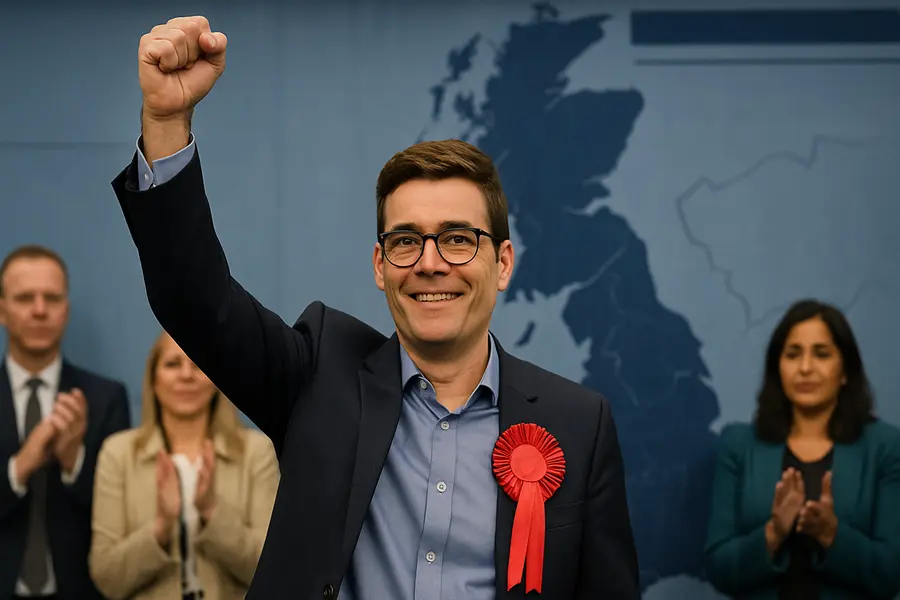
I have all the data needed. Writing the article now.
- Andy Burnham won the Makerfield by-election on 18 June 2026 with 54.8% of the vote, a 20.3-point margin over Reform UK.
- The result gives Burnham a Westminster platform to scale his "Manchesterism" model — integrated regional governance, transport, and skills — nationally.
- A formal Labour leadership challenge now becomes possible, with Burnham refusing to rule out a direct contest against Prime Minister Keir Starmer.
---
Greater Manchester's outgoing mayor enters Parliament after a decisive June 2026 by-election victory, positioning himself to redefine British devolution and challenge Keir Starmer's Labour leadership.
Lead
Andy Burnham, the outgoing Mayor of Greater Manchester, secured a commanding victory in the Makerfield by-election on 18 June 2026, claiming 24,937 votes — a 54.8% share — and defeating Reform UK's Robert Kenyon by a margin of 9,241 votes. The result, which lifted Labour's winning margin from 13.4 percentage points at the 2024 general election to 20.3 points on a 58.75% turnout, delivers Burnham a seat in the House of Commons and transforms the landscape of UK regional policy, Manchester politics, and national Labour strategy in a single night.What Happened
The Makerfield seat was vacated by sitting MP Josh Simons, who resigned in May 2026 expressly to create the by-election opening. The mechanism — unusual in British political history — was engineered to allow Burnham, constitutionally barred from standing for Parliament while serving as a regional mayor, to enter Westminster without resigning his mayoralty before a successor had been named.
Burnham's campaign centred on extending his nine-year tenure in Greater Manchester to the national stage, framing the contest as a referendum on a different model of UK regional policy: one built on place-based investment, integrated public services, and long-term settlement funding rather than Whitehall discretion.
The Andy Burnham victory was secured against a backdrop of deteriorating Labour poll ratings and a turbulent spring. Local elections in May produced historically poor results for Starmer's government; Wes Streeting resigned as Health Secretary the same month, citing "vision vacuum" at the top of the party.
The Devolution Dimension
Burnham's record in Greater Manchester forms the substantive core of his political offer. Since 2017, he has overseen what became a benchmark for UK devolution news: a trailblazer agreement signed with the Treasury in March 2023 unlocked a £630 million integrated settlement covering post-19 skills, housing and regeneration, transport, and net-zero transition — all managed locally rather than through fragmented central grants.
The model deliberately bypassed traditional departmental silos, consolidating funding streams and accountability in the Manchester Combined Authority. Transport for Greater Manchester expanded its Bee Network to cover buses, trams, and cycling infrastructure under unified public control — a reversal of the 1980s deregulation that Burnham had campaigned against for a decade.
That record animates his national pitch: "Manchesterism," as Burnham's team frames it, posits that regional governments with genuine fiscal autonomy and integrated delivery responsibility outperform centrally managed programmes on outcomes per pound spent. The argument carries increasing weight inside the English devolution debate, where the current government's devolution white paper — published in late 2024 — promised expanded mayoral powers but delivered them unevenly and incrementally.
Strategic Context
The Andy Burnham victory arrives at a pivotal moment for UK regional policy. The Labour government has acknowledged that England's asymmetric devolution — where Greater Manchester, West Midlands, and a handful of other combined authorities hold substantive powers while most English regions remain Whitehall-dependent — is politically and economically untenable. Yet the pace of change has frustrated northern and Midlands leaders who argue that fiscal devolution remains rhetorical.
Burnham has been explicit: he intends to use his new parliamentary position to accelerate that agenda, pressing for place-based budgeting across health, welfare, and economic development — powers that currently remain ringfenced in Westminster. His brand of Manchester politics rests on a conviction that post-industrial regions cannot be regenerated by central diktat, and his Makerfield result suggests that message resonates even in constituencies where Reform UK's anti-establishment narrative has made significant inroads.
The 34.5% recorded by Reform UK in Makerfield is not a figure Burnham's team dismisses. It reflects a constituency — largely working-class, post-coal and post-manufacturing — where wage growth has lagged the national average for two decades. Burnham's argument is that the devolution framework he champions is precisely the instrument capable of redirecting investment into such communities. The counter-argument, amplified by Reform, is that devolved governance has not yet delivered material improvement at ground level.
Labour Leadership Arithmetic
Under Labour Party rules, a leadership challenger must secure nominations from 20% of parliamentary Labour Members — currently 81 MPs. Burnham's entry into the Commons does not itself trigger a contest, but it removes the constitutional barrier that had made any leadership campaign impossible while he remained a regional mayor.
Prime Minister Keir Starmer stated publicly he would contest any leadership challenge, adding that he had "no intention of walking away." But with Streeting already declared as an alternative candidate and backbench discontent running high following the May local elections, the leadership question now sits alongside — rather than separate from — the UK regional policy debate. Burnham's prospective candidacy, should he launch one, would place devolution and regional economic governance at the centre of an internal Labour argument about the party's direction.
Outlook
Burnham's Makerfield win cements him as the dominant figure in the English devolution conversation and the most consequential new voice in Westminster for UK regional policy. Whether he mounts a formal leadership challenge or operates as a powerful cross-bench reformist within the parliamentary Labour Party, his entry into the Commons accelerates pressure on the Starmer government to move faster on fiscal devolution, integrated public service delivery, and place-based investment. The near-term test will be whether the government's response to Burnham's arrival amounts to genuine structural concession on UK devolution news or a managed accommodation designed to contain a rival. The outcome of that negotiation will determine the pace and depth of England's regional settlement for the decade ahead.
Mentioned tickers: None