 Pomegra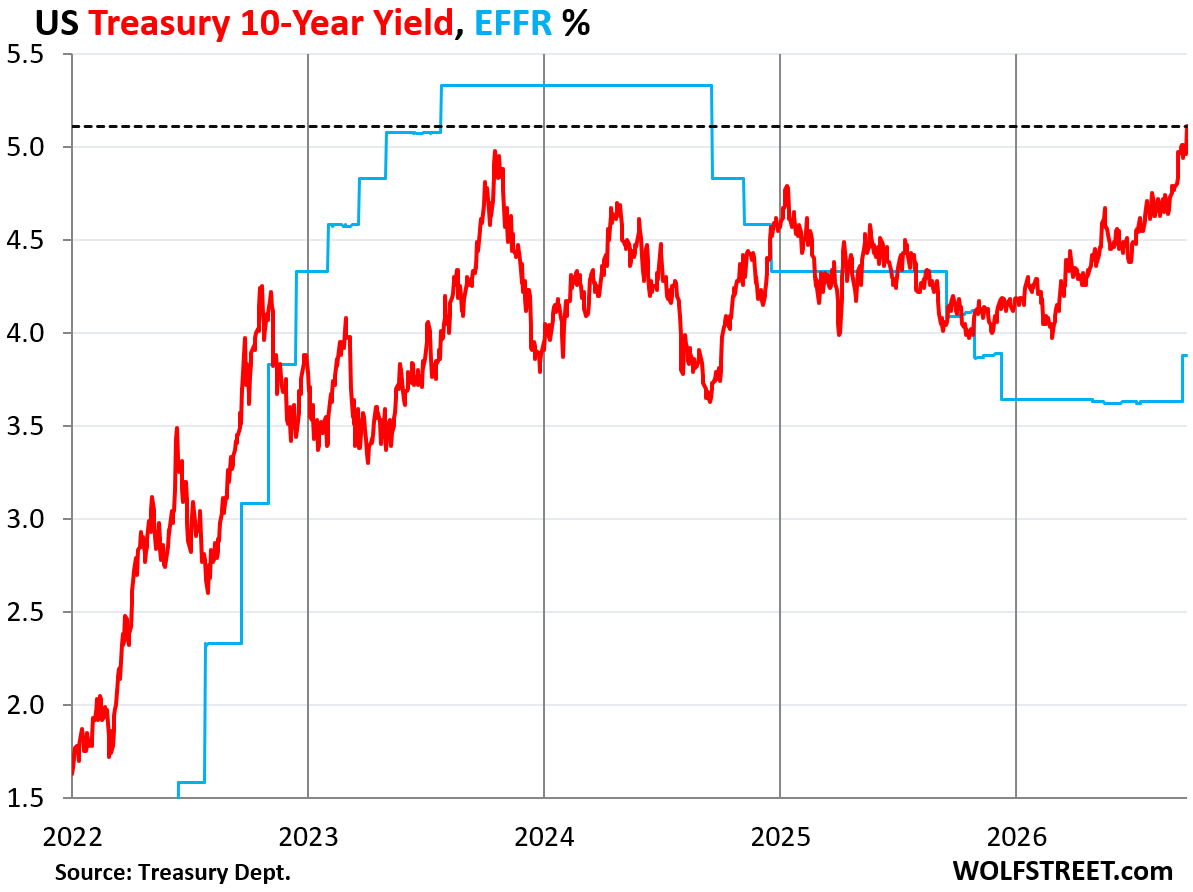
5-Year Treasury Yield Tops 5% After PMI Surge and Weak Bond Auction
Why is the 5-year Treasury yield rising today?
The 5-year Treasury yield (^FVX) rose above 5% on Wednesday for the first time since 2007, driven by a tepid $70 billion note auction and a surprise surge in PMI business activity data.
Key numbers
| 5-Year Treasury Yield (intraday peak) | 5.03%+18 bps on the day; first cross above 5% since 2007 |
|---|---|
| 5-Year Treasury Yield (closing level) | 4.99%+15 bps; settled just below 5% threshold |
| 10-Year Treasury Yield (intraday peak) | 5.135%+13 bps; highest since July 2007 [1][4] |
| 5-Year Note Auction Yield | 5.033%Weakest demand in ~4 years; size $70B [3] vs $80B reported by [2] |
| S&P Global Composite PMI (September) | 58.4vs 55.3 expected; highest since July 2021 [3][4] |
| October Fed Rate-Hike Probability | 71%Up from 55% the prior day [1][4] |
What happened
The 5-year Treasury yield (^FVX) rose above 5% on Wednesday for the first time since 2007, driven by a tepid $70 billion note auction and a surprise surge in PMI business activity data. Investors demanded a 5.033% yield to buy all notes on offer — the highest auction yield in nearly 20 years — signaling fading demand for US government debt. The S&P Global Composite PMI jumped to 58.4 in September, its best reading since July 2021, showing the economy was still running hot with rising price pressures. Traders lifted October Fed hike odds to 71%, dragging the Nasdaq down 1.1% and the Russell 2000 down 1.7%.
Why it matters
The 5-year Treasury yield is a benchmark that ripples through the whole economy — it shapes mortgage rates, car loans, and the borrowing costs companies pay when they want to grow. When it hits 5%, it competes directly with riskier investments, making stocks look less attractive by comparison. The fastest-growing companies — the kind that crowd the Nasdaq and Russell 2000 — are hurt most, since their value depends heavily on cheap future credit. Investors with large bond portfolios also face real losses as prices fall when yields rise.
Who this affects
- MarketbearishHigh impact
- Nasdaq and Russell 2000 fell sharply on rate fears.
- CompanybearishHigh impact
- Debt-heavy companies face higher refinancing costs as yields surge.
- CompetitorsmixedMedium impact
- Banks and money-market funds gain; growth stocks lose.
- IndustrybearishHigh impact
- Tech and small-cap sectors face worst valuation pressure.
US 5-Year Treasury vs UK 5-Year Gilt, German 5-Year Bund
| US 5-Year Treasury^FVX | 4.99% | +15 bps | +121 bps |
|---|---|---|---|
| UK 5-Year GiltGUKG5Y | 4.99% | — | — |
| German 5-Year BundGDBR5 | 3.39% | ~0 bps | +102 bps |
As of 2026-09-24
How we got here
Fed raised rates to 3.75–4.00% target range at September meeting
S&P Global Flash PMI surged to 58.4 composite, highest since July 2021
$70B 5-year note auction drew the weakest investor demand in four years
5-year yield briefly topped 5% intraday; 10-year peaked at 5.135%
Nasdaq fell 1.13% and Russell 2000 lost 1.77% at close on rate fears
What to watch
- Federal Reserve October meeting: rate hike now 71% likely2026-10
- If 10-year yield holds above 5%, equity pressure intensifies2026-10
- September CPI report: hot reading would raise odds of further hikes2026-10
Educational content only. Not investment advice.
More briefsAll briefs →

Darden Stock Jumps 5% on Q1 Earnings Beat
Darden (DRI) beat the $2.06 Q1 EPS consensus as Olive Garden and LongHorn sales both fell short of estimates.

Nscale Files for $35 Billion NYSE IPO on AI Cloud Demand
Nscale (NSCL) targets a $35 billion NYSE valuation, weeks after closing a $3.1 billion Nvidia-backed deal.

Shopify Stock Jumps 7.9% on Meta Muse AI Shopping Deal
Shopify (SHOP) opens Shop Pay's $400B platform to Meta's Muse AI as Amazon bans the agent over data access.