Pomegra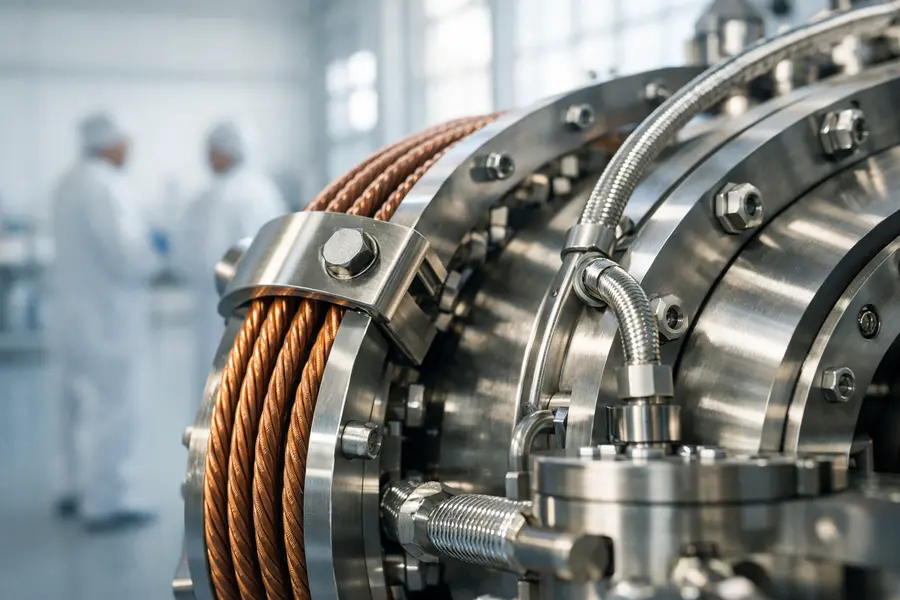
Yanchao Juneng, a Shanghai stellarator fusion startup, closed a Pre-A round of several hundred million yuan with Hongshan Capital and Yanshan Technology.
Key Takeaways
- Yanchao Juneng closed a Pre-A of several hundred million yuan in Q3 2026 and announced it on October 13.
- Hongshan Capital, Yanshan Technology, Hongyuan Investment Group and Wanlian Guangsheng invested; no lead or valuation was disclosed.
- A larger Series A has started, with 50% of the target reportedly committed.
Lead
Yanchao Juneng (YAN Fusion), a Shanghai company building superconducting magnets for stellarator fusion reactors, announced on October 13, 2026 that it completed a Pre-A round of several hundred million yuan in the third quarter. Investors include Hongshan Capital, listed A-share company Yanshan Technology, Hongyuan Investment Group and Wanlian Guangsheng, along with other industrial backers. The company did not state the exact amount or its valuation.
The round is the third in roughly twelve months for a company founded in March 2025. Its headline claim is a domestic first: a production line for three-dimensional stellarator magnets.
What Does Yanchao Juneng Actually Build?
Yanchao builds the hardest component of a stellarator, the twisted three-dimensional magnet set that confines plasma. The company says it has made high-strength, stainless-steel-armored cable-in-conduit conductor (CICC) coils and describes itself as the only Chinese stellarator company with fully in-house CICC 3D magnet capability. Its earlier production line was described as working to millimeter-level precision and covered by 13 patented technologies.
Stellarators run in steady state, which suits grid-connected power generation better than the pulsed operation of most tokamaks. The cost is geometry. Coils must be wound in non-planar shapes with tight tolerances, and that manufacturing problem has slowed the design for decades.
The company has a Shanghai headquarters, an R&D center in Hefei and a joint lab in Shenzhen. It employs nearly 60 full-time staff and about 10 senior advisers across fusion physics, device engineering and superconducting magnets. Founder and CEO Hao Xianglin, born in 1990, holds a doctorate from the University of Science and Technology of China. He previously founded an education technology company.
How Fast Is the Funding Moving?
The funding has moved quickly. Yanshan Technology led an angel round in October 2025. An angel-plus round of about 100 million yuan followed on March 26, 2026, led by Hongli Da, a STAR Market-listed company, and Hongyuan Investment. The Pre-A closed within six months of that.
Rapid stacking of rounds usually signals either strong demand or a company that must fund hardware ahead of milestones. Fusion hardware is capital-hungry, and a machine cannot be built on software-style burn rates. The absence of a named lead and a disclosed valuation also limits outside reading of the price. Repeat participation from Yanshan, Hongyuan and Hongshan suggests existing holders are doing much of the underwriting.
The Series A is already open, and Yanchao says half of the target is committed. The target size is undisclosed.
What Will the Money Pay For?
The proceeds go to a prototype device, expanded magnet manufacturing and commercialization of the superconducting technology in other industries. The company calls this a "1+N" strategy. The "1" is stellarator power generation. The "N" is magnet sales into energy, industrial, medical, aerospace and semiconductor applications for near-term revenue. A subsidiary, Star Boundless, targets space superconductor technology.
The device roadmap has three stages:
- YF-1: a small machine using all high-temperature superconductor, metal 3D printing and an AI digital twin, due in 2027.
- YF-2: a mid-size device combining NbTi, Nb3Sn and YBCO conductors, due in 2029.
- YF-3: a large device with pure high-temperature superconductor CICC magnets, due before 2035.
Why Does the Magnet-First Approach Matter?
The magnet-first approach matters because magnets are the main cost and risk in a stellarator, and a magnet business can sell before a reactor works. That gives Yanchao revenue options that pure reactor developers lack. It also makes the company a supplier story as much as a fusion story, which changes how investors may value it.
The counterargument is plain. A magnet line is not a plasma result. Chinese tokamak programs have far larger state backing, and no stellarator has yet produced net energy. The 2027 YF-1 date is the first test of whether the manufacturing claims translate into a working confinement device.
Outlook
Yanchao enters the Series A with a magnet production line, a staged device plan and investors who have returned for each round. The next milestones are the Series A close, the size of which is undisclosed, and YF-1 construction ahead of its 2027 target. Valuation, lead investor identity and independent verification of the magnet performance will determine how much of the roadmap the market prices in.