Pomegra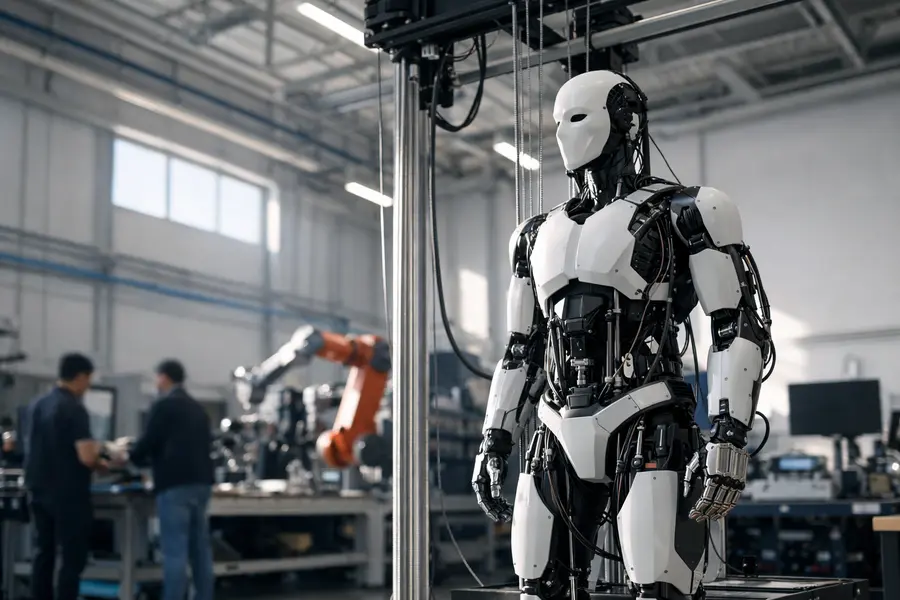
Shenzhen's Astribot raised 1 billion yuan, about $149M, led by state-backed Toucontrol Donghai, to scale cable-driven humanoid robots at a 15B yuan valuation.
Key Takeaways
- Astribot raised 1 billion yuan (about $149M) on October 13, 2026, at a valuation of 15 billion yuan.
- Toucontrol Donghai, a Shenzhen state-linked investor, led. Hongtai, Shanheng Capital and Xianmu also joined.
- It is the company's fourth round in about six months, and its valuation is up from just above 10 billion yuan in June.
Lead
Astribot, the Shenzhen embodied-AI company, closed a 1 billion yuan round on October 13, 2026, roughly $149M. The round values the company at 15 billion yuan. Toucontrol Donghai, an investment vehicle tied to Shenzhen's state-owned capital, led it. The company says it is the first to mass-produce robots driven by ropes (cables) instead of the rigid gearboxes and rods used in most humanoids.
Who Backed the Round?
Toucontrol Donghai led, with Hongtai Fund, the Ninghai Xingtai Hebi fund managed by Guanghua Sunshine, and Shanheng Capital joining. Existing investor Xianmu followed on. The company did not name a series for this round.
The investor mix leans toward state-affiliated and financial capital. Earlier rounds had a more strategic cast. According to Caixin, the April 2025 Series A and A+ were co-led by Jinqiu Fund and Ant Group. The new round shifts toward local government-linked money, a pattern common in Chinese hardware financings once a startup nears volume production.
How Fast Is Astribot's Valuation Rising?
The valuation has risen quickly: the Series B, announced in June 2026, raised more than 1 billion yuan at a valuation that first passed 10 billion yuan. The latest round values the company at 15 billion yuan, about 50% above that mark. The last two rounds together exceed 2 billion yuan.
Four financings in roughly six months show strong investor demand for embodied AI. They also show how closely valuations track the sector's momentum rather than revenue. Astribot has not disclosed revenue or unit shipments, so the step-up cannot be tested against sales.
What Does Astribot Actually Build?
Astribot builds cable-driven humanoid platforms controlled by its own software stack: the Lumo embodied foundation model and AstribotOS. The cables give the arms low end-effector inertia, compliant contact and continuous force feedback. Those traits matter for tasks that involve touching people or delicate objects.
The company, founded in December 2022 and led by CEO Lai Jie, a former Tencent Robotics X Lab architect, has two product lines. Its S series began taking orders at the scale of thousands of units in September 2025. The newer T1 generation launched in June 2026 at a starting price of 89,900 yuan. Combined production capacity for the two lines has reached the ten-thousand-unit level, according to the company.
Customers and partners named include Jinma Entertainment, ZigmaLabs, CCTV and JD.com. The company says its MART retail robot units have operated in six cities since November 2025. Applications span retail, tourism, industry, research and education.
What Will the Money Fund?
The company plans to spend the proceeds on model iteration, hiring, commercialization and manufacturing capacity. Capacity is the item to watch. A stated ten-thousand-unit capability is a ceiling, not a delivery figure, and the company has not said how many robots are deployed.
The cable-driven approach also carries trade-offs that rivals will press. Cables stretch, wear and need tensioning, which raises maintenance questions for units working long shifts. Astribot has offered no public reliability data. Competitors using conventional actuators benefit from mature supply chains and falling component prices.
Outlook
Astribot enters the final quarter of 2026 with fresh capital, a state-linked lead investor and a 15 billion yuan valuation that rests on promised volume rather than disclosed revenue. The next markers are delivered unit counts, T1 pricing pressure and evidence that cable-driven designs hold up in sustained commercial use. If deployments scale as planned, the valuation gains a basis in sales. If they lag, a fifth round at a higher price becomes harder to justify.