Pomegra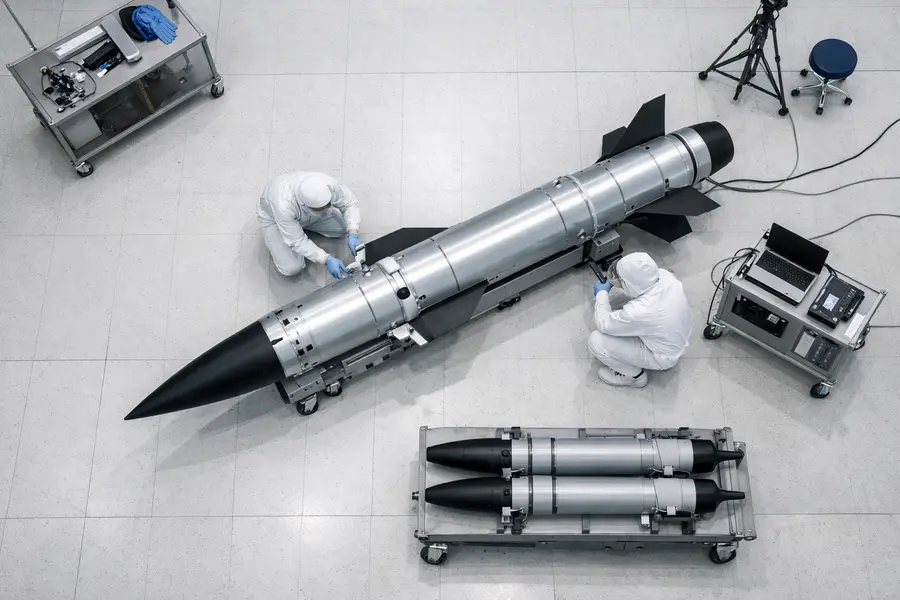
Singularity, a Los Angeles startup building low-cost air defense interceptors, left stealth on July 14, 2026 with an $80M Series A led by Khosla Ventures and Felicis.
Key Takeaways
- Singularity raised an $80M Series A at a $400M valuation, led by Khosla Ventures and Felicis.
- The Los Angeles startup is building ground-launched interceptors on automotive-style production lines.
- The company has about 65 employees and has not disclosed contract values or unit pricing.
Lead
Singularity, a Los Angeles defense startup, emerged from stealth on July 14, 2026 with an $80M Series A at a $400M valuation. Khosla Ventures and Felicis co-led the round, which was oversubscribed. The company is developing ground-launched interceptors meant to cost far less than the missiles that Western militaries now fire at cheap drones.
Jack Oswald, the chief executive and co-founder, said the Western air defense industry cannot meet demand. "If every single air defense line in the West was running at max volume today, we wouldn't have one percent of what's needed," he said.
Who Is Backing Singularity?
Two firms led the round, joined by a long list of existing and new backers. Participating investors include AE Ventures, NEA, Long Journey, Harpoon, Menlo Ventures, Y Combinator, Decisive Point, New Vista, Sunflower and Soma.
The company has not published the size of its earlier financing. At $400M post-emergence, the round implies Singularity sold roughly 20% of the company if the valuation is post-money, a figure the company has not confirmed. That is a rich price for a startup that has shown no public test results or disclosed contract values.
What Is Singularity Building?
Singularity is building a ground-launched, missile-based interceptor with an in-house solid-fuel rocket motor and internally developed subsystems. The company says the system is designed for Mach-class speeds and integrates with existing U.S. military command-and-control, radar and fire control systems. It has not named the product or published performance specifications.
The pitch targets a cost imbalance. Interceptors such as those fired from Patriot and THAAD batteries cost hundreds of thousands of dollars or more per shot, while the drones and loitering munitions they engage cost a few thousand. Singularity says its design will be "much lower cost," without giving a figure.
Why Does Manufacturing Matter More Than the Missile?
Production capacity is the company's central claim, because interceptor stockpiles have run down in Ukraine and the Middle East faster than defense primes can refill them. Singularity says it will build lines that exceed anything now operating in the United States for air defense, but it has not disclosed volume targets.
The hiring reflects that bet. Cyril Londechamp, who previously led Model X production at Tesla, runs manufacturing. The propulsion team is led by a specialist who scaled rocket motor production at NAVSEA Indian Head. Todd Morrow, a former short-range air defense commander who says he sold about $12B in air defense systems at Lockheed Martin, leads business development. The roughly 65-person staff also includes alumni of SpaceX, Anduril and Toyota.
How Crowded Is the Interceptor Market?
The field is filling quickly, and rivals hold contracts Singularity does not yet have. Perennial Autonomy's Merops drone interceptor, priced at about $15,000 per shot, won a $500M award from JIATF-401 in May 2026. AeroVironment received a separate $500M JIATF-401 award on July 6, 2026 for its Titan counter-UAS and directed-energy systems.
The U.S. Army is also pursuing a Low-Cost Interceptor program with a government-owned modular architecture, targeting kinetic interceptors below $1M each. That program could become either a customer channel or a competitor to a vertically integrated vendor.
Singularity says it works with the U.S. Army, Navy and Air Force and with JIATF-401, and that its team operates continuously in Ukraine. It has not announced a contract. Its advisory board includes Gen. James McConville, the former Army Chief of Staff, Gen. Jim Dickinson, the former head of U.S. Space Command, and Maj. Gen. Volodymyr Havrylov, a former Ukrainian deputy defense minister.
What Comes Next for Singularity?
The proceeds will go toward finishing system development, expanding manufacturing capacity and hiring. The company says it has line of sight to fielding systems soon but has given no date.
The test is whether a startup can reach production volume before competitors lock in government programs. Hardware companies in defense have often raised large rounds on credible teams, then stalled at the transition from prototype to repeatable manufacturing. A first live-fire demonstration, a production contract or a published unit cost would do more to justify the $400M mark than any further fundraising.
Outlook
Singularity enters a market where demand for cheap interceptors is clear and supply is thin. Its edge, if it holds, will come from factory throughput and unit economics rather than missile design alone. Until it shows either, the valuation rests on its team and the scale of the problem.