Pomegra
Warp Sciences, founded by ex-OpenAI science head Kevin Weil, raised a $215M Series A at $865M valuation to build an AI-driven US chemistry lab for drugmakers.
Key Takeaways
- Warp Sciences raised a $215M Series A led by Lightspeed at a post-money valuation of $865M.
- The company has about 20 people and is building a US lab for molecular optimization work.
- IVP, Premji Invest and Lux Capital joined the round, alongside angels including Sarah Friar and Reid Hoffman.
Lead
Warp Sciences came out of stealth on Thursday, October 22, 2026, with a $215M Series A led by Lightspeed Venture Partners. The round values the company at $865M including the new money, which implies a pre-money valuation of about $650M. Weil, who ran OpenAI's science unit until he left in April, is chief executive.
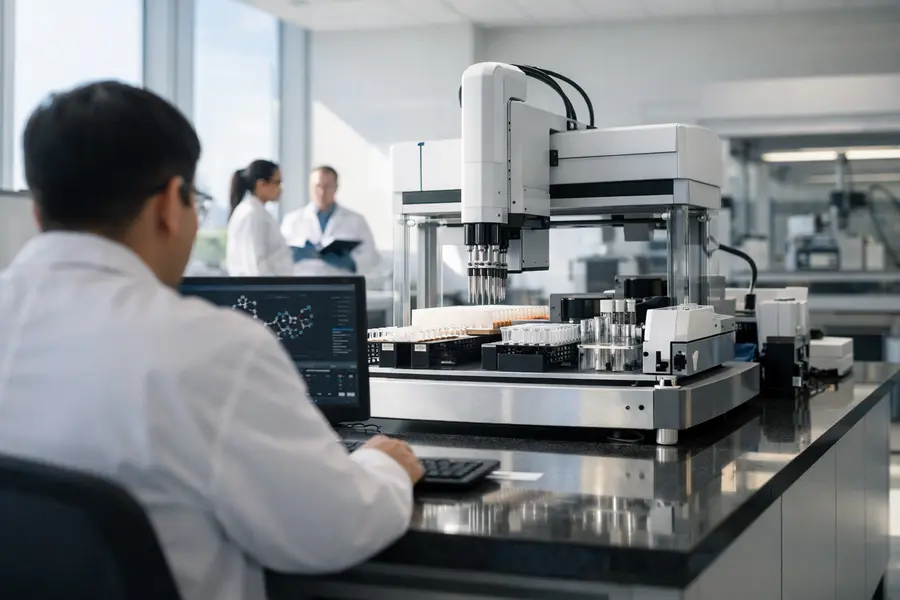
The startup is a contract research organization, or CRO, focused on chemistry. It plans to make and test candidate drug molecules for pharmaceutical customers in a US lab that combines chemists, robotics and proprietary AI models.
What Does Warp Sciences Actually Do?
Warp targets molecular optimization, the stage where drug developers generate hundreds or thousands of variants of a candidate compound to improve potency and reduce side effects. Drugmakers have long outsourced this work to contractors, with Chinese firms such as WuXi AppTec among the largest.
Warp's pitch is that AI can design molecules faster than anyone can physically make them. Synthesis and testing remain the bottleneck, so the company is building the capacity to do that work itself rather than sell software.
The training approach is unusual. Chemists in the lab wear cameras and pressure-sensing gloves while they work, producing data that Warp uses to train its models. Weil has said the field is far more experimentally driven than software engineering and that the models need to see that data.
Who Is Behind the Round?
Lightspeed led, with IVP, Premji Invest and Lux Capital also participating. Angel investors include OpenAI finance chief Sarah Friar, Coinbase chief executive Brian Armstrong, Palantir chief technology officer Shyam Sankar and LinkedIn co-founder Reid Hoffman.
Weil co-founded the company with DJ Patil, the first White House chief data scientist, Manohar Paluri, a former vice president at Meta Superintelligence Labs, and Solomon Reisberg, who previously led medicinal chemistry at Terremoto Biosciences. At OpenAI, Weil's group built GPT-Rosalind, a model trained on chemistry, protein engineering and genomics.
Why Is a $215M Series A Notable for a 20-Person Team?
The round is large for a company with roughly 20 employees and no disclosed customers, which works out to more than $10M of capital per head. The size reflects what Warp intends to buy: lab space, robotic equipment and chemists, all of which cost far more than a software team's laptops. Investors are paying for a founding team with AI credentials and a capital-intensive plan, not for revenue.
The valuation also assumes Warp can win business from an incumbent base built on low cost and speed. CROs compete on turnaround and price per compound, and Warp has not published either metric. Whether automation narrows the cost gap with offshore labs is the central unproven claim.
How Does Geopolitics Shape the Opportunity?
Supply chain and data security concerns around Chinese contractors give Warp a US-based sales argument. The Pentagon linked WuXi AppTec to China's military in June, and a judge blocked that designation in August. The legal outcome remains unsettled, which leaves pharma buyers weighing the risk of relying on offshore chemistry.
A domestic alternative benefits if that risk stays elevated. If courts and regulators ease the pressure, the argument rests more heavily on price and quality, where Warp has no track record.
What Comes Next for Warp?
The near-term milestones are operational: opening the lab, signing first pharma customers and showing that robot-assisted chemistry can match the throughput of established contractors. Warp has not disclosed customer names, lab location or pricing.
Competitors include the incumbent CROs and a growing group of AI drug discovery companies, some of which also operate their own wet labs. Warp's differentiation rests on the camera-and-glove data collection, which has no public benchmark yet.
Outlook
Warp Sciences enters the market with $215M, an $865M valuation and a founding team from OpenAI, Meta and the US government. The round funds a bet that automated, US-based chemistry can displace part of the outsourced work pharma sends abroad. Customer contracts and cost per compound will show whether the valuation holds up.