Pomegra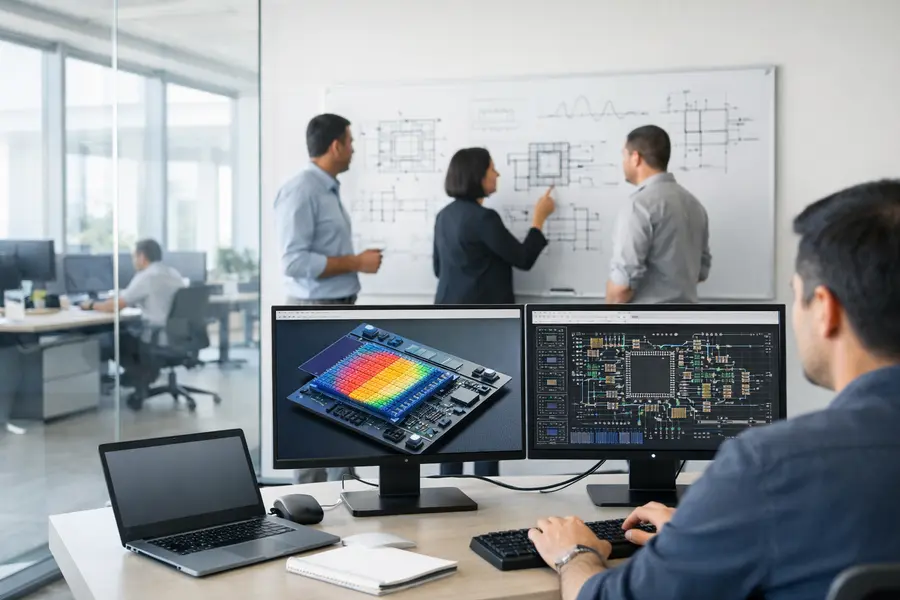
Palo Alto-based Vinci has raised $250 million at a $1.5 billion valuation to build AI that simulates heat and mechanical stress in chip and hardware design, with Advent, Temasek and Xora Innovation co-leading.
Key Takeaways
- Vinci raised a $250M Series B at a $1.5B valuation, co-led by Advent, Temasek and Xora Innovation, announced in October 2026.
- The round follows a $46M seed and Series A disclosed in December 2025, bringing announced funding to about $296M.
- Vinci plans to grow pilot deployments from two to 20 customers and extend beyond thermal into other physics.
Lead
Vinci, a Palo Alto software company founded in 2023, announced a $250 million Series B in October 2026 at a $1.5 billion valuation. Advent, Temasek and Xora Innovation co-led the round. AMD Ventures, Madrona, Eclipse and Khosla Ventures also participated.
The company sells AI-driven physics simulation for chip, package and board design. It started with thermal analysis, a growing constraint as AI accelerators get larger and hotter. Vinci says the money will pay for computing capacity, hiring and new simulation products.
What Does Vinci Actually Build?
Vinci builds simulation software that predicts how a hardware design will behave physically before anything is manufactured. The company calls its approach Continuous Physics Reasoning. It aims to move simulation from occasional checkpoints into the daily design loop.
The platform combines automated design preparation, agentic orchestration, a Foundation Model for Physics and GPU-native physics kernels. Vinci says it can analyze manufacturing-scale designs, from hundreds of millions to more than 15 billion degrees of freedom, in minutes rather than hours or days. It also claims speeds up to 1,000 times faster than conventional tools, and says no customer-specific training or fine-tuning is needed.
Current capabilities cover thermal analysis, thermo-mechanical analysis and convective fluid behavior. A package warping simulation was added in February 2026. Those speed figures are the company's own and have not been independently verified in public.
How Big a Jump Is This Valuation?
The valuation is a steep step for a company that emerged from stealth in December 2025 with $46 million. Eclipse led the seed and Xora led the Series A. The Series B is more than five times the size of that combined early funding, and it arrives about ten months later.
A round this size at this age says investors are pricing in a category more than a product ledger. Vinci has two pilot deployments in the field, according to the company's own plans to reach 20. That gap between valuation and deployment count is the main risk in the story. The company says it has customers across the US, Europe and Asia, but it has not named them.
The investor mix does carry weight. AMD Ventures is a strategic backer from inside the chip industry. Brian Amick, AMD's senior vice president of technology and engineering, said designing advanced systems requires engineers to understand how thermal, physical and electrical behavior interact across the chip, package and board. That is a statement of the problem Vinci targets, not a purchase commitment.
Who Is Vinci Up Against?
Vinci competes with the incumbents of electronic design automation, chiefly Cadence and Synopsys. Both sell mature simulation and analysis tools that chip makers already embed in their design flows. Both have also been adding AI features to existing products.
That is the hard part of the pitch. Chip designers switch tools slowly, because sign-off flows are validated over years and errors cost millions in respun silicon. A startup has to show accuracy that matches established solvers, then show it fits inside existing pipelines. Speed alone rarely wins that argument.
Vinci's counter is that heat has become a first-order design problem. Larger AI packages, stacked memory and denser power delivery stress traditional workflows. If simulation takes days, engineers run it late and rarely. If it takes minutes, they can run it while they design. CEO Hardik Kabaria has described the product as a foundation model proven to work in the field.
What Comes Next for Vinci?
The near-term plan is to raise pilot deployments from two to 20. The company has about 70 employees, and the new capital will fund a hiring push alongside GPU capacity for training and running its models.
On the product side, Vinci intends to extend beyond thermal and mechanical work into vibration testing and electromagnetics, and into memory systems and advanced computing. Longer term, it names vehicles, aircraft and satellites as targets. Each new physics domain means a new accuracy bar against entrenched solvers, so the pace of expansion will test the foundation-model claim.
Outcomes to watch include named production customers, published accuracy comparisons against reference solvers, and whether either incumbent responds with acquisitions or pricing moves.
Outlook
Vinci now holds roughly $296 million in announced funding and a $1.5 billion valuation, built on a thermal simulation product with two pilots in the field. The backing from Advent, Temasek, Xora Innovation and AMD Ventures signals appetite for AI-native engineering software. The next 12 months will show whether pilots convert to production use inside chip design flows, and whether the speed claims hold up against Cadence and Synopsys on accuracy.