Pomegra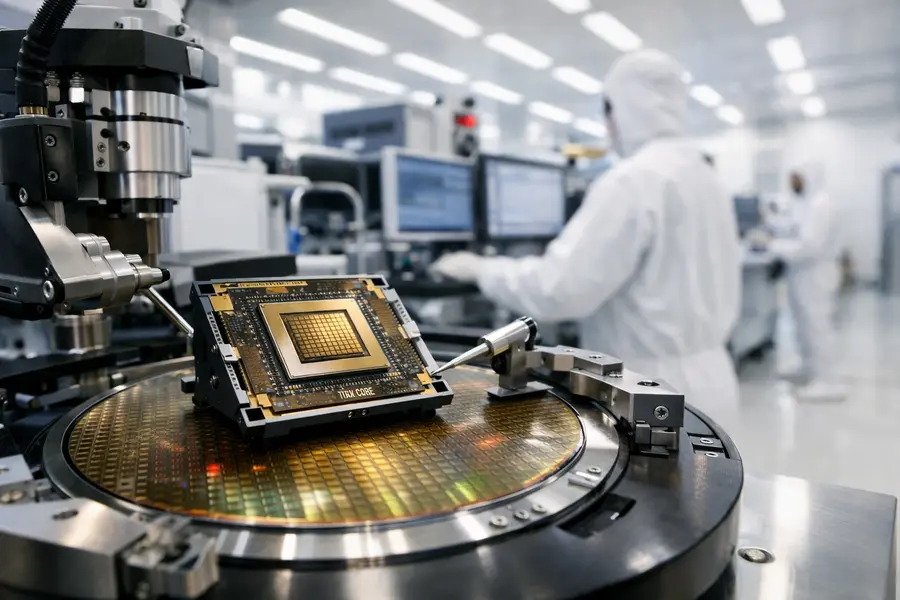
Velaura AI hit unicorn status with a $110M Series A led by Seligman Ventures, betting on Titan Core silicon that claims 2-4x better AI performance per watt than existing accelerators.
- Velaura AI closed a $110M Series A on August 18, 2026, crossing a $1B+ valuation with Seligman Ventures as lead investor.
- Its Titan Core silicon uses patented low-voltage libraries and proprietary circuit design to deliver 2-4x better performance per watt.
- Target markets span AI data centers, robotics, drones, and autonomous Physical AI systems.
Lead
Velaura AI raised $110 million in a Series A round on August 18, 2026, clearing a $1 billion valuation and joining the short list of AI chip startups to reach unicorn status before shipping product at scale. Seligman Ventures led the round, joined by new investors Capricorn Investment Group and Prosperity7 Ventures, alongside existing backers Mayfield, Maverick Silicon, MARA, Premji Invest, Samsung Catalyst Fund, and StepStone Group. The capital is earmarked for commercializing the company's Titan Core silicon platform and scaling engineering and customer-facing operations.
What Does Titan Core Actually Do?
Titan Core delivers 2-4x better performance per watt on AI workloads compared to conventional accelerators, achieved through a combination of low-voltage libraries, proprietary circuit design, and specialized EDA flows. The company frames this as full functional equivalence, not a tradeoff - a meaningful distinction because competing efficiency startups have historically sacrificed throughput or accuracy to hit power targets. Velaura says it does not.
The platform targets the matrix multiplication operations that dominate AI inference and training workloads. Cutting power at that layer, rather than at memory or networking, compounds across an entire cluster. An operator running 10,000 GPUs at half the power consumption does not save half the electricity bill - it also reduces cooling load, physical space requirements, and grid interconnection demands, each of which has become its own bottleneck.
Why Is Power Efficiency the Right Bet in 2026?
Grid capacity has replaced compute availability as the binding constraint on AI infrastructure. Data center operators are signing power purchase agreements years in advance and facing interconnection queues measured in years, not months. A chip architecture that does materially more math per watt directly shrinks the power footprint needed to run a given workload. That pressure has driven a wave of efficiency-focused semiconductor investment since 2024, and Velaura is positioned squarely in it.
The bull case is straightforward: if Titan Core performs as claimed in production, hyperscalers and co-location providers have a direct financial incentive to adopt it. The skeptical read is that general-purpose GPU vendors are not standing still - software optimization and architectural iteration from incumbents have repeatedly narrowed the efficiency gap that startups exploit at launch.
Physical AI: Second Market or Second Pitch?
Beyond data centers, Velaura is targeting robotics, drones, and autonomous systems under the Physical AI label. The power constraints at the edge are far more severe than in the data center: a drone running inference at 3 watts rather than 10 watts is a different vehicle. If Titan Core's efficiency gains transfer to edge deployment without requalification, the company has a genuinely distinct second market.
Whether Velaura has edge customers under contract today, or is projecting from data center benchmarks, is not disclosed. That ambiguity matters more at the Series B than at the Series A, but the composition of the investor syndicate offers a signal: Prosperity7 Ventures, the venture arm of Saudi Aramco, brings direct exposure to industrial and autonomous systems applications where Physical AI converges with energy infrastructure. Samsung Catalyst Fund adds a strategic dimension that connects to foundry and memory supply chain relationships Velaura will need to scale production.
Syndicate Structure
The breadth of the investor base is notable for a Series A at this size. Seven existing investors rolled forward alongside two new institutional names, suggesting conviction from those who had the most information about early technical progress. Seligman Ventures taking the lead, rather than a semiconductor-specialist fund, reflects the degree to which AI chip investment has moved into generalist growth territory.
Outlook
Velaura AI enters commercialization with a billion-dollar valuation, a credible and diverse investor syndicate, and an efficiency claim - 2-4x performance per watt - specific enough to test in the field. The next pressure point is production: a chip that performs in simulation faces different challenges than one delivered in volume to paying customers on a repeatable schedule. Expansion of engineering and sales teams signals that transition is underway. Revenue conversion against the $110 million runway will determine whether the $1 billion figure is a floor or a ceiling.
--- Sources:
- Velaura AI Raises $110M Series A - BusinessWire
- Velaura AI raises $110M Series A, hits $1B valuation - Quartz
- Velaura AI Raises $110M Series A for Ultra-Low-Power AI Compute Infrastructure - HPCwire
- Velaura AI Raises $110 Million Series A At $1+ Billion Valuation - Pulse2
- Velaura AI raises $110M to develop power-efficient AI chips - SiliconANGLE