Pomegra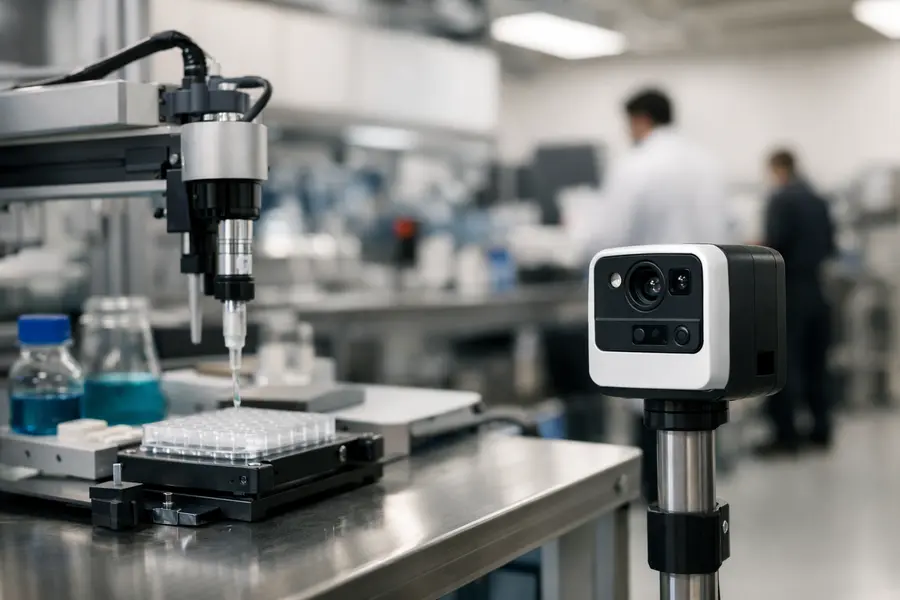
Physical AI startup Transfyr exits stealth with a General Catalyst-led $25M seed to deploy sensor stacks in scientific labs and capture experimental context that never makes it into research papers.
Key Takeaways
- General Catalyst led the $25M seed, with Lux Capital, Breakout Ventures, Factory, Neo, SV Angel, MVP Ventures, Underscore VC, and Lyda Hill also participating.
- Transfyr installs integrated sensor systems in wet labs to passively record bench execution, environmental variables, operator decisions, and instrument telemetry that never reach published papers.
- The company holds a Massachusetts Life Sciences Center grant and is embedded in the NSF's $400M Programmable Cloud Labs initiative.
The Launch
Cambridge, Massachusetts-based Transfyr emerged from stealth on August 26, 2026, with a $25 million seed round to build sensor-based infrastructure for capturing how science is actually performed. General Catalyst led the financing. Lux Capital, Breakout Ventures, Factory, Neo, SV Angel, MVP Ventures, Underscore VC, and Lyda Hill also participated, along with several angels. No valuation was disclosed.
The company was co-founded by Anna Marie Wagner, who serves as CEO and was previously Head of AI and Corporate Development at Ginkgo Bioworks, and Renee Wegrzyn, Chief Innovation Officer and founding director of ARPA-H, the federal health innovation agency. The pairing of deep biotech operational experience with government-level scientific translation work shapes both the company's thesis and its early access to institutional partners.
What Does Transfyr Actually Build?
Transfyr deploys integrated sensor stacks - cameras, microphones, environmental monitors, and instrument telemetry readers - directly into wet labs. Multimodal AI models trained on real-world scientific execution then process that sensor data into structured, machine-readable records of experimental work: who did what, in what order, under what conditions, and with what deviations from the written protocol.
The core premise is that a published paper captures only a fragment of any experiment. Informal adjustments, ambient conditions, the physical technique of a specific researcher - none of it lands in a methods section. Tacit knowledge accumulated over years at the bench vanishes when a scientist moves labs, retires, or simply forgets to write things down. Transfyr's sensor layer is designed to capture that disappearing record at the point of origin, before it is lost.
Why Does Reproducibility Keep Failing?
Survey data across biomedical and life sciences disciplines show that a majority of published results prove difficult or impossible to replicate when independent labs attempt them, with cost estimates to the pharmaceutical and biotech industries running into the tens of billions annually in failed downstream programs. The standard responses - better documentation requirements, stronger peer review, mandatory data sharing mandates - have not closed the gap.
Transfyr's founders are betting the problem is structural. Critical information is lost before it is ever recorded, and no documentation standard can recover what was never written. Sensor-based capture at the bench is the alternative thesis. Wagner's time at Ginkgo placed her inside the challenge of scaling biological processes across facilities, where tacit knowledge failures carry direct commercial consequences. Wegrzyn's work at ARPA-H focused precisely on the translation gap between laboratory science and real-world health outcomes - the same failure mode Transfyr is targeting.
Strategic Position
Transfyr operates its own wet lab at The Engine, a Cambridge deep-tech incubator, where it generates training data for its models and tests the sensor stack against live experimental workflows. That in-house lab also functions as a proof-of-concept environment for potential customers before they commit to an installation.
The company's platform forms the core technology for a nearly $1 million Massachusetts Life Sciences Center "Gamechanger" grant and is embedded in a Boston University-led program under the NSF's $400 million Programmable Cloud Labs initiative. Those government partnerships provide non-dilutive capital and access to academic laboratory environments where additional training data can be collected.
Transfyr says it is already working with partners across diagnostics, academic research, workforce development, robotics, and what it describes as the largest frontier AI labs - indicating that sensor-captured experimental data has commercial interest well beyond the research institutions where it is generated.
What Comes Next for Physical AI in Labs?
The investors behind Transfyr are effectively betting that real-world scientific execution data has compounding value as AI capabilities expand. Robotic lab systems and AI-driven research tools need training data built on how humans actually perform complex physical tasks. Published papers cannot supply that. Sensor-captured bench records potentially can, and the frontier AI labs already working with Transfyr appear to agree.
The $25 million seed round is unusually large by typical deep-tech seed standards. Most comparable rounds close under $10 million, and the size here implies that General Catalyst and its co-investors have underwritten a long hardware development and model training cycle before broad commercial deployment becomes feasible.
Outlook
Transfyr enters a narrow category with strong founding credentials and a well-capitalized start. The critical unknowns are lab adoption speed - persuading researchers to install persistent sensor systems in their workspaces carries its own friction - data quality across diverse scientific disciplines, and whether the company's multimodal models can generalize without collapsing into bespoke per-customer engineering work. The government partnerships reduce near-term commercial pressure but do not resolve any of those questions.