Pomegra
Science Corporation raised $400M at a $3.5B valuation to widen PRIMA retinal implant sales across Europe and prepare a US launch, up from $1.5B in March.
Key Takeaways
- Science Corporation closed a $400M Series D announced November 17, 2026, at a reported $3.5B valuation.
- The Series C closed in March 2026 at $1.5B post-money, so the valuation rose about 2.3 times in eight months.
- PRIMA is CE marked and sold in Germany; US sales still need FDA Humanitarian Device Exemption review.
Lead
Science Corporation, the neurotechnology company founded in 2021 by former Neuralink president Max Hodak, announced a $400M Series D on November 17, 2026. The company will spend the money on wider European availability of its PRIMA retinal implant, preparation for a US launch, and a biohybrid neural interface program. Total funding since founding now exceeds $900M. Science did not name a lead investor, and the $3.5B valuation was reported by TechCrunch rather than confirmed in the company's own announcement.
Who Invested in the Series D?
The round included Khosla Ventures, the Ackman Oxman Institute, Tenet Healthcare, 885 Capital, Y Combinator and PLC Neurotech. Khosla and Y Combinator also backed the March Series C, so the cap table shows continuity rather than a wholesale change of owners. The Series C was co-backed by Lightspeed Venture Partners, Quiet Capital and In-Q-Tel.
Tenet is the unusual name. A listed US hospital operator on the list suggests Science is already thinking about where US implant surgeries will happen. The company has not said what Tenet's role goes beyond its equity.
What Is PRIMA and What Does It Do?
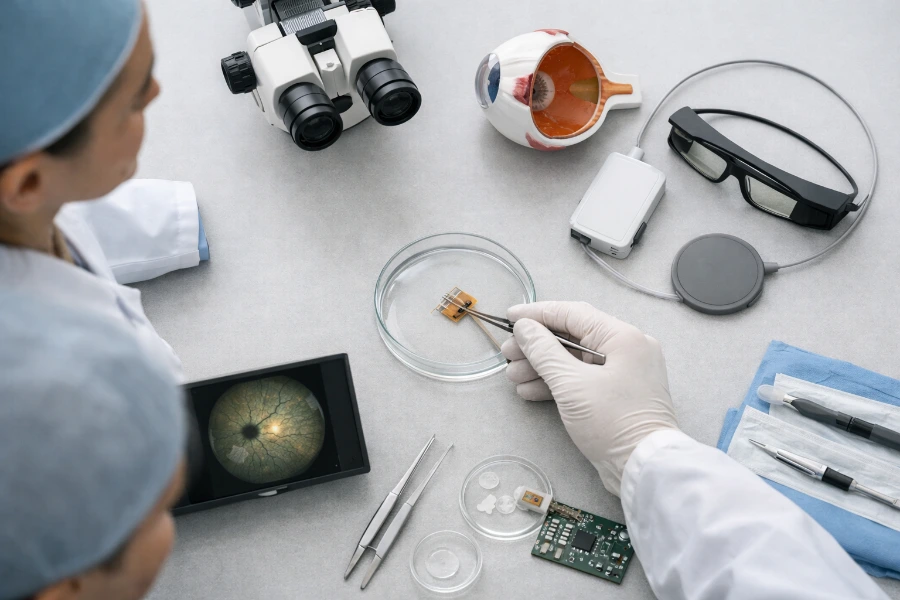
PRIMA is a subretinal implant, paired with glasses, for geographic atrophy, the late stage of dry age-related macular degeneration. The implant carries 378 light-powered pixels. The glasses project near-infrared light onto it, and the chip converts that light into electrical signals that stimulate the retina. It displaces nothing on the market for these patients, since no approved therapy restores lost central vision at this stage.
Results published in the New England Journal of Medicine covered 38 patients implanted at 17 sites in five countries. In that study, 84% of patients reported reading letters, numbers and words at home with the device after 12 months. The CE mark, issued under the EU Medical Device Regulation by DEKRA, covers 30 European countries and was announced in July 2026. Commercial sales have started in Germany. Pricing has not been disclosed.
How Does a $400M Round Change Science's Position?
The round gives Science the capital to run a commercial rollout and a regulatory filing at once, which few neurotech startups manage. Competitors in brain-computer interfaces, including Precision Neuroscience, which raised $250M in September 2026, Synchron and Paradromics, are still mostly in clinical studies. Science is the only one of that group selling a CE-marked product.
The valuation step is the number to question. A move from $1.5B to $3.5B in eight months reflects the CE mark and the German launch, but Science has not published sales figures, patient counts under commercial use, or revenue. The price is paying for regulatory progress and a first-mover position, not for demonstrated commercial traction.
What Stands Between PRIMA and the US Market?
The FDA Humanitarian Device Exemption review is the main gate. The pathway is meant for devices treating uncommon conditions, and Science convinced the agency that advanced macular degeneration affecting both eyes qualifies. That classification speeds approval but could also limit the addressable patient population, and the company has not said how many US patients it expects to treat in the first year.
Science is also testing PRIMA in Stargardt disease and has flagged retinitis pigmentosa as a further target. Each new indication adds trial costs, and the Series D funds those alongside manufacturing and operations expansion.
What Is the Biohybrid Program?
The biohybrid program is a separate, earlier-stage effort to join cultured neurons with silicon and connect them to the brain's own circuits. Science is designing first human trials with Yale neurosurgeon Murat Günel, with Parkinson's disease and other brain injuries as potential applications. No trial start date has been announced. This is the long-dated bet in the portfolio, and PRIMA revenue would have to carry it.
Outlook
Science now holds more than $900M in lifetime funding and the only CE-marked product in its category. The next tests are whether German sales scale, how quickly the FDA acts on the Humanitarian Device Exemption, and whether the company discloses commercial figures that justify a $3.5B valuation. Until then, the round measures investor appetite for regulatory milestones in brain-computer interfaces more than it measures sales.