Pomegra
Genesis AI's $500 million Series A at a $3.5 billion valuation funds general-purpose robots with human-like hands, plus a 2027 U.S. manufacturing start.
- Genesis AI raised a $500M Series A at a $3.5B post-money valuation on Nov. 17, 2026.
- Premji Invest, Khosla Ventures and Eclipse co-led; Nvidia, AMD Ventures and Zoom joined.
- The seed was $105M in July 2025; only 30-40 Eno robots exist so far.
Lead
Genesis AI, a robotics startup based in Paris and California, announced a $500 million Series A on November 17, 2026, at a $3.5 billion post-money valuation. Premji Invest, Khosla Ventures and Eclipse co-led the round. The company is building general-purpose robots whose hands match human dexterity, and it will spend the money on training data, manipulation research, customer deployments and hiring.
The round arrives about 16 months after Genesis emerged from stealth with a $105 million seed. That seed was co-led by Eclipse and Khosla, so two of the three Series A leads are returning backers.
Who Else Is Backing Genesis AI?
The round drew a long list of strategic and financial investors beyond the three leads. They include Durable Capital Partners, T. Rowe Price Associates, Bpifrance, HSG, Nvidia, AMD Ventures, Zoom, Samsung Next and Ericsson.
Individual backers include former Google CEO Eric Schmidt, Zoom CEO Eric Yuan, former Yahoo CEO Jerry Yang, French entrepreneur Xavier Niel and former Tesla CFO Zach Kirkhorn. Chip suppliers on the cap table give the company early access to the compute it needs. They also gain a customer for physical-AI hardware.
What Does Genesis AI Actually Build?
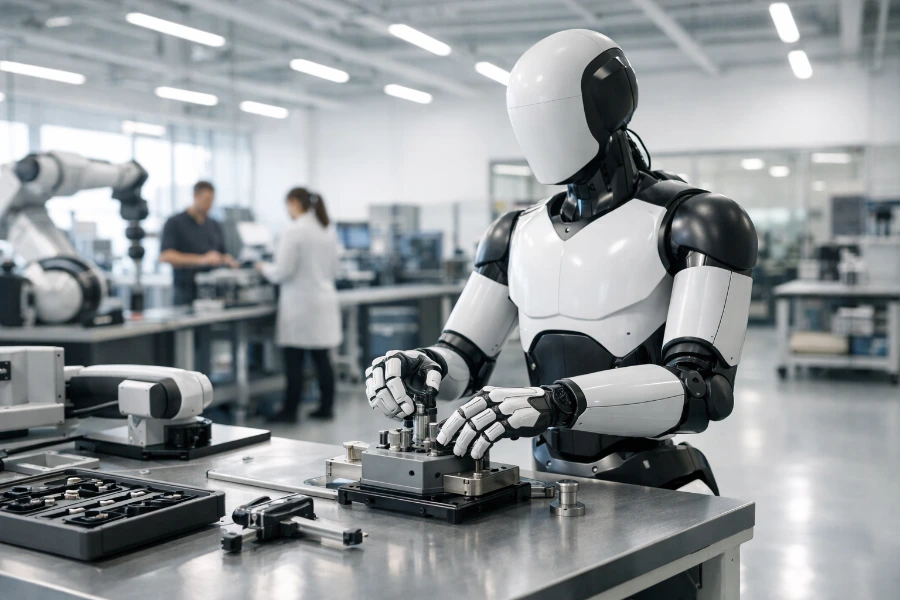
Genesis builds the full stack in-house: a robot, a foundation model, a simulation platform and a data collection system. The robot is Eno, aimed at performance, reliability and mass production. The model is GENE, which the company says targets human-level physical manipulation. Genesis World is the simulation platform used to train robots across virtual scenarios.
The distinctive piece is the hand. The company maps a human hand, a sensor-equipped collection glove and the robotic hand one to one to one. More than 100 workers worldwide wear the gloves, along with headset cameras, to capture force and video data. Co-founder and CEO Zhou Xian has said the aim is to "ship the best robot, end-to-end product."
How Far Along Is the Hardware?
Hardware is the weak point in the pitch. Between 30 and 40 Eno units exist today, a small number of undisclosed companies are piloting them, and the dexterous hands need replacing after weeks of regular use. Demonstrations showed box packing, labeling and manipulation tasks, with occasional failures.
Genesis says the mass-production design is finalized and a contract manufacturer is chosen. U.S. production is due to begin next year. Initial targets are manufacturing, logistics and laboratories, with hospitality, healthcare, consumer and outdoor use listed as later expansions.
Why Is the Valuation So High for a Two-Year-Old Company?
The valuation reflects a bet on a category rather than on revenue. Genesis, founded in 2024 by Xian and Théophile Gervet, who met as graduate students at Carnegie Mellon University, has disclosed no revenue or customer names. Gervet previously worked as a researcher at Mistral AI.
Investors are pricing the odds that dexterity is the bottleneck separating today's robots from broad deployment. A $500 million raise at $3.5 billion implies investors received roughly 14% of the company if the figure is measured against post-money, a sizable stake for a company with pilots only. The seed valuation was not disclosed, so the step-up cannot be calculated here.
Strategic Context
Vertical integration carries cost. Competitors in humanoid and manipulation robotics have split between hardware makers and software-only model developers. Genesis is attempting both, which means carrying hardware reliability risk and model risk at once. The glove-based data approach is cheaper than teleoperating fleets of robots, but its value depends on how well human demonstrations transfer to a machine whose hands wear out in weeks.
The European angle matters too. Bpifrance and a French-founded team give Paris a credible entrant in a field dominated by U.S. and Chinese companies. The company keeps research and operations on both sides of the Atlantic.
Outlook
Genesis now holds one of the larger early-stage war chests in robotics, and its next test is operational. The company must move from 30-40 handbuilt units to contract-manufactured production in the U.S. in 2027, and it must extend hand durability well beyond weeks. Pilot conversions into named, paying deployments in factories, warehouses and labs would be the first hard evidence for the valuation. Without them, the round remains a wager on a data method and a design still under test.